
| Full title | IEEE Std 802.3bt-2018, IEEE Standard for Ethernet Amendment 2: Physical Layer and Management Parameters for Power over Ethernet over 4 pairs |
| Publisher | IEEE Standards Association, 802.3 Working Group |
| Approved | 27 September 2018. Published 31 January 2019 |
| Status | Superseded as a separate document; its content is carried in the base IEEE 802.3 standard as Clause 145 |
| Adds | Type 3 and Type 4 PSEs and PDs, Classes 5 to 8 |
| Common name | PoE++ (not an IEEE term) |
What 802.3bt adds
IEEE 802.3bt extends Power over Ethernet to all four pairs of the cable. It defines two new types: Type 3, up to 60 W at the PSE, and Type 4, up to 90 W. It keeps full backward compatibility with 802.3af and 802.3at: a Type 3 or Type 4 PSE powers older Type 1 and Type 2 devices, and an 802.3bt device connected to an older PSE must limit itself to the lower power available, so some devices will not run fully or at all.
Supporting operation with 10GBASE-T was one of the project’s objectives, so four-pair power and multi-gigabit data can share the same link.
Type 3 and Type 4 compared
| Parameter | Type 3 | Type 4 |
|---|---|---|
| Maximum output at the PSE | 60 W | 90 W |
| Maximum power at the PD | 51 W | 71.3 W |
| PSE output voltage | 50 to 57 V DC | 52 to 57 V DC |
| Classes supported | 1 to 6 | 1 to 8 |
| Nominal maximum current per pair | 600 mA | 960 mA |
| Maximum DC loop resistance | 12.5 Ω per pair set | 12.5 Ω per pair set |
| Pairs carrying power | 2 or 4 (4 for Classes 5 and 6) | 4 |
| Minimum cabling | ISO/IEC 11801 Class D / Category 5e | ISO/IEC 11801 Class D / Category 5e |
| Maximum channel length | 100 m | 100 m |
960 mA is the nominal highest current per pair in Table 145-1. A Class 8 PSE delivering its full 90 W at the 52 V minimum output voltage supplies about 1.73 A, or about 866 mA per pair. Nominally, the current in each conductor is half the pair current.
Power classes
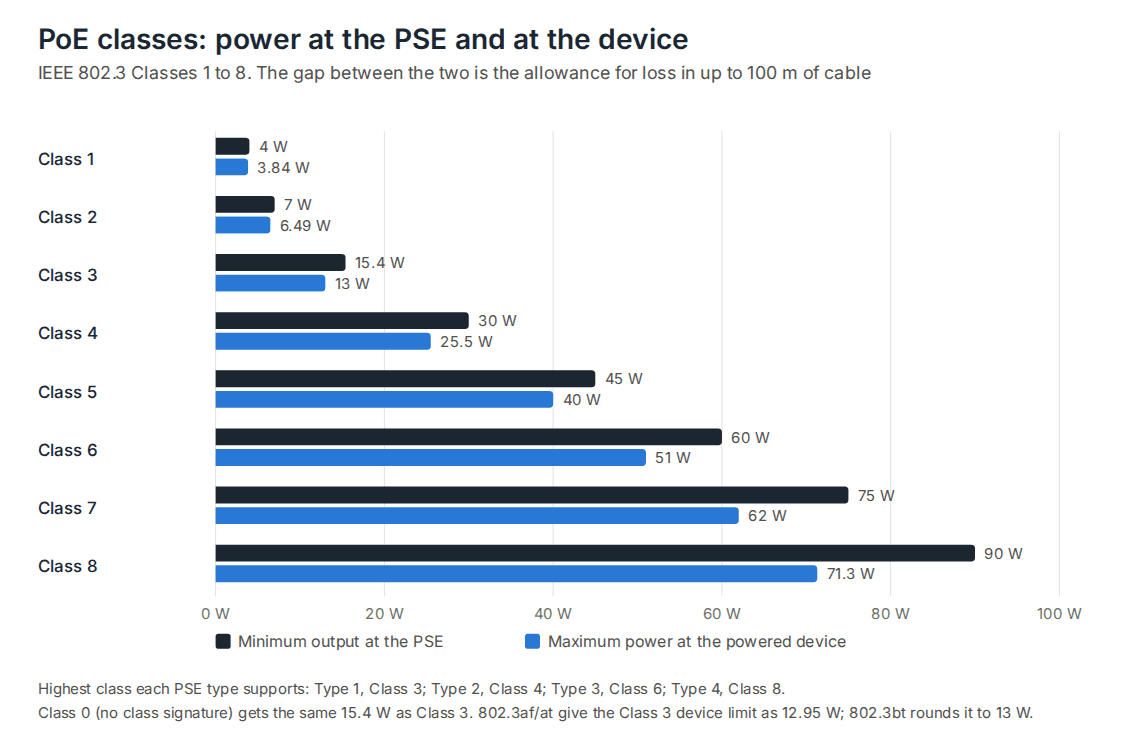
| Class | Output at the PSE | Power at the PD | Type |
|---|---|---|---|
| 5 | 45 W | 40 W | Type 3 |
| 6 | 60 W | 51 W | Type 3 |
| 7 | 75 W | 62 W | Type 4 |
| 8 | 90 W | 71.3 W | Type 4 |
Classes 1 to 4 keep the values from 802.3at and can be delivered over two or four pairs.
Single-signature and dual-signature devices
- Single-signature PD: presents one detection signature across both pair sets and is classified and powered as one load. This is the usual design and supports Classes 1 to 8.
- Dual-signature PD: presents a separate signature on each pair set, so each pair set is detected, classified and powered independently. The maximum is Class 5 on each pair set: 45 W from the PSE per pair set, or about 71 W in total at the device.
Other features
- Autoclass: an optional feature in which the PSE measures the device’s actual maximum draw at start-up and allocates power to suit, instead of reserving the full class allowance.
- Short maintain power signature (MPS): lets a device in standby keep its power with much lower consumption, about 20 mW compared with about 200 mW under 802.3at.
- Multi-event classification: up to four classification events for Type 3 (to Class 6) and five for Type 4 (to Class 8).
Against the BS 7671 limit
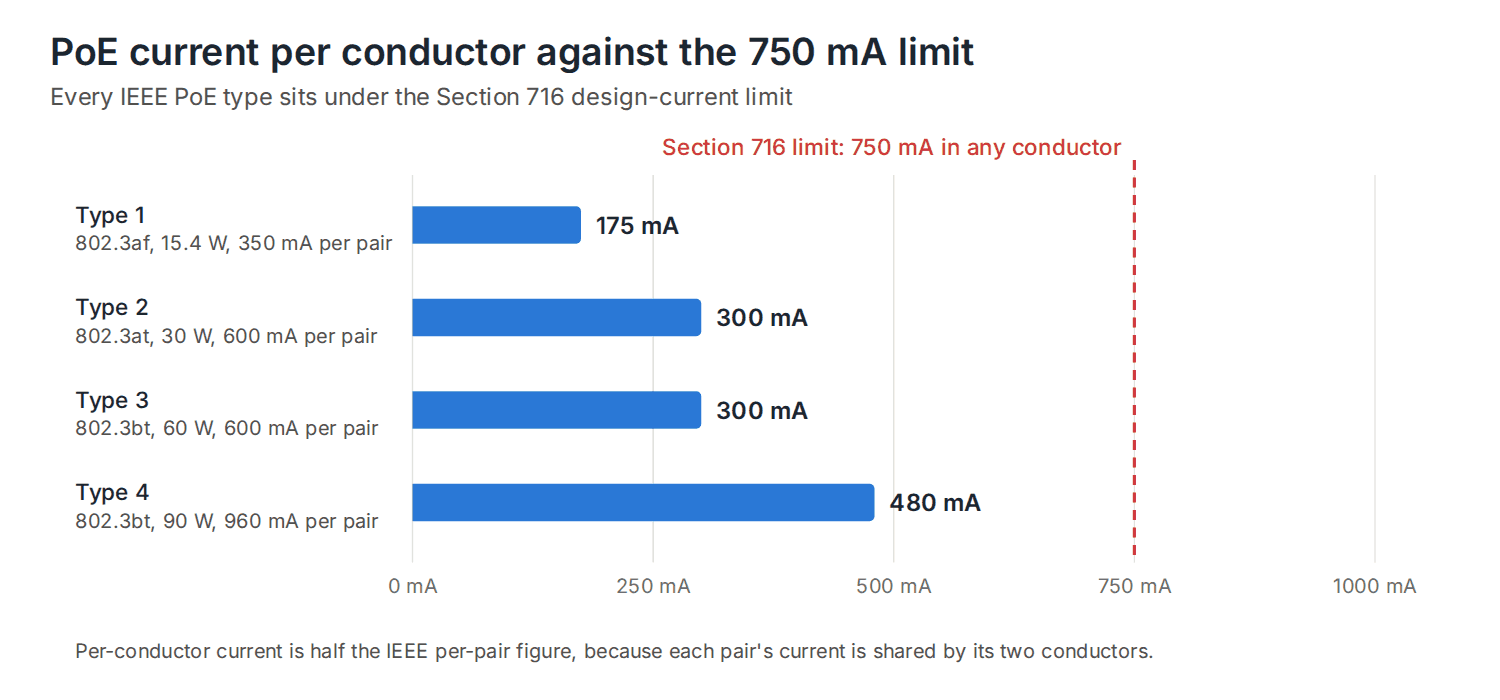
BS 7671 Section 716 limits the design current in any conductor to 750 mA. At the nominal 960 mA per pair, Type 4 puts 480 mA through each conductor, inside the limit. Connecting hardware in the link must also be rated for the current.
Related schemes outside IEEE 802.3
- Cisco UPOE: Cisco’s own 60 W scheme, which Cisco describes as proprietary and now maps to 802.3bt Type 3. Cisco’s UPOE+ (90 W) is its name for 802.3bt Type 4.
- Power over HDBaseT (PoH): the HDBaseT Alliance’s four-pair power scheme, delivering up to 100 W. HDBaseT is standardised as IEEE 1911, which is separate from IEEE 802.3.
The Ethernet Alliance runs a Gen 2 PoE certification programme for 802.3bt equipment, covering Classes 1 to 8.
Read PoE vs PoE+ vs PoE++ for a plain-English comparison, and BS 7671 Amendment 4 for the UK installation rules.