
Power over Ethernet (PoE) has become a core technology for powering modern connected devices — allowing both data and electrical power to travel through a single Ethernet cable. As networks grow more advanced and devices become more power-hungry, the industry is shifting toward PoE++, the next generation of high-power Ethernet delivery.
This guide explains the differences between PoE, PoE+, and PoE++, provides a clear power comparison, and includes practical guidance to help installers, engineers, and IT professionals choose the right standard for their project.
What is PoE (802.3af)?
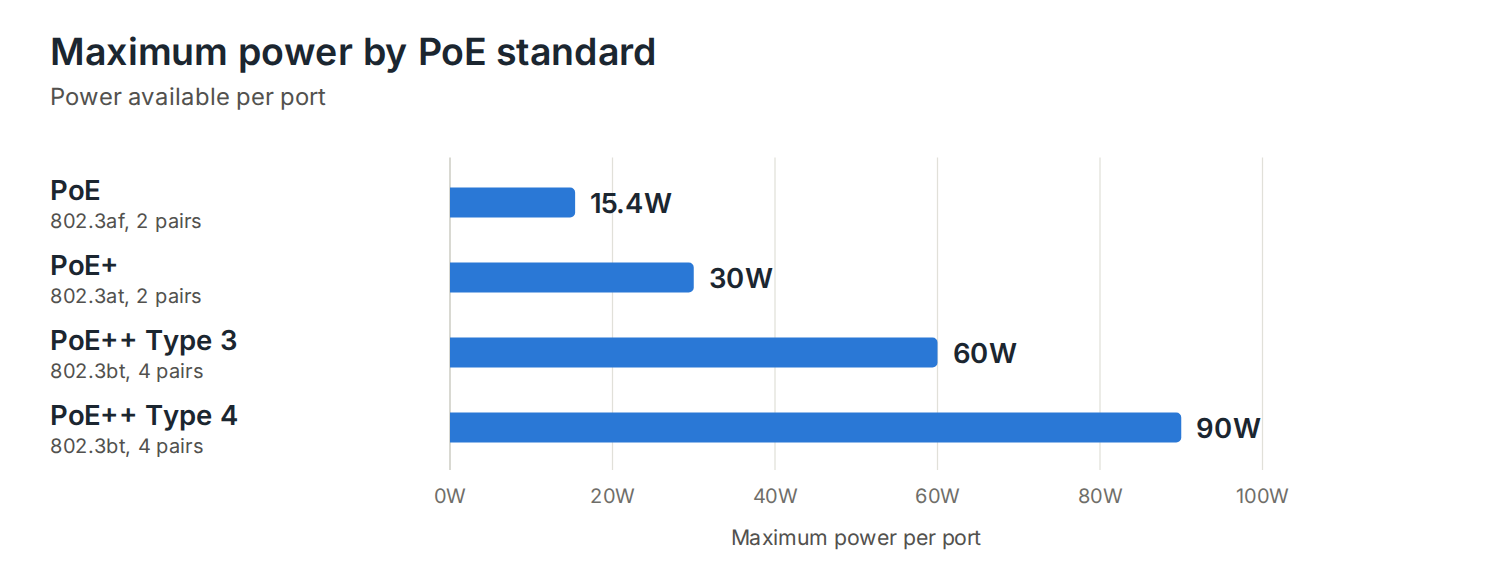
The original Power over Ethernet standard, IEEE 802.3af, delivers up to 15.4W per port. It was introduced to simplify low-power device installations by eliminating the need for dedicated electrical wiring at every endpoint.
PoE (802.3af) is ideal for powering:
- IP security cameras
- VoIP phones
- Basic Wi-Fi access points
- Entry-level IoT devices
PoE simplifies installation by delivering power and data over one cable, reducing both hardware costs and installation time — particularly valuable in large-scale CCTV or telephony deployments where running separate power feeds to every device is impractical.
What is PoE+ (802.3at)?
IEEE 802.3at, commonly known as PoE+, doubles the available power to 30W per port. It was developed to support the next generation of more power-hungry networked devices that exceeded what the original PoE standard could deliver.
PoE+ (802.3at) is ideal for powering:
- PTZ (pan-tilt-zoom) cameras
- Wi-Fi 5 and Wi-Fi 6 access points
- Digital signage and displays
- Smart lighting systems
- Video intercoms
PoE+ is now the most widely deployed standard across enterprise and commercial networks. High-quality Cat6 and Cat6A cabling is recommended to ensure stable, low-loss PoE+ performance — particularly over longer cable runs.
What is PoE++ (802.3bt)?
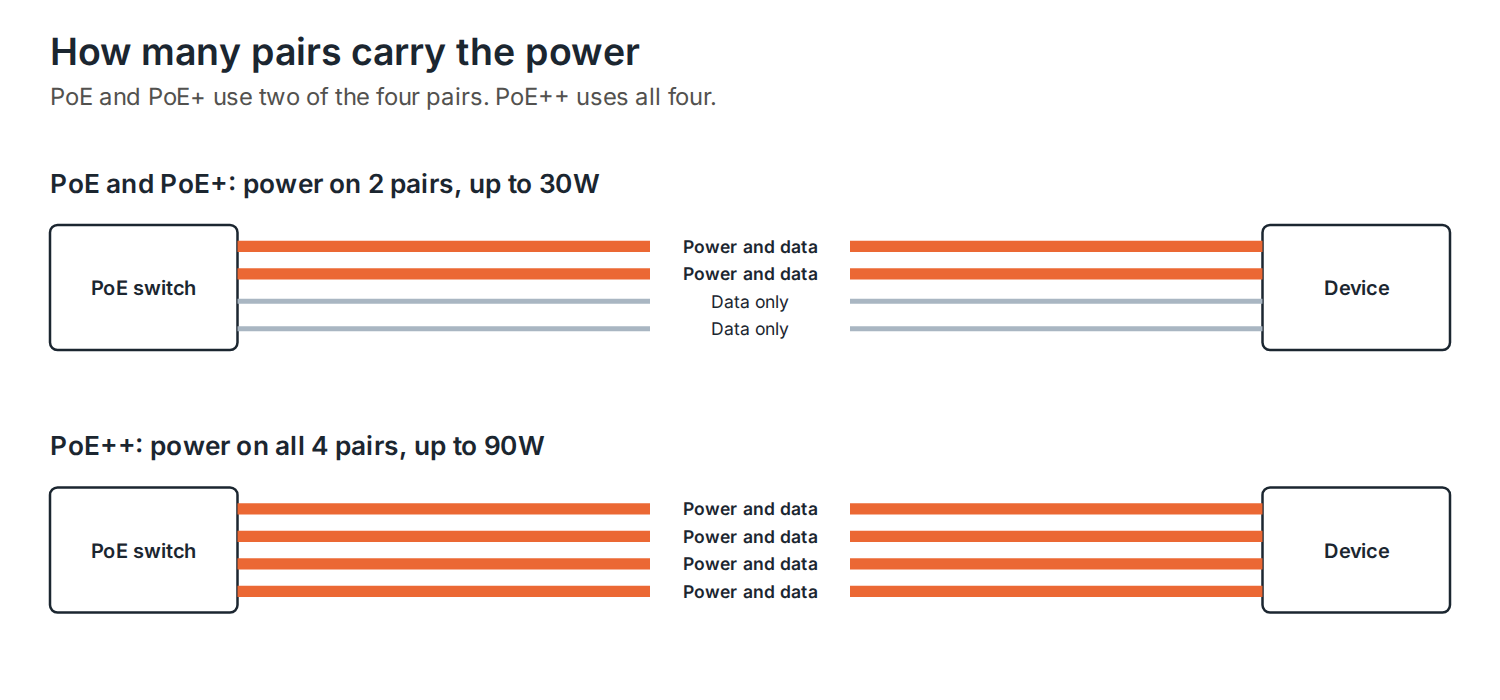
IEEE 802.3bt, known as PoE++ or 4PPoE (Four-Pair Power over Ethernet), is the most powerful PoE standard available today. It uses all four pairs of an Ethernet cable to deliver significantly higher power levels:
- Type 3: Up to 60W per port
- Type 4: Up to 90W per port
PoE++ (802.3bt) is ideal for powering:
- Laptops and thin clients
- Video conferencing systems
- Smart building controllers
- High-density Wi-Fi 6E access points
- Industrial IoT equipment
- Digital kiosks and large displays
PoE++ requires Cat6A cabling to reliably deliver full power levels, particularly for Type 4 (90W) deployments. The four-pair delivery method also reduces heat generation across cable runs, making it more efficient than earlier standards at high wattages.
PoE vs PoE+ vs PoE++: Side-by-side comparison
| Standard | IEEE Designation | Max Power | Cable Pairs Used | Recommended Cabling |
|---|---|---|---|---|
| PoE | 802.3af | 15.4W | 2 pairs | Cat5e or above |
| PoE+ | 802.3at | 30W | 2 pairs | Cat6 or above |
| PoE++ Type 3 | 802.3bt | 60W | 4 pairs | Cat6A or DTECH AV-Ready Cat 6 |
| PoE++ Type 4 | 802.3bt | 90W | 4 pairs | Cat6A or DTECH AV-Ready Cat 6 |
Backward compatibility: Will older PoE devices still work?
Yes. The PoE standards are designed to be backward compatible. A PoE++ switch will negotiate the correct power level automatically with the connected device — so a PoE (802.3af) IP camera plugged into a PoE++ switch will receive only the 15.4W it requires, not the full 90W the switch is capable of delivering.
This negotiation process is handled by the LLDP (Link Layer Discovery Protocol) or by a classification handshake when the cable is first connected. You do not need to manually configure power levels per port in most deployments.
However, the reverse is not true: a PoE device plugged into a non-PoE switch will receive no power at all. Always verify that your switch supports the PoE standard required by your devices before purchasing infrastructure.
How to choose the right PoE standard for your project
The right PoE standard depends on the power requirements of the devices you are connecting. Here is a practical decision guide:
- Choose PoE (802.3af) if you are deploying basic IP cameras, older VoIP handsets, or simple IoT sensors where the device draws under 15W.
- Choose PoE+ (802.3at) if you are installing Wi-Fi 6 access points, PTZ cameras, or any device that requires between 15W and 30W. This is the recommended minimum for most modern commercial deployments.
- Choose PoE++ (802.3bt) if you are powering laptops, video conferencing endpoints, smart building infrastructure, or any device that requires between 30W and 90W. Also consider PoE++ if you want future-proof headroom in your network infrastructure.
When in doubt, specify PoE++. The cost difference between a PoE+ and PoE++ switch has narrowed considerably, and the additional headroom avoids costly infrastructure upgrades as your devices evolve.
Cabling considerations for PoE deployments
Cabling quality has a direct impact on PoE performance. Higher power levels generate more heat in the cable, which in turn increases resistance and reduces the power available at the device end — a phenomenon known as cable derating.
Key cabling guidelines for PoE installations:
- Use Cat6A for PoE++ deployments. The larger conductor diameter (typically 23 AWG) reduces resistance and heat buildup, maintaining full power delivery over the standard 100m maximum cable run.
- Avoid bundling PoE cables tightly. Bundled cables trap heat, which accelerates derating. Allow adequate separation or use installation methods that promote airflow.
- Check cable length. Longer runs increase resistance. For high-power PoE++ Type 4 deployments, consider keeping runs under 80m where possible to ensure stable power delivery.
- Use shielded cabling (S/FTP or F/UTP) in high-interference environments. Industrial environments with heavy electrical equipment can introduce interference that impacts both data and power stability.
PoE injectors and midspan devices
If your existing switch does not support PoE, you do not necessarily need to replace it. PoE injectors (single-port) and midspan devices (multi-port) can be installed between your switch and your devices to add PoE capability to a non-PoE network.
This approach is particularly useful when:
- Upgrading only a subset of ports to PoE
- Adding PoE to a network where switch replacement is not feasible
- Provisioning temporary or event-based PoE infrastructure
When selecting a PoE injector or midspan, ensure it supports the correct standard (802.3af, 802.3at, or 802.3bt) and that its total power budget is sufficient for all connected devices running simultaneously at peak load.
Frequently asked questions
Can I use a PoE++ switch with standard (non-PoE) devices?
Yes. A PoE++ switch will detect whether a connected device supports PoE during the link negotiation process. If the device does not support PoE, the switch will not send power — only data. Your existing non-PoE devices will work normally.
What happens if my switch doesn’t have enough power budget?
If the total power demand of all connected PoE devices exceeds the switch’s total power budget, some devices will not receive power or will be powered at a lower level. Always calculate the total power budget required before specifying a switch — add up the maximum wattage of every PoE device on the switch, then add a 20–25% margin for safety.
Is PoE safe for devices?
Yes. PoE uses a controlled discovery and classification process before delivering power. The switch first sends a low-voltage test signal to confirm the device is PoE-compatible, then negotiates the power class before enabling full power delivery. This prevents accidental damage to non-PoE devices.
Does PoE affect data speeds?
No. PoE and data transmission use separate wire pairs (or, in the case of PoE++, deliver power across all four pairs using a method that does not interfere with data signalling). Your network performance is not affected by enabling PoE on a port.
Summary
PoE technology has evolved significantly from its origins as a convenient way to power IP phones. Today, PoE++ delivers enough power to run laptops and sophisticated building management systems over standard Ethernet infrastructure.
For most modern installations, PoE+ (802.3at) is the practical minimum and PoE++ (802.3bt) is the recommended standard where budget allows. Pair either with quality Cat6A cabling and a correctly sized power budget, and you will have an infrastructure that serves your network reliably for years to come.
If you need help specifying the right PoE infrastructure for your project, get in touch with the DTECH team — we work with installers, system integrators, and IT teams across the UK, Europe and Middle East.