KNX is the most widely deployed open standard for building automation in Europe — controlling lighting, heating, blinds, ventilation, and energy management across residential and commercial installations. Unlike most low-voltage control systems, KNX has a formally defined cable specification: EN 50090. Using anything other than genuine KNX bus cable is one of the most common — and most consequential — specification mistakes on a KNX installation, because the standard governs not just the jacket colour but the electrical characteristics that the bus protocol depends on to function reliably.
This guide explains what KNX cable actually is, why it differs from standard data or control cable, how KNX topology and cable length limits work, and what to specify for a compliant installation.
What KNX is
KNX — the successor to and convergence of the earlier European Installation Bus (EIB), European Home Systems (EHS), and BatiBus standards — is a standardised, manufacturer-independent protocol for building automation, defined under CENELEC EN 50090 and ISO/IEC 14543-3. It links sensors, switches, actuators, and controllers over a twisted pair bus, allowing devices from different manufacturers to interoperate on the same installation provided they carry KNX certification. This interoperability is the defining commercial strength of KNX over proprietary building automation systems — a KNX-certified switch from one manufacturer will work correctly with a KNX-certified actuator from another.
The most common physical medium for KNX is TP1 — twisted pair wiring inherited from the original EIB standard, though KNX also supports IP, RF, and power-line communication. TP1 provides half-duplex bidirectional differential signalling at 9,600 bit/s, with SELV power for low-power bus devices distributed over the same pair as the data signal. This is why the cable used for a KNX TP1 installation is far more specific than a generic twisted pair — it needs to reliably carry both a low-speed data signal and low-voltage power over long bus runs, in a shared installation environment alongside mains cabling.
What EN 50090 KNX cable actually specifies
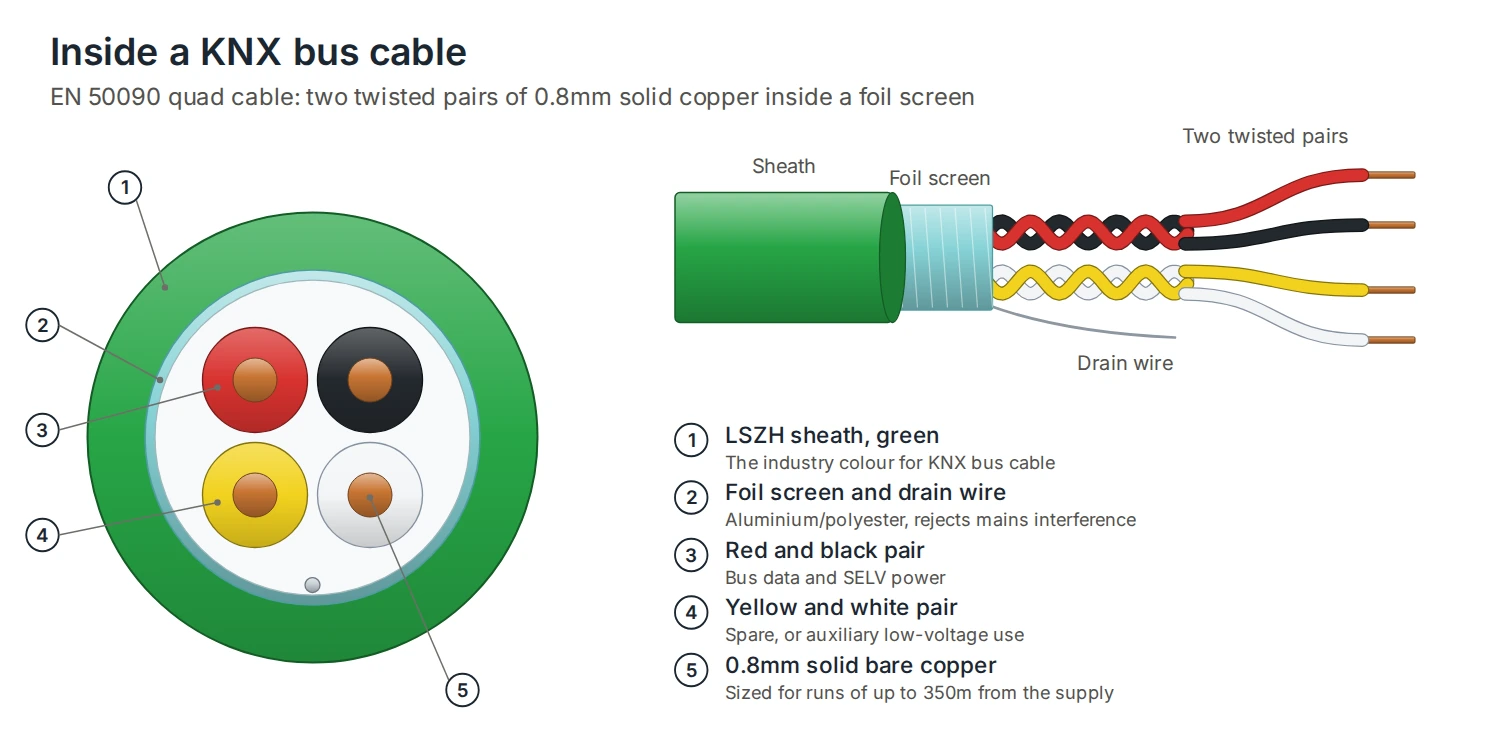
KNX/EIB cable to EN 50090 has a distinctive and precisely specified construction. It is a quad cable — four solid bare copper conductors, each 0.8mm in diameter, formed into two twisted pairs within a single core. One pair carries the bus data and SELV power; the second pair is typically used as a spare or for auxiliary low-voltage functions. The conductors are individually colour-identified — red, black, yellow, and white are the standard core colours — with an aluminium/polyester foil screen and drain wire providing shielding around the twisted pairs, and an LSZH outer sheath, conventionally green, completing the construction.
Every element of this construction matters to how the bus performs. The 0.8mm solid copper conductor size is specified to manage the voltage drop over long bus runs — KNX devices can be up to 350 metres from their power supply, and thinner conductors would introduce excessive resistance and voltage drop over that distance, risking devices operating outside their required voltage tolerance. The foil screen with drain wire rejects electromagnetic interference — important given that KNX cable is routinely installed running parallel to mains power cabling in the same containment. The controlled twisted pair geometry maintains the impedance characteristics the bus protocol depends on for reliable telegram transmission across the installation.
This is why standard Cat5e, Cat6, or generic multi-core control cable is not an acceptable substitute, even though it may appear physically similar and technically “work” over a short test run. Standard data cable is engineered for high-frequency Ethernet signalling, not for the specific low-frequency, power-and-data-combined characteristics of a KNX bus, and it has not been tested or certified against EN 50090’s requirements for conductor size, shielding, and voltage drop performance over the distances KNX installations commonly span.
KNX topology and cable length limits
Understanding KNX cable specification requires understanding the topology it supports, because the cable’s electrical characteristics are what make the standard’s distance limits achievable. A KNX installation is organised into lines, each built around a power supply and a defined number of bus devices — up to 64 devices under the original TP1-64 topology, or up to 256 under the newer TP1-256 topology introduced in 2019, which allows more devices per line without additional line repeaters by improving telegram integrity through updated bus coupling unit electronics.
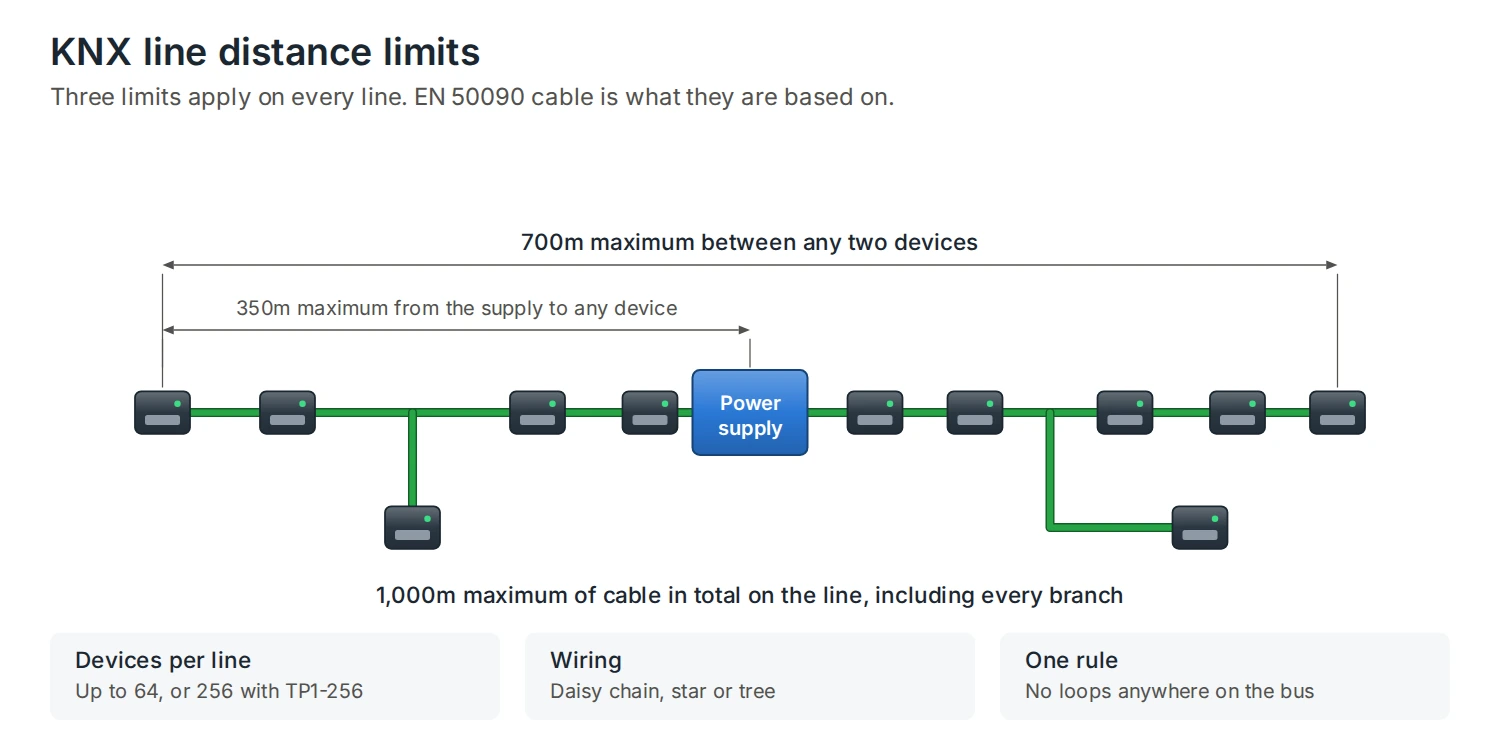
Within a single line, KNX defines three critical distance limits: a maximum of 350 metres between any device and its power supply, a maximum of 700 metres between any two bus devices, and a maximum accumulated cable length of 1,000 metres across all segments on the line. Lines can be extended using line repeaters — adding up to three additional segments per line under TP1-64 for a maximum of 256 devices — or connected together via line couplers into an area, with up to 15 lines per area connected through a main line. Multiple areas can in turn be linked via a backbone line, allowing KNX installations to scale in principle to tens of thousands of devices across a large building or campus.
Wiring topology within a line can be daisy chain, star, tree, or a free combination of these — the only restriction is that no loop may be formed anywhere on the bus. Daisy chaining is the generally recommended approach because it simplifies fault finding and maintenance compared to more complex branching topologies. Correctly specified EN 50090 cable is what allows these distance limits to be reliably achieved — the conductor gauge, shielding, and controlled electrical characteristics of genuine KNX cable are what the 350m, 700m, and 1,000m figures are based on.
Why the green jacket matters
Green is the industry-standard jacket colour for KNX/EIB bus cable across manufacturers. While not a mandatory requirement of EN 50090 itself, the convention is universally observed, and for good practical reason. KNX cable is very commonly installed running in parallel with mains power cabling, and in a multi-cable containment run alongside control, data, and power cabling, being able to instantly identify the KNX bus cable by jacket colour — rather than by tracing or testing — is a significant practical advantage during installation, commissioning, and any future maintenance or fault-finding work.
DTECH’s KNX/EIB quad cable follows this convention with its green jacket, and is manufactured to the full EN 50090 specification — 0.8mm solid bare copper conductors in two twisted pairs, foil screened, LSZH throughout for fire performance in occupied buildings. It is suitable for all standard KNX TP1 bus wiring in residential and commercial building automation installations.
A practical use beyond KNX
EIB-specification cable has a useful secondary application worth noting for installers working across both building automation and industrial networking. DTECH uses EIB cable as the basis for some of its M12 D-code assemblies — the twisted pair, foil-screened construction of EIB cable, designed for reliable low-frequency signal transmission with good EMI rejection over long distances, translates well to certain industrial D-code applications operating at similar frequencies. This is a practical example of how a cable specification developed for one application — building automation bus wiring — can suit adjacent low-frequency industrial signalling requirements where the electrical characteristics align, even though the two applications are otherwise unrelated.
KNX cable vs generic control cable
| KNX/EIB cable (EN 50090) | Generic multi-pair control cable | |
|---|---|---|
| Conductor | 0.8mm solid bare copper, quad construction | Typically 22–24AWG, varies by product |
| Shielding | Aluminium/polyester foil with drain wire | Varies — often unshielded |
| Standard compliance | EN 50090 tested and certified | No KNX-specific compliance |
| Voltage drop over distance | Engineered for KNX’s 350m/700m/1000m limits | Not verified against KNX distance requirements |
| Jacket colour | Green — industry standard for KNX identification | Varies — grey most common |
| Suitability for KNX | Correct specification | Not recommended — compliance and reliability risk |
View our automation and control cable range: Automation and control cable
Frequently asked questions
Can I use Cat5e or Cat6 cable for a KNX installation?
It is not recommended. Standard Ethernet cable is engineered for high-frequency data signalling and has not been tested or certified against EN 50090’s requirements for conductor size, shielding, and voltage drop over KNX’s typical bus distances. Using it may appear to work on a short test installation, but introduces reliability risk on longer runs, non-compliance with the KNX specification, and potential issues with power delivery to bus devices over distance. Genuine EN 50090 KNX cable is the correct specification for any KNX TP1 bus wiring.
How many devices can be on a single KNX line?
Under the original TP1-64 topology, a line supports up to 64 devices without additional hardware, extendable to 256 devices using up to three line repeaters. Under the newer TP1-256 topology introduced in 2019, a single line can support up to 256 devices directly, subject to the power supply’s current rating and the total current draw of the connected devices. Most standard KNX power supplies are rated around 640mA, which in practice limits a line to around 64 devices at typical per-device current draw regardless of which topology is used, unless a higher-capacity power supply is specified.
What is the maximum distance for a KNX bus run?
Within a single KNX line, the limits are a maximum of 350 metres between any device and its power supply, a maximum of 700 metres between any two bus devices, and a maximum accumulated cable length of 1,000 metres across all segments in the line. For larger installations, lines can be extended using line repeaters, or multiple lines can be connected via line couplers into an area — with up to 15 lines per area — allowing the overall system to scale well beyond a single line’s limits.
Can KNX cable be run alongside mains power cabling?
Yes — this is one of the most common installation configurations, and part of why the shielding on genuine KNX cable matters. The foil screen and drain wire on EN 50090 cable reject interference that would otherwise be picked up from adjacent mains cabling. It is still good practice to maintain reasonable physical separation where possible and avoid running KNX cable directly bundled with high-current mains circuits, but running in the same containment or conduit route as mains cabling is standard and accepted practice for KNX bus wiring.
Why does KNX cable have two twisted pairs if only one carries the bus signal?
The second pair in a standard KNX/EIB quad cable is typically installed as a spare — providing redundancy in case the primary pair develops a fault, or capacity for a future auxiliary low-voltage function without needing to pull additional cable. Installing a spare pair as standard is common practice in KNX installations given the cost of accessing and re-pulling bus cable once a building is complete, and it is one of the reasons the quad construction has remained the standard format for KNX cable since its EIB origins.
Summary
KNX cable is a precisely specified quad construction under EN 50090 — 0.8mm solid bare copper conductors in two twisted pairs, foil screened with a drain wire, and an LSZH green jacket — engineered specifically to deliver the KNX TP1 bus protocol’s combined data and SELV power requirements reliably over distances up to 1,000 metres per line. Standard data or control cable is not an adequate substitute, regardless of superficial similarity, because it has not been designed or certified against the voltage drop, shielding, and impedance characteristics that KNX depends on. DTECH’s KNX/EIB quad cable is manufactured to the full EN 50090 specification in the industry-standard green jacket, suitable for all standard KNX bus wiring in residential and commercial building automation installations.
If you need help specifying KNX or other building automation cable, get in touch with the DTECH team — we supply KNX/EIB and automation control cable to installers and system integrators across the UK, Europe, and the Middle East.