If you have priced fibre optic cable in the last six months and been surprised by what you found, you are not alone. From late 2025 into 2026, global fibre optic prices have increased sharply and across the board — standard single-mode, bend-insensitive grades, and in turn pre-terminated assemblies, patch leads, and bulk cable. The causes are structural, they are not going away quickly, and understanding what is driving them helps make better procurement decisions in a market that is unlikely to normalise any time soon.
This is our explanation of what is happening in the global fibre market, why it is happening, and what it means for installers and infrastructure teams buying fibre in the UK and Europe right now.
How significant are the price increases?
To put scale on what has happened: standard G.652D single-mode fibre — the baseline commercial grade used in the majority of telecommunications and data infrastructure — has increased between 45% and 80% in price since mid-2025. G.657A1 bend-insensitive fibre, the grade most commonly used in FTTH drop cables and commercial building installations, is now trading at approximately $22 per kilometre, up from $12–14/km a year ago. G.657A2, the higher-performance bend-insensitive grade used in data centres and tight-radius applications, has reached approximately $35 per kilometre — roughly double its mid-2025 price.
These are not standard market fluctuations. The fibre market has gone through pricing cycles before — oversupply in the early 2020s pushed prices to historic lows — but what is happening now is different in character. Multiple independent analysts, including CRU and Guosheng Securities, have described the current situation as a structural shift rather than a cyclical spike, driven by demand sources that did not exist at meaningful scale two years ago.
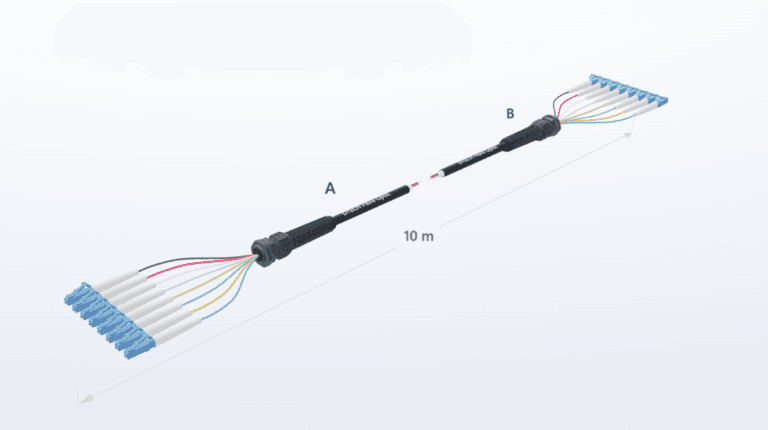
The increases have spread across the entire fibre ecosystem. Pre-terminated assemblies, patch leads, and bulk cable of all grades have seen similar upward pressure as raw fibre costs feed through the product chain.
| Fibre grade | Mid-2025 price | Early 2026 price | Increase |
|---|---|---|---|
| G.652D standard single-mode | ~$2.50–3.50/km | ~$12–16/km | 45–80%+ |
| G.657A1 bend-insensitive | ~$12–14/km | ~$22/km | ~80% |
| G.657A2 high-performance bend-insensitive | ~$18–22/km | ~$33–35/km | ~90% |
Approximate market prices. Figures sourced from CRU, Guosheng Securities, and industry analysis — March 2026.
What is driving demand
Military drone demand
The single largest new demand driver that analysts point to is fibre consumption by military drone programmes, particularly in Eastern Europe and the Middle East. Fibre-guided drones — loitering munitions and FPV attack drones that spool out a thin optical fibre behind them as they fly — use fibre as their primary data link because it cannot be jammed by electronic warfare systems in the way radio links can. Each drone consumes a single-use length of fibre. Deployed at scale across active conflict zones, the volumes involved are substantial.
Annual military drone fibre consumption has been estimated at 50–60 million fibre-kilometres in 2025, representing close to 10% of total global fibre demand. That is a demand source that effectively did not exist in commercial terms three years ago and is now competing directly with FTTH rollouts, data centre builds, and commercial infrastructure projects for the same fibre grades. Military orders have also been given priority access to high-purity preforms — the glass blanks from which fibre is drawn — which has tightened supply for commercial manufacturers.
AI data centre demand
The second major driver is AI infrastructure. Hyperscale data centres supporting large language model training and inference require significantly more fibre than traditional data centres — inside the facility for GPU cluster interconnects, and between facilities for data centre interconnect links. According to CRU data, the proportion of global fibre demand attributable to AI data centres is expected to rise from around 5% in 2024 to 30% by 2027. Major hyperscalers including Meta and Amazon have placed large long-term supply contracts, locking up manufacturer capacity that would otherwise flow into the commercial market.
These two demand drivers — military drones and AI infrastructure — share an important characteristic: neither is price-sensitive in the way that a commercial installer or network operator is. Military procurement and hyperscale infrastructure projects absorb cost increases that would cause commercial buyers to defer or reduce orders. This makes them structural demand floors that support elevated prices even if commercial demand softens.
Why supply cannot respond quickly
Fibre manufacturing begins with an optical preform — a high-purity glass rod from which fibre is drawn at high temperature. Preform production is capital-intensive, technically complex, and concentrated among a small number of major global manufacturers: YOFC, Corning, Prysmian, Sumitomo, Fujikura, and a handful of others. Adding meaningful preform capacity takes 18 to 24 months from investment decision to production — there is no short-term lever that can be pulled to increase supply when demand spikes unexpectedly.
Manufacturers are also cautious about committing to capacity expansion. The fibre market crashed severely in 2019 following a period of Chinese domestic overbuild, and many producers who expanded capacity at the peak were left with underutilised plant when prices collapsed. That institutional memory makes the industry conservative about adding capacity on the basis of what could still be a temporary demand surge, even when current signals are strong.
A further complication is that manufacturers have shifted production capacity towards higher-margin specialty grades — G.657A2 for data centre and drone applications — at the expense of standard G.652D output. This has tightened supply of mainstream commercial grades even among buyers who have no need for the premium grades. The price increase has spread across the entire fibre market, not just the grades where demand has grown most sharply.
What this means for fibre buyers in the UK
For installers and infrastructure teams buying OS2 single-mode or OM4 multimode fibre for commercial building, campus, or data centre installations, the practical implication is straightforward: prices are higher than they were twelve months ago and are unlikely to fall significantly in the near term. Analyst consensus points to the current supply-demand imbalance persisting through 2026, with any meaningful price relief dependent on new preform capacity that will not come online until 2027 at the earliest.
For projects still in the design or specification phase, the current pricing environment reinforces the case for getting fibre right first time. Higher cable prices make rework and remediation more expensive. Specifying correctly — the right grade, the right fibre count, the right jacket for the installation environment — avoids the cost of revisiting a fibre installation in a market where everything costs more. Buying ahead of confirmed project start dates, rather than at the point of installation, also protects against further price movement between project award and installation.
DTECH’s position
We are not insulated from global supply conditions — no fibre supplier is. What we can offer is transparency about what is happening in the market and straightforward pricing on the grades we stock. Our OS2 single-mode and OM4 multimode bulk cable and pre-terminated ranges are available now. If you are planning a project and want to confirm current pricing before committing to a programme, get in touch with the team directly — we would rather have that conversation early and give you a firm number to work with.
Frequently asked questions
Is the fibre price increase affecting all grades equally?
No — the steepest increases have been in bend-insensitive grades, particularly G.657A2, which has roughly doubled in price since mid-2025. Standard G.652D single-mode has also increased significantly — between 45% and 80% depending on grade and source. OM4 multimode has seen increases too, though the military drone demand is concentrated in single-mode grades. The increases have spread across the market because capacity has been reallocated towards higher-margin specialty grades, reducing supply of mainstream commercial grades.
When are fibre prices likely to come down?
Analyst consensus from CRU, Guosheng Securities, and others is that prices are unlikely to fall significantly during 2026. New preform manufacturing capacity, if investment decisions are made now, would not come online until 2027 at the earliest. The structural demand drivers — AI data centres and military applications — are not short-term. Meaningful price normalisation is a 2027 story at the earliest, and only if new supply comes to market on schedule.
Should I defer a fibre installation and wait for prices to fall?
Based on current market analysis, deferring in the expectation of near-term price falls is unlikely to be rewarded. Prices are expected to remain elevated or increase further through 2026. If a project has a confirmed requirement, ordering ahead of the installation date and locking in current pricing is the more defensible position than waiting.
Does this affect pre-terminated fibre assemblies as well as bulk cable?
Yes — pre-terminated assemblies, patch leads, and other fibre products have seen similar or steeper price increases than bulk cable, because the raw fibre cost feeds through the entire product chain.
Summary
Fibre optic prices have increased sharply from late 2025, driven by two structural demand shifts — military drone programmes consuming fibre at scale, and AI data centre build-out driving hyperscale procurement — against a supply base that cannot respond quickly due to the 18–24 month lead time for new preform capacity. Prices across single-mode and bend-insensitive grades have increased between 45% and 90% since mid-2025, and analyst consensus does not anticipate meaningful relief before 2027. For UK installers and infrastructure teams, the practical response is to treat current pricing as the baseline rather than a temporary anomaly, and to specify correctly first time in a market where remedial work costs significantly more than it did two years ago.
If you have a fibre project in the pipeline and want to discuss current pricing and availability, get in touch with the DTECH team — we supply OS2 and OM4 fibre cable and assemblies to installers and IT teams across the UK, Europe, and the Middle East.