A keystone jack is one of the smallest components in a structured cabling installation and one of the most consequential. It is the modular connector that terminates the permanent horizontal cable at the wall outlet and patch panel — the point where solid-core installed cable transitions to the RJ45 port that a device or patch cord plugs into. Get the keystone jack right and it disappears into the infrastructure, reliably delivering rated channel performance for the life of the installation. Get it wrong — wrong category, wrong termination, poorly seated — and it becomes the weakest link in the channel, limiting performance regardless of the quality of the cable behind it.
This guide explains what keystone jacks are, how they work, what the different variants offer, and what to consider when specifying them for a copper installation.
What a keystone jack is and how it works
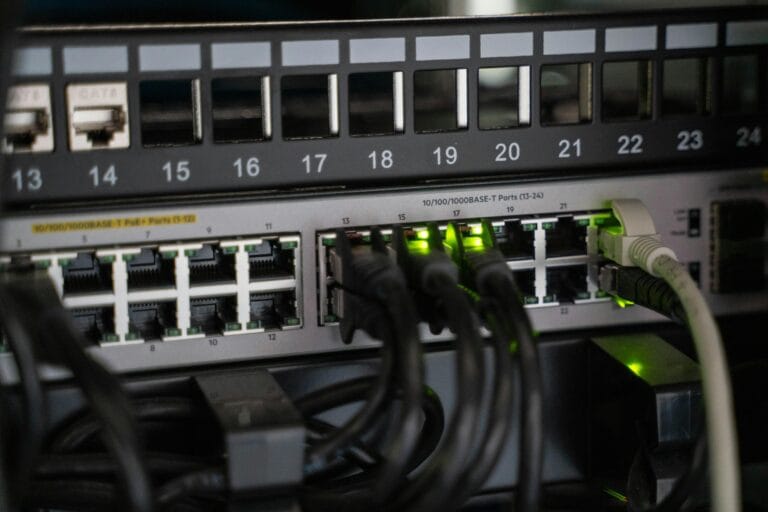
A keystone jack is a small modular connector designed to snap into a standard-sized aperture in a wall plate, surface-mount box, or patch panel frame. The rear of the jack has IDC (insulation displacement connector) terminals — colour-coded contact slots into which the individual conductors of the horizontal cable are seated, either using a punch-down tool or, on toolless designs, by pressing a termination cap that seats all conductors simultaneously. The front of the jack is a female RJ45 port that accepts a patch cord or device cable.
The IDC termination method means the cable insulation does not need to be stripped from individual conductors — the IDC blade cuts through the insulation as the conductor is seated, making direct electrical contact. This creates a reliable, gas-tight connection without soldering. The eight conductors of the Cat cable — four twisted pairs — are seated according to the T568A or T568B wiring standard, with the same standard used at both ends of the channel.
Once terminated and snapped into a wall plate or panel frame, the keystone jack is a fixed part of the permanent link. It is not designed to be connected and disconnected — that is the role of the patch cord. The keystone jack stays in place for the life of the installation; only the patch cord at the front changes as devices are connected and reconnected.
Why keystone jack category matters
A structured cabling channel is only as good as its weakest component. This is not a generalisation — it is how channel performance is defined in ISO/IEC 11801 and TIA-568. The channel includes the horizontal cable, the keystone jack at each end, and the patch cords. If any single component in that chain is rated below the others, the entire channel performs at the lower rating.
A Cat6 cable terminated into a Cat5e keystone jack is a Cat5e channel. A Cat6A cable terminated into a Cat6 keystone jack is a Cat6 channel. The cable behind the jack is irrelevant to the channel rating if the jack itself is underspecified. This is why specifying keystone jacks to match or exceed the cable category is not optional — it determines what the installation actually delivers, regardless of what was budgeted for the cable.
For most commercial installations, the practical choice is between Cat6 and Cat6A keystone jacks. Cat6A keystones support 10GBase-T to the full 90-metre permanent link and are the correct specification for any installation where 10 Gigabit performance at full channel length is required now or may be required in future.
Punch-down vs toolless termination
Keystone jacks are available in two termination styles. Punch-down jacks require a 110-type punch-down tool to seat each conductor individually into its IDC slot. The tool drives the conductor into the contact and trims the excess simultaneously. Punch-down termination is reliable and produces consistent results in experienced hands, but is slower on large installations and requires the correct tool to be available on site.
Toolless jacks — also called tool-free or snap-down jacks — use a termination cap that the installer loads with the dressed conductors and then presses closed, seating all conductors at once without a punch-down tool. Toolless termination is faster, particularly on high-port-count installations, and reduces the variability that comes from individual conductor seating. DTECH’s keystone range uses toolless termination throughout, with colour-coded T568A and T568B markings on the termination cap for straightforward wiring.
Standard vs quick-lock: the installer difference
Beyond termination method, the practical installation experience is shaped by two further factors: the depth of the keystone behind the wall plate or panel frame, and how the horizontal cable is managed at the rear.
DTECH’s standard toolless keystone jack has an overall depth of 35mm behind the mounting face — in line with most standard keystone designs — and is supplied with cable ties for managing the horizontal cable at the rear of the wall plate or panel. It is a straightforward, reliable toolless keystone suitable for Cat5e, Cat6, and Cat6A installations and 10GBase-T.
DTECH’s quick-lock toolless keystone jack reduces overall depth to 28mm — a meaningful difference in shallow back boxes and surface-mount enclosures where space behind the faceplate is limited. More significantly, it incorporates the same quick-lock rear cable management system as DTECH’s keystone panel frames: the horizontal cable is secured without cable ties, snapping into the rear retention system during termination. On a wall plate with one or two ports the time saving is modest. On a full installation with dozens or hundreds of keystones across multiple floors, removing the cable-tie step from every termination adds up to a substantial reduction in installation time — and produces a cleaner, more accessible result when future access to the rear of the outlet is needed.
Both variants are suitable for 22–24AWG solid core copper cable, support Cat5e, Cat6, and Cat6A, and are rated for 10GBase-T. Both are available in black and white unshielded UTP versions and in a zinc metal shielded variant for shielded installations.
Unshielded vs shielded keystone jacks
Unshielded (UTP) keystone jacks are the correct specification for the vast majority of commercial structured cabling installations. They are simpler to install — no grounding continuity to manage — and perform reliably at Cat6A speeds in any electrically normal environment. The internal twisting of the cable pairs and the precision of the jack’s IDC contacts provide the crosstalk rejection needed for 10GBase-T without a metallic shield.
Shielded (STP/FTP) keystone jacks are required when the installation uses shielded cable throughout — typically in environments with significant electromagnetic interference, such as industrial settings, plant rooms, or installations running alongside heavy electrical infrastructure. The critical point is that shielding only functions as intended when it is continuous and correctly grounded across the entire channel. A shielded cable terminated into an unshielded keystone jack breaks the shielding continuity and negates the benefit of using shielded cable. Equally, an unshielded cable terminated into a shielded jack gains nothing from the jack’s metallic housing. Shielded and unshielded components must not be mixed in the same channel.
DTECH’s zinc metal shielded keystone variants are designed for shielded installations, providing the housing and grounding path required to maintain shield continuity through the connection point. For the majority of commercial office, retail, education, and healthcare installations, the unshielded variants are the correct and sufficient specification.
Keystone jacks in wall plates and patch panels
The same keystone jack fits both wall outlet faceplates and keystone patch panel frames — this is the value of the standardised keystone form factor. An installer can terminate the wall end of the horizontal cable into a keystone jack and snap it into the faceplate, then terminate the panel end into an identical jack and snap it into the patch panel frame. The same tool, the same termination process, the same component category, at both ends of the permanent link.
This also means that a keystone jack can be replaced individually if a port fails or is damaged, without replacing the wall plate, the faceplate, or the patch panel frame. Unsnap the faulty jack, re-terminate a replacement onto the existing cable, and snap the new jack in. This modularity is one of the practical advantages of keystone-based infrastructure over fixed-port panels and faceplates, particularly on installations that will be in service for many years.
Frequently asked questions
Does it matter which category keystone jack I use if I have Cat6 cable?
Yes — the channel category is determined by the lowest-rated component in the link. A Cat6 cable terminated into a Cat5e keystone jack produces a Cat5e channel. Specifying Cat6 or Cat6A keystone jacks with Cat6 or Cat6A cable ensures the channel performs at the cable’s rated category. DTECH’s keystone jacks are suitable for Cat5e, Cat6, and Cat6A cable and support 10GBase-T, so a single product specification covers the full range of common commercial installation categories.
What is the difference between the quick-lock and standard keystone in terms of performance?
There is no performance difference between the two variants — both are rated for Cat5e, Cat6, and Cat6A and support 10GBase-T. The difference is purely in installation practicality: the quick-lock version is 28mm deep versus 35mm on the standard version, and uses a built-in rear cable retention system that eliminates the cable-tie step from the termination process. Both are toolless and use the same IDC termination method.
Can I use the same keystone jack in a wall plate and a patch panel?
Yes — the standard keystone form factor is universal. The same jack fits standard keystone wall plates and standard keystone panel frames interchangeably. This means the same component, the same termination process, and the same tooling can be used throughout the installation at both the outlet end and the panel end.
Do I need shielded keystone jacks for a Cat6A installation?
Not necessarily — it depends on whether the cable is shielded. Cat6A is available in both UTP (unshielded) and shielded variants. If the installation uses UTP Cat6A cable, unshielded keystone jacks are correct. If the installation uses shielded Cat6A cable, shielded keystone jacks are required throughout to maintain shield continuity. Mixing shielded cable with unshielded jacks defeats the purpose of shielded cabling and can cause performance issues rather than solving them.
How many times can a keystone jack be re-terminated?
IDC termination contacts are typically rated for a limited number of re-terminations — commonly in the region of 200–250 punch-down cycles, though this varies by manufacturer. In practice, keystone jacks in a permanent link installation are terminated once and remain in place for the life of the installation. Re-termination would only occur if the initial termination failed a test or if the cable needed to be re-dressed. The RJ45 port on the front of the jack is typically rated for 750 insertion/withdrawal cycles — far more than the number of patch cord connections the port will see over a normal installation lifetime.
Summary
Keystone jacks are the termination point for horizontal cabling at both ends of the permanent link — at the wall outlet and at the patch panel. Their category rating determines the channel rating regardless of the cable behind them, making correct specification critical. Toolless termination reduces installation time and variability. DTECH’s quick-lock variant further reduces depth and eliminates cable ties from the termination process, offering a meaningful time saving on larger installations. Unshielded jacks are correct for the majority of commercial installations; shielded jacks are required only where shielded cable is used throughout and shield continuity must be maintained across the connection point.
If you need help specifying keystone jacks for a copper installation, get in touch with the DTECH team — we supply structured cabling components to installers and IT teams across the UK, Europe, and the Middle East.