One of the most common specification errors in structured cabling installations is using standard internal cable on a route that passes outside — through an external wall, across a roof, between buildings, or underground. Internal cable used externally degrades quickly. UV radiation breaks down PVC and LSZH jackets not formulated for external use, moisture penetrates the cable construction over time, and temperature cycling accelerates the process. The result is a cable that looks fine from the outside but is corroding internally, causing intermittent faults that are difficult to trace and expensive to remediate.
This guide explains the difference between internal and external data cable, what the jacket materials actually do, when each is appropriate, and how to specify correctly for routes that transition between environments.
Why jacket material is the key difference
The electrical performance of a Cat6 or Cat6A cable — its bandwidth, crosstalk characteristics, and signal integrity — is determined by the conductor geometry, twist rates, and insulation materials inside the cable. The jacket does not affect electrical performance. What it does is determine how long those internal components remain protected from the environment around them.
Internal cables are jacketed in materials optimised for fire safety and flexibility in occupied buildings. LSZH (Low Smoke Zero Halogen) is the standard in the UK and Europe for permanently installed cabling — it produces no halogen gases and minimal smoke in a fire, protecting building occupants. PVC is also used, though LSZH is the correct specification for commercial buildings. Neither standard LSZH nor PVC is formulated to resist UV radiation or prolonged moisture exposure — standard LSZH is a fire safety specification, not an environmental one. Installed externally, both materials will deteriorate — cracking, becoming brittle, and eventually allowing moisture into the cable construction.
External cables are jacketed in polyethylene (PE) — a material with fundamentally different properties. PE resists UV radiation, moisture, and the wide temperature swings of external environments, typically rated from -40°C to +80°C. Black PE has the highest UV resistance of the standard external jacket options because carbon black is added to the compound specifically to absorb and dissipate UV energy rather than allowing it to degrade the polymer chains. The tradeoff is that PE does not self-extinguish when burned — it softens, drips, and can spread flame. This makes PE-jacketed cable unsuitable for routing through occupied buildings where fire performance standards apply.
This creates a practical problem for any installation where a cable route transitions between internal and external environments. Using internal cable for the whole run means the external section degrades. Using PE external cable for the whole run means the internal section does not meet fire performance requirements. The solution is either a cable join at the building transition point — connecting an internal cable to an external cable in a weatherproof enclosure — or a cable specifically designed and rated for both environments.
Internal/external rated cable
Internal/external rated cable solves the transition problem by using a UV-stabilised LSZH jacket that combines the fire performance required for internal installation with the UV and moisture resistance needed for external exposure. The jacket compound is formulated differently from standard LSZH — UV stabilisers are added to resist photodegradation — while retaining the low smoke and zero halogen properties required for installation in occupied buildings.
This makes internal/external cable the practical choice for any installation where the cable route passes through an external wall, across a roof space, between buildings on the same site, through a covered but exposed walkway, or into an external plant room. One cable, one pull, one termination at each end — no junction box at the wall penetration, no different cable types to manage in documentation, and no compliance question about what is acceptable on which section of the route.
DTECH’s Cat XG F/UTP 500MHz internal/external cable is the flagship specification for this application — rated to 500MHz, F/UTP shielded for EMI rejection on external runs, UV-stabilised LSZH black jacket, and suitable for both internal and external sections of the same route without any change of cable type. The F/UTP construction adds an overall foil screen that provides interference rejection on the external section of the run, where the cable is more likely to be exposed to electrical noise from external lighting, plant equipment, and other infrastructure. For installations where shielding is not required, DTECH’s Cat6 UTP external cable uses a PE black jacket for purely external routes or external-only sections where the cable does not pass through occupied building space.
Both cables use a black outer jacket — the standard identification colour for external-rated data cable, and the colour that provides the best UV resistance in PE and UV-stabilised LSZH compounds.
External fibre cable
The same internal/external principle applies to fibre optic cable. Tight-buffered fibre — the standard construction for intra-building backbone runs — uses individual fibre buffers that provide mechanical protection and make the cable suitable for direct termination, but the jacket materials used on standard internal tight-buffered cables are not rated for prolonged UV or moisture exposure.
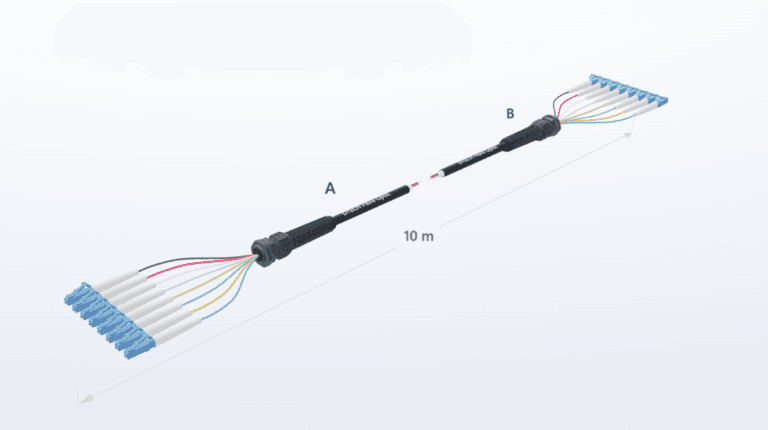
DTECH’s OM4 multimode and OS2 single-mode bulk fibre cables are available in internal/external rated versions — tight-buffered construction with LSZH jackets rated for both internal and external use. This allows a single continuous fibre run from an equipment room, through a building, across an external route to another building, and into a second equipment room, without requiring a splice or junction point at the building transition. For backbone runs between buildings on a campus, this is the practical specification — one cable type, one pull, terminated at patch panels in each building.
For exposed external routes — cable running on external walls, across rooftops, or in environments with mechanical hazard risk — armoured fibre provides additional physical protection beyond the jacket alone. Armoured vs unarmoured fibre is covered in a separate guide. View DTECH’s full fibre optic bulk cable range for available specifications.
Underground cable runs
Running cable underground between buildings — whether under a car park, across a courtyard, or through landscaped grounds — requires additional consideration beyond UV resistance. Cable installed underground must resist moisture penetration under soil pressure over time, cope with ground movement, and in some environments resist rodent damage and soil chemicals.
Standard external-rated cable with a PE or UV-stabilised LSZH jacket provides UV and surface moisture resistance but is not designed for the sustained moisture exposure and mechanical stress of direct burial. For underground routes, cable in a buried conduit is the cleanest solution — an internal/external rated cable is run through a buried HDPE duct that provides mechanical protection, moisture management, and the ability to replace the cable without excavation if required. The conduit is the external protection layer; the cable inside it can be standard internal/external rated.
Where conduit is not practical, direct burial-rated cable with gel-filled or water-blocked construction provides the additional moisture protection needed. The gel filling prevents water migration along the cable length if the outer jacket is penetrated. This is a more expensive cable construction and harder to terminate cleanly, which is why conduit is the preferred approach for most commercial underground installations.
Choosing the right cable for the route
| Route type | Correct specification | Why |
|---|---|---|
| Fully internal — walls, ceiling voids, risers | LSZH internal cable | Fire performance for occupied buildings |
| Transition route — through external wall, partly external | UV-stabilised LSZH internal/external cable | Fire safe internally, UV and moisture resistant externally |
| Fully external — wall-mounted, roof, between buildings above ground | PE external cable or UV-stabilised LSZH internal/external | Maximum UV and weather resistance |
| Underground in conduit | Internal/external cable in HDPE duct | Conduit provides moisture and mechanical protection |
| Direct burial without conduit | Direct burial rated cable with gel or water-block | Sustained moisture resistance under soil pressure |
| External route with mechanical hazard or rodent risk | Armoured cable | Physical protection beyond jacket alone |
View our copper and fibre cable ranges: Bulk copper data cable | Fibre optic bulk cable
Frequently asked questions
Can I use internal cable externally if it is in conduit?
In a fully buried and sealed conduit with no exposed sections, internal cable is better protected than exposed external cable — the conduit provides the environmental barrier. However, conduit joints, end caps, and building entry points are points where moisture can enter over time, and if the conduit seal fails the cable inside is unprotected. For new installations, specifying internal/external rated cable even when running in conduit adds very little cost and removes any risk from conduit seal failure over the lifetime of the installation.
Is black cable always external rated?
Not necessarily — black is the standard jacket colour for external-rated data cable, but colour alone is not a specification. Always verify the jacket material and external rating from the product specification rather than relying on jacket colour. A cable must explicitly state UV-stabilised, external-rated, or internal/external on its specification to be relied upon for external installation.
What happens if internal cable is installed externally?
In the short term, often nothing visible. Internal cable installed externally may perform normally for months or even a year or two, particularly if it is sheltered from direct sunlight. Over time, UV radiation degrades the jacket compound — it becomes brittle, cracks, and eventually splits. Once the jacket is compromised, moisture enters the cable. On copper cable this causes conductor corrosion, increasing resistance and eventually causing intermittent link failures. On fibre, moisture ingress can affect the buffer coatings and increase attenuation. By the time faults are visible the cable typically needs full replacement.
Does external cable need to be shielded?
Not always, but shielding is more commonly specified for external runs than internal ones. External cable routes are more likely to run alongside power infrastructure, external lighting circuits, and plant equipment that generates electromagnetic interference. F/UTP shielding — an overall foil screen — provides rejection of this interference and is the construction used on DTECH’s Cat XG internal/external cable for this reason. For short external runs in clean environments, unshielded cable is adequate. For longer runs near electrical infrastructure, shielded is the more conservative specification.
Can I join internal and external cable at the wall?
Yes — a weatherproof junction enclosure at the wall penetration point with a proper cable entry gland to maintain weatherproofing is a legitimate installation method, particularly on retrofit projects where pulling a new cable is not practical. The join introduces two additional connection points into the channel, which must be accounted for in the channel performance budget and will appear in test results. For new installations, a single internal/external rated cable run from end to end is cleaner, simpler to document, and avoids the maintenance point that a junction box represents.
Summary
Internal and external data cables differ primarily in jacket material, not electrical specification. LSZH jackets provide fire safety for occupied buildings but are not rated for UV or prolonged moisture exposure. PE jackets provide excellent external durability but are not suitable for routing through occupied buildings. Internal/external rated cable — UV-stabilised LSZH — resolves the transition problem by providing both fire performance and external durability in a single cable, allowing continuous runs from inside to outside without a cable join at the building transition. The same principle applies to fibre: DTECH’s OM4 and OS2 bulk fibre cables are available in internal/external rated versions for backbone runs that pass between buildings. For underground routes, cable in buried conduit is the preferred approach; direct burial cable with gel or water-block construction is the alternative where conduit is not practical.
If you need help specifying internal or external cable for a copper or fibre installation, get in touch with the DTECH team — we supply internal, external, and internal/external rated copper and fibre cabling to installers and IT teams across the UK, Europe, and the Middle East.