Tight buffered and loose tube are the two fundamental fibre optic cable constructions. Every fibre backbone cable — whether multimode or single mode, internal or external, four fibre or forty-eight — is built on one of these two approaches, and the choice between them determines how the cable handles environmental stress, how it is terminated, and which installation scenarios it is suited for. Both constructions are available in versions rated for internal and internal/external installation — the decision is not simply indoor versus outdoor, but about which construction best suits the termination method, the installation environment, and the specific route being cabled.
This guide explains the difference between tight buffered and loose tube fibre, the strengths and limitations of each, and how DTECH’s OM4 and OS2 cable ranges cover both constructions across internal and internal/external applications.
Tight buffered fibre
In a tight buffered cable, each optical fibre has a protective buffer material applied directly and tightly around it, increasing the overall fibre diameter from 250µm — the bare coated fibre — to 900µm. This buffer is a dual-layer construction: a soft inner layer that cushions the fibre against mechanical stress, and a harder outer layer that provides protection during handling and installation. The buffer is bonded directly to the fibre coating, so the fibre and buffer move as a single unit.
The 900µm diameter is significant because it is the standard size for fibre pigtails and patch leads. A tight buffered fibre can be terminated directly — a connector can be applied directly to the buffered fibre without any fanout or breakout hardware, in the same way a pigtail is terminated. This makes tight buffered cable the most practical choice for any installation where the cable is terminated at connectors at a patch panel, wall outlet, or equipment room enclosure. Termination is faster, cleaner, and does not require gel cleaning or breakout hardware.
The tight buffer also adds mechanical robustness. The fibre is protected against bending forces, crushing, and the physical demands of being pulled through containment and around corners. Tight buffered cables handle more like copper cable than loose tube — they are more forgiving during installation and do not require the same degree of care in routing and bend radius management.
Modern tight buffered cables — including DTECH’s OM4 and OS2 tight buffered range — are available with UV-stabilised LSZH jackets rated for both internal and internal/external installation. This is a significant practical advantage: a single tight buffered cable can run continuously from an equipment room, through a building, through an external wall, across an external route between buildings, and terminate directly at connectors at each end without a cable join or construction change at the building transition point. The UV-stabilised jacket resists photodegradation in external environments while retaining the low smoke zero halogen fire performance required for occupied buildings.
Loose tube fibre
In a loose tube cable, the bare 250µm coated fibres are placed inside a protective tube that is larger than the fibres themselves. The fibres float freely inside the tube, which means they are not under any strain from the cable’s mechanical behaviour. When the cable expands or contracts with temperature, bends, or is placed under tensile load, the tube accommodates the movement without transmitting stress to the fibres. This makes loose tube fibre significantly more tolerant of wide temperature fluctuations and sustained mechanical stress than tight buffered.
Loose tube cables are typically gel-filled — the space inside the tube around the fibres is filled with a thixotropic gel that acts as a moisture barrier. If the outer jacket is damaged and water enters the cable, the gel prevents it from migrating along the tube length and reaching the fibres. This moisture protection is the primary advantage of loose tube construction for external, underground, and long-distance installations where moisture ingress is a risk over the cable’s lifetime.
The practical tradeoff is termination. The 250µm bare fibres inside a loose tube cable cannot be directly terminated — they need to be either spliced to pigtails or broken out using a fanout kit that applies individual protective sleeves to each bare fibre before termination. Gel filling also needs to be cleaned from the fibre ends before splicing or termination, adding time and process steps. For long backbone runs where the cable is spliced into splice trays at each end, this is manageable. For installations with many termination points or where speed of installation matters, the additional termination steps are a real consideration.
Loose tube cable typically holds more fibres in a given outer diameter than tight buffered, because the 250µm bare fibres pack more densely than 900µm buffered fibres. This makes loose tube the preferred construction for very high-fibre-count backbone cables where cable diameter and weight are constraints.
Internal/external rating: what it means for each construction
The assumption that tight buffered is internal-only and loose tube is for external use reflects older cable technology. Modern tight buffered cables with UV-stabilised LSZH jackets are fully rated for internal/external installation — they provide the direct termination advantage of tight buffered construction alongside the environmental protection needed for external routes. For most commercial structured cabling installations involving inter-building backbone runs, tight buffered internal/external cable is the more practical specification because it eliminates the additional termination steps that loose tube requires.
Loose tube internal/external cable remains the correct choice for installations where the external section is very long, where the cable is subject to wide temperature swings in exposed environments, or where the gel-filled moisture protection provides additional resilience that the installation risk profile demands. For underground runs in conduit, aerial installations, or routes through particularly harsh external environments, the environmental tolerance of loose tube construction justifies the additional termination complexity.
For the majority of commercial inter-building backbone installations — campus links through ducted external routes between buildings — both constructions are viable with internal/external rated cable. The decision comes down to installation priority: if termination simplicity and speed matter most, tight buffered is the better choice. If the external environment is harsh or the run is long and exposed, loose tube provides greater environmental margin.
Which construction for which application
| Application | Recommended construction | Why |
|---|---|---|
| Internal backbone — equipment room to floor distributor | Tight buffered | Direct termination, fast installation, controlled environment |
| Riser cables — vertical between floors | Tight buffered | Internal environment, direct termination at each floor distributor |
| Campus links — between buildings, ducted external route | Tight buffered internal/external or loose tube internal/external | Tight buffered simpler to terminate; loose tube better for longer or more exposed external sections |
| Underground in conduit | Loose tube internal/external | Gel-filled moisture protection for sustained underground exposure |
| Mixed internal/external route — through external wall, short external section | Tight buffered internal/external | Direct termination advantage, UV-stabilised jacket handles external section |
| Long exposed external run, aerial, harsh environment | Loose tube internal/external | Maximum environmental and moisture tolerance |
| High fibre count backbone | Loose tube | More fibres per cable diameter, more efficient for large counts |
DTECH OM4 and OS2 in both constructions
DTECH supplies both OM4 multimode and OS2 single mode fibre in tight buffered and loose tube constructions, with internal/external rated versions of both for routes that pass outside the building.
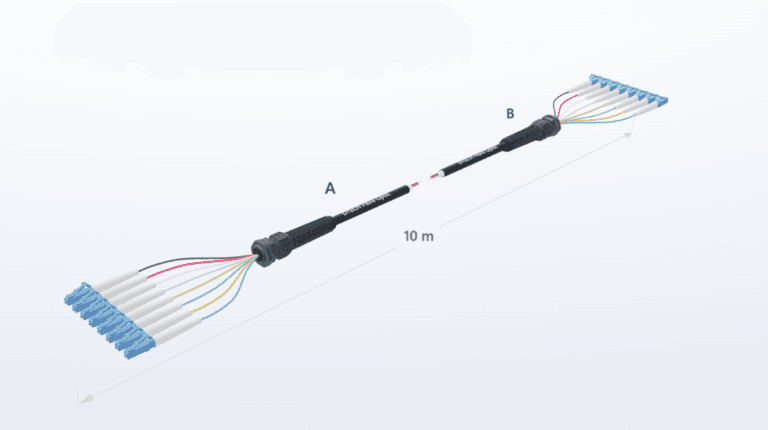
DTECH’s tight buffered cables — OM4 tight buffered 8 fibre and OS2 tight buffered 8 fibre — are rated CPR Cca and carry a UV-stabilised LSZH black jacket rated for both internal and internal/external installation. The 900µm buffered fibres terminate directly onto pigtails or via fusion splice without breakout hardware, and the UV-stabilised jacket means the same cable can run from inside a building through an external wall and continue to a second building without a cable join at the transition. CPR Cca is a higher fire performance rating than Eca, requiring testing for smoke production, flaming droplets, and acidity in addition to flame propagation — making these cables the correct specification for commercial buildings, healthcare, education, and any project where higher CPR performance is required.
DTECH’s loose tube internal/external cables — OM4 loose tube 8 fibre and OS2 loose tube 8 fibre — are rated CPR Eca with a UV-stabilised LSZH black jacket rated for internal and external installation. The gel-filled tube construction provides maximum moisture protection for underground runs and long exposed external sections. These cables are the correct specification where the environmental demands of the installation — sustained moisture exposure, wide temperature range, or long exposed external sections — justify the additional termination steps that loose tube requires. View the full DTECH fibre optic bulk cable range for all available specifications.
CPR ratings explained
Both DTECH tight buffered and loose tube cables carry CPR ratings under EN 50575 — the Construction Products Regulation standard that applies to all cables permanently installed in buildings in the UK and EU. Tight buffered cables are rated CPR Cca — a higher Euroclass that requires testing for heat release, flame propagation, smoke production, flaming droplets, and acidity. Loose tube cables are rated CPR Eca — the base Euroclass requiring vertical flame propagation testing. Both ratings are valid for permanently installed cables in commercial buildings. Cca is the higher performance rating and is the correct specification for projects where fire performance requirements are more stringent.
Frequently asked questions
Can tight buffered cable be used externally?
Yes — modern tight buffered cables with UV-stabilised LSZH jackets are rated for internal/external installation. DTECH’s tight buffered OM4 and OS2 cables carry UV-stabilised LSZH black jackets rated for both internal and internal/external routes, meaning they can run continuously through a building, through an external wall, and across an external section without requiring a cable join or change of cable type. This is one of the key practical advantages of tight buffered over loose tube for inter-building backbone installations — the same cable that terminates directly at connectors at each end also handles the external section of the route.
When should I choose loose tube over tight buffered for an external route?
For underground runs in conduit, long aerial sections, or routes through particularly harsh external environments where sustained moisture exposure and wide temperature swings are a concern, loose tube’s gel-filled construction provides greater environmental margin than tight buffered. For most standard commercial campus links through ducted external routes between buildings, tight buffered internal/external is the simpler and equally effective specification. The choice comes down to the severity of the external environment and the installation priority — termination simplicity versus maximum environmental tolerance.
What is the difference between CPR Cca and Eca?
Both are CPR Euroclass ratings under EN 50575 for the reaction-to-fire performance of cables permanently installed in buildings. Cca is a higher rating than Eca — it requires more stringent testing including assessment of smoke production, flaming droplets, and acidity in addition to flame propagation. Eca requires only the basic vertical flame propagation test. DTECH’s tight buffered cables are rated Cca; loose tube cables are rated Eca. Both meet CPR requirements for their respective installation contexts — Cca provides higher fire performance for projects where this is specified.
Do I need a fanout kit with loose tube cable?
If you are direct-terminating the loose tube cable at connectors, yes — the 250µm bare fibres need individual protective sleeves applied before termination, either through a fanout kit or by splicing to pigtails. Pigtail splicing is the more common approach for loose tube installation in commercial structured cabling — the pigtail handles the connector and the fusion splice handles the transition from bare fibre to connectorised fibre. Tight buffered cable avoids this entirely — the 900µm buffered fibres can be spliced directly to pigtails or terminated without breakout hardware.
Why is 8 fibre the most common count for backbone installations?
Eight fibres provides enough capacity for most commercial building backbone requirements — typically one or two fibre pairs for current active links and spare fibres for future use or redundancy — while keeping cable diameter and cost manageable. Most 40G and 100G parallel optics transceivers use 8 fibres (four transmit, four receive). An 8-fibre backbone cable therefore provides one 40G or 100G link with four spare fibres for future use, or two duplex 10G links with four spares. For higher-density requirements, 12, 24, and 48 fibre counts are available.
Can loose tube cable be used inside a building?
Yes — DTECH’s loose tube cables are LSZH jacketed and CPR Eca rated, making them suitable for internal installation. The practical reason to choose tight buffered over loose tube for internal-only routes is termination simplicity — the 900µm buffered fibres of a tight buffered cable terminate more easily and require no gel cleaning before splicing. For a purely internal run that terminates at patch panels at both ends, tight buffered is the easier and higher CPR-rated choice.
Summary
Tight buffered fibre — with its 900µm directly terminated fibres — is the practical choice for the majority of commercial backbone installations, both internal and internal/external. Modern tight buffered cables with UV-stabilised LSZH jackets handle external routes without a cable join at the building transition, terminate directly without breakout hardware, and carry a higher CPR Cca fire performance rating. Loose tube fibre — with gel-filled tubes and 250µm free-floating fibres — provides maximum environmental and moisture tolerance for underground runs, long aerial sections, and harsh external environments where the additional termination complexity is justified by the environmental demands of the installation. DTECH supplies both OM4 and OS2 in tight buffered (CPR Cca, UV-stabilised LSZH, internal/external rated) and loose tube (CPR Eca, UV-stabilised LSZH, internal/external rated) constructions, covering the full range of commercial backbone installation requirements.
If you need help specifying the right fibre construction for your installation, get in touch with the DTECH team — we supply OM4 and OS2 fibre cable to installers and IT teams across the UK, Europe, and the Middle East.