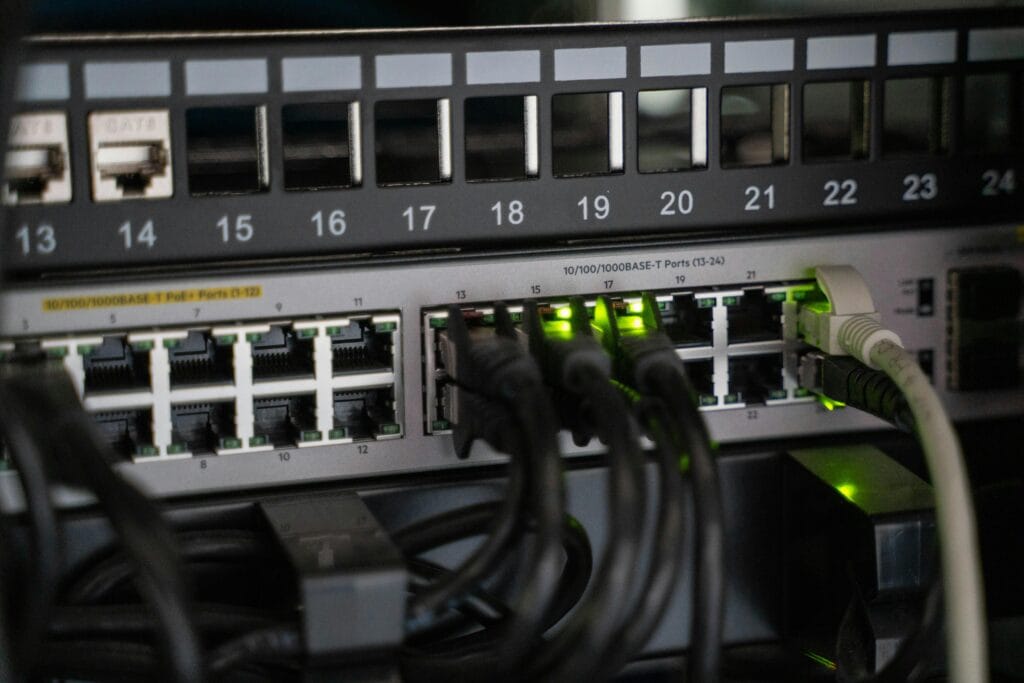
The RJ45 connector is the small plastic plug at the end of every Ethernet cable — the thing you click into a laptop, a network switch, a wall outlet, or a patch panel. It is the most widely used data connector in the world, found in virtually every commercial building, home network, data centre, and industrial installation that uses copper Ethernet infrastructure. Despite being ubiquitous, the details of what it actually is, how it works, and how to choose the right variant for a specific application are less widely understood than the connector’s familiarity might suggest.
This guide explains what an RJ45 connector is, where the name comes from, how it works, the different types available, and how to choose the right one for patch cord fabrication, field termination, or industrial applications.
What RJ45 actually means
RJ stands for Registered Jack — a designation that originated in the Bell System’s telephone infrastructure in the 1970s. The original RJ45 was a keyed telecommunications connector used for connecting data equipment to telephone networks. When Ethernet networking adopted a very similar 8-position modular connector for data transmission, the RJ45 name came with it — and it has stuck ever since, despite the fact that the connector used in modern Ethernet is technically an 8P8C (8 Position, 8 Contact) modular connector rather than a true RJ45.
The distinction is largely academic at this point. The entire networking industry — manufacturers, installers, engineers, and standards bodies — uses “RJ45” to mean the 8-pin modular Ethernet connector, and that is unlikely to change. Understanding that the technical name is 8P8C is useful context, but in day-to-day practice RJ45 is the correct term to use.
The “45” in RJ45 refers to the interface standard number in the original Bell System classification — not to any physical dimension of the connector. The connector itself has eight gold-plated contacts arranged in a single row, housed in a transparent or coloured plastic body with a locking tab that clips into the corresponding socket to hold the connection in place.
How an RJ45 connector works
The RJ45 plug is a crimped connector — it is attached to the end of a cable by inserting the eight conductors of the twisted pair cable into the plug body in the correct order, then applying a crimping tool that drives eight metal contacts down through the insulation of each conductor simultaneously. This IDC (insulation displacement contact) mechanism cuts through the wire insulation and makes direct electrical contact with the copper conductor inside, creating a secure and reliable connection without soldering.
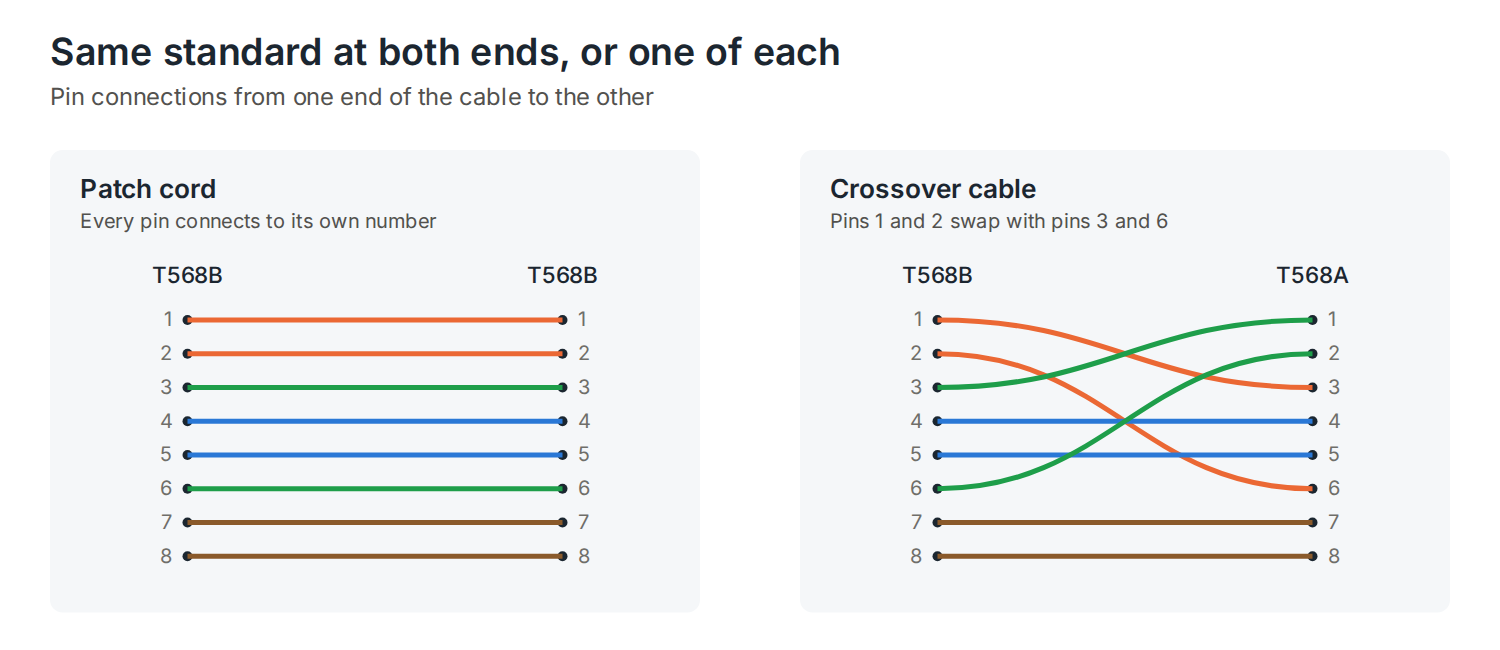
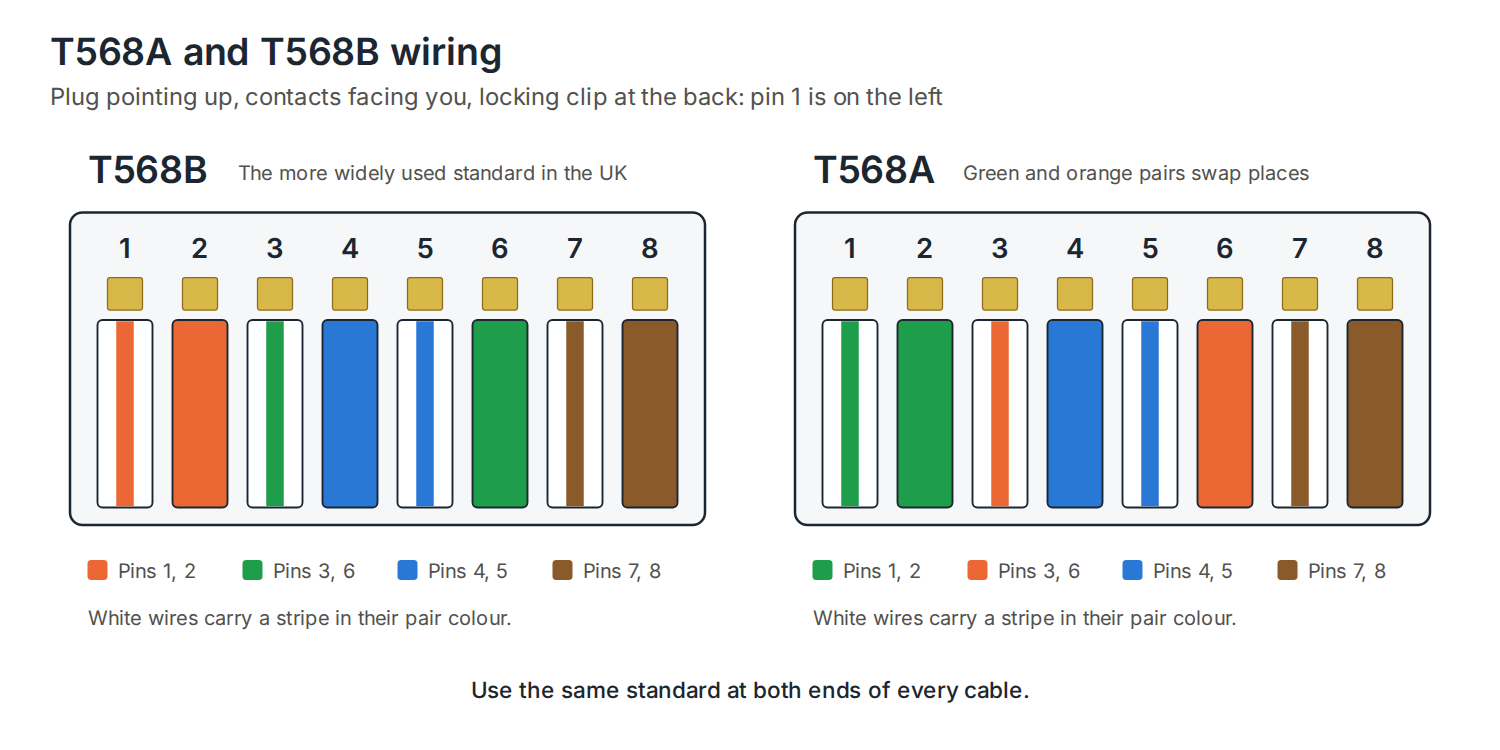
The eight contacts correspond to the eight conductors of a four-pair twisted pair cable — two conductors per pair, four pairs per cable. The order in which the conductors are inserted into the plug body determines the wiring standard: T568A or T568B. Both standards result in a fully functional Ethernet connection, but the conductor order is different. T568B is the more widely used standard in the UK and commercial installations globally. The critical requirement is consistency — both ends of the cable must use the same wiring standard. A cable terminated T568B at one end and T568A at the other is a crossover cable, not a standard patch cord.
The locking tab on the top of the plug body snaps into a retention clip in the corresponding RJ45 socket, holding the connector securely in place until deliberately released by pressing the tab and pulling the connector. On industrial and ruggedised variants, this locking mechanism is supplemented or replaced by threaded metal couplings that provide vibration-resistant and ingress-protected connections unsuitable for standard plastic RJ45.
Unshielded vs shielded RJ45 plugs
RJ45 plugs are available in unshielded (UTP) and shielded variants. Unshielded plugs have a standard plastic body with no metallic shielding — they are the correct choice for UTP cable installations in standard office, education, and commercial environments where EMI is not a concern. The vast majority of structured cabling installations use unshielded RJ45 plugs on both ends of every patch cord.
Shielded RJ45 plugs have a metal housing or shield that provides EMI protection and, critically, maintains the shielding continuity of a shielded cable through the connection point. If a shielded cable — F/UTP, U/FTP, or S/FTP — is terminated with an unshielded plug, the shielding continuity is broken at the connector and the benefit of shielded cable is lost. Shielded installations require shielded plugs throughout, with the shield correctly grounded to maintain its effectiveness.
DTECH’s Cat6 UTP RJ45 plugs with 50 micron gold plating cover standard unshielded patch cord fabrication for Cat5e and Cat6 installations. The Cat XG shielded RJ45 plugs and large OD shielded RJ45 plugs for cables up to 8.5mm outer diameter cover shielded Cat6 and Cat6A installations — the large OD variant accommodating the thicker jacket of Cat6A cable that standard plugs cannot accept.
Standard vs quick-fit vs field-termination plugs
RJ45 plugs come in several termination styles that suit different installation scenarios and skill levels.
Standard crimp plugs require the conductors to be cut to length, inserted into the plug body in the correct order, and crimped with a standard RJ45 crimping tool. The conductor tips are flush with or just inside the front of the plug when correctly seated. This is the standard method for patch cord fabrication in volume and produces consistent, reliable results in experienced hands.
Quick-fit or pass-through plugs allow the conductors to extend through the front of the plug body before crimping. This makes it significantly easier to verify that all eight conductors are correctly seated and in the right order before committing to the crimp — a practical advantage particularly on site, where working conditions are less controlled than on a bench. After crimping, the excess conductor that protrudes through the front is trimmed flush. DTECH’s quick-fit variants are designed for this approach, reducing the most common source of failed patch cord terminations — a conductor that is not fully seated before crimping.
Field-termination plugs are designed for terminating Cat6 and Cat6A cable in the field without a traditional crimp tool — typically using a tool-free or low-effort mechanism that seats the conductors through a pair-loading insert. DTECH’s Cat6/6A field termination STP plugs use a metal shielded construction for shielded Cat6 and Cat6A cable and are suited to on-site patch cord fabrication and repair where bench crimping tools are not available.
Gold plating — why it matters
The contacts inside an RJ45 plug are typically plated with gold to provide corrosion resistance and reliable electrical contact over the life of the connector. Gold does not oxidise, meaning the contact surface remains clean and conductive even after repeated insertions. The standard plating thickness is expressed in microns — 50 micron gold plating is the specification used in DTECH’s RJ45 plug range, providing a durable contact surface suitable for the insertion cycle life required in structured cabling applications.
Cheaper connectors may use thinner plating or non-gold contact materials. Over time, oxidation on the contact surface can increase contact resistance, causing intermittent link failures that are difficult to diagnose. For patch cords that will be connected and disconnected frequently — in data centres, hot-desking environments, and AV installations — the quality of the contact plating directly affects the reliability of the connection over its lifetime.
Industrial RJ45
Standard RJ45 connectors are designed for controlled indoor environments — offices, server rooms, and structured cabling installations in buildings. They provide no protection against dust, moisture, or mechanical stress. In industrial environments — factory floors, plant rooms, outdoor installations, and any location with exposure to dust, coolant, vibration, or wash-down water — standard RJ45 fails rapidly.
DTECH’s industrial RJ45 connector addresses this with a metal-bodied, tool-free construction providing ingress protection for industrial Ethernet applications where the familiar RJ45 interface is required but standard plastic connectors are inadequate. For the highest levels of environmental protection in industrial installations, M12 circular connectors with IP67 or IP68 ratings are the alternative — but where the installed equipment uses standard RJ45 ports and industrial protection is needed at the cable end, ruggedised industrial RJ45 is the practical solution.
Choosing the right RJ45 plug
| Application | Correct plug | Why |
|---|---|---|
| Standard patch cord fabrication — Cat5e or Cat6 UTP | UTP quick-fit crimp plug | Pass-through design reduces termination errors, 50µm gold plating for reliability |
| Shielded Cat6 or Cat6A patch cord | Shielded quick-fit crimp plug | Maintains shielding continuity through the connection point |
| Cat6A cable with larger OD jacket | Large OD shielded plug (8.5mm) | Standard plugs cannot accept the thicker Cat6A cable jacket |
| On-site field termination without bench crimp tool | Field termination STP plug | Tool-free termination for shielded Cat6/6A on site |
| Industrial environment — dust, moisture, vibration | Industrial RJ45 metal connector | Metal body and ingress protection for harsh environments |
View the full DTECH RJ45 plug and boot range: RJ45 plugs and boots
Frequently asked questions
Is RJ45 the same as Ethernet?
RJ45 is the connector used for copper Ethernet — the physical plug and socket at the end of the cable. Ethernet is the network protocol and standard that uses RJ45 as its physical interface on copper twisted pair cable. They are not the same thing — RJ45 is the hardware, Ethernet is the communication standard that runs over it. Other interfaces also use 8P8C connectors that look identical to RJ45 but carry different signals — serial console ports on network equipment, for example — which is why specifying RJ45 for Ethernet when ordering connectors is important.
T568A and T568B — the two wiring standards
T568A and T568B are the two standardised wiring configurations for RJ45 connectors, defined under ANSI/TIA-568. Both use the same eight conductors from a four-pair twisted pair cable, and both deliver identical electrical performance — the choice between them makes no difference to speed, signal quality, or reliability. The only physical difference is the position of the orange and green pairs, which are swapped between the two standards on pins 1, 2, 3, and 6.
Why two standards exist
The reason two standards exist is historical. T568B descends from AT&T’s earlier 258A wiring specification, which was widely used in commercial telecommunications installations before structured cabling standards were formalised. When the TIA/EIA-568 standard was developed in the early 1990s, T568B was essentially codified from existing AT&T practice — which is why it became dominant in commercial and enterprise cabling, particularly in the UK and North America.
T568A was developed alongside T568B as an alternative that provided backward compatibility with older USOC (Universal Service Order Code) telephone wiring schemes — allowing the same outlet to be used for both Ethernet data and legacy two-line telephone systems without rewiring. The US government adopted T568A as the required standard for federal contracts because of this backward compatibility. In most commercial environments outside government work, T568B became the default simply because it matched what was already installed from the AT&T era.
Today the backward compatibility argument for T568A is largely irrelevant — legacy telephone wiring schemes have been superseded — but the installed base of T568B in commercial buildings is so large that it remains the practical default for new installations. The most important rule is not which standard you choose, but that you use the same standard consistently throughout an installation. Both ends of every cable must use the same wiring standard — mixing T568A at one end with T568B at the other produces a crossover cable that will not function as a standard patch cord in modern installations.
T568B pinout — standard for UK commercial installations
| Pin | Colour | Pair |
|---|---|---|
| 1 | White / Orange | Pair 2 |
| 2 | Orange | Pair 2 |
| 3 | White / Green | Pair 3 |
| 4 | Blue | Pair 1 |
| 5 | White / Blue | Pair 1 |
| 6 | Green | Pair 3 |
| 7 | White / Brown | Pair 4 |
| 8 | Brown | Pair 4 |
T568A pinout — US government contracts and some residential installations
| Pin | Colour | Pair |
|---|---|---|
| 1 | White / Green | Pair 3 |
| 2 | Green | Pair 3 |
| 3 | White / Orange | Pair 2 |
| 4 | Blue | Pair 1 |
| 5 | White / Blue | Pair 1 |
| 6 | Orange | Pair 2 |
| 7 | White / Brown | Pair 4 |
| 8 | Brown | Pair 4 |
Note that pins 4, 5, 7, and 8 — the blue and brown pairs — are identical in both standards. Only the orange and green pairs swap positions. For new UK commercial installations with no pre-existing wiring standard in place, T568B is the correct default. If extending or adding to an existing installation, always match whatever standard is already in use — check before terminating.
Why are some RJ45 plugs described as “Cat6A compatible” and others are not?
Cat6A cable has a larger outer diameter than Cat5e and Cat6, typically 7–8mm versus 6mm, due to the additional insulation and shielding required to meet Cat6A’s performance specification. Standard RJ45 plugs have a cable entry opening sized for thinner cables and cannot physically accept Cat6A cable. Cat6A compatible plugs — including DTECH’s large OD shielded variant rated to 8.5mm — have an enlarged cable entry to accommodate the larger jacket without damaging it during insertion.
What is a strain relief boot and do I need one?
A strain relief boot is a flexible plastic sleeve that slides over the cable before crimping and covers the junction between the cable jacket and the RJ45 plug body after crimping. Its function is to prevent the cable from bending sharply at the point where it enters the plug — sharp bends at the connector entry point are one of the most common causes of cable damage and intermittent link failure on patch cords that are regularly moved or flexed. On patch cords in fixed installations where the cable will not be repeatedly moved, boots are less critical but still recommended as good practice. On patch cords used in AV, industrial, or frequently reconfigured environments, they are essential.
Can I terminate Cat6A with a standard RJ45 plug?
Only if the plug is rated for Cat6A and has the correct cable entry diameter for the specific cable being terminated. A standard Cat5e or Cat6 plug will not accept the larger jacket of most Cat6A cables. Even where the cable physically fits, a plug not rated to Cat6A specification may not maintain the conductor geometry and crosstalk performance required to certify the link at Cat6A. For Cat6A installations, use plugs specifically rated to Cat6A.
Do Cat7 and Cat8 use RJ45 connectors?
Cat7 does not use standard RJ45. The Cat7 standard specifies GG45 or TERA connectors — proprietary connector types that are not compatible with standard RJ45 infrastructure. This is one of the primary reasons Cat7 never achieved widespread commercial adoption in the UK and Europe despite its higher bandwidth specification — the requirement to replace every outlet, patch panel, and patch cord with non-standard connectors made it impractical for most installations. Cat6A, which uses standard RJ45 throughout, delivers 10GBase-T to the full channel length and is the current recommended standard for new commercial installations. Cat8 uses a modified RJ45 connector — physically compatible with standard RJ45 sockets and built to the same 8P8C form factor but manufactured to tighter tolerances to support Cat8’s 2000MHz bandwidth specification. Cat8 is designed for data centre use at very short distances — maximum 30 metres — for 25GBase-T and 40GBase-T switch-to-server connections. It is not a structured cabling standard for general commercial horizontal cabling. For the vast majority of commercial installations, Cat6A with standard RJ45 is the correct and sufficient specification.
Summary
The RJ45 connector — technically an 8P8C modular connector — is the universal interface for copper Ethernet across Cat5e, Cat6, and Cat6A infrastructure. It connects via crimped IDC contacts onto the eight conductors of a twisted pair cable, wired to T568A or T568B standard, with a plastic locking tab providing secure retention in the corresponding socket. Unshielded plugs suit UTP installations; shielded plugs are required for shielded cable to maintain continuity. Quick-fit pass-through designs reduce field termination errors; field termination plugs suit on-site work without bench tools; large OD variants accommodate Cat6A’s thicker cable jacket. Industrial RJ45 connectors provide the mechanical and environmental protection that standard plastic plugs cannot in harsh installation environments.
If you need help selecting the right RJ45 plug for your installation, get in touch with the DTECH team — we supply RJ45 plugs, boots, and structured cabling components to installers and IT teams across the UK, Europe, and the Middle East.