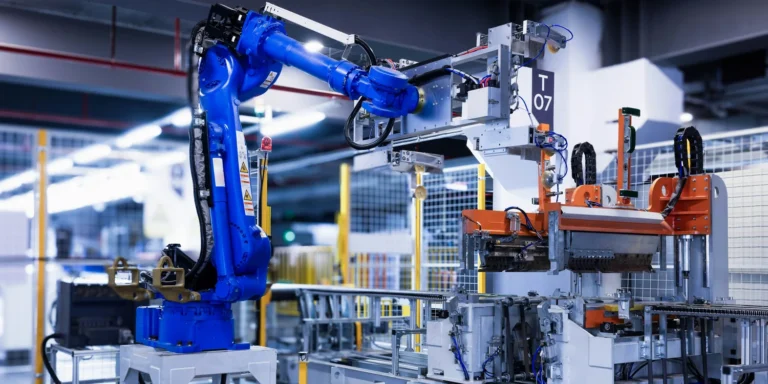
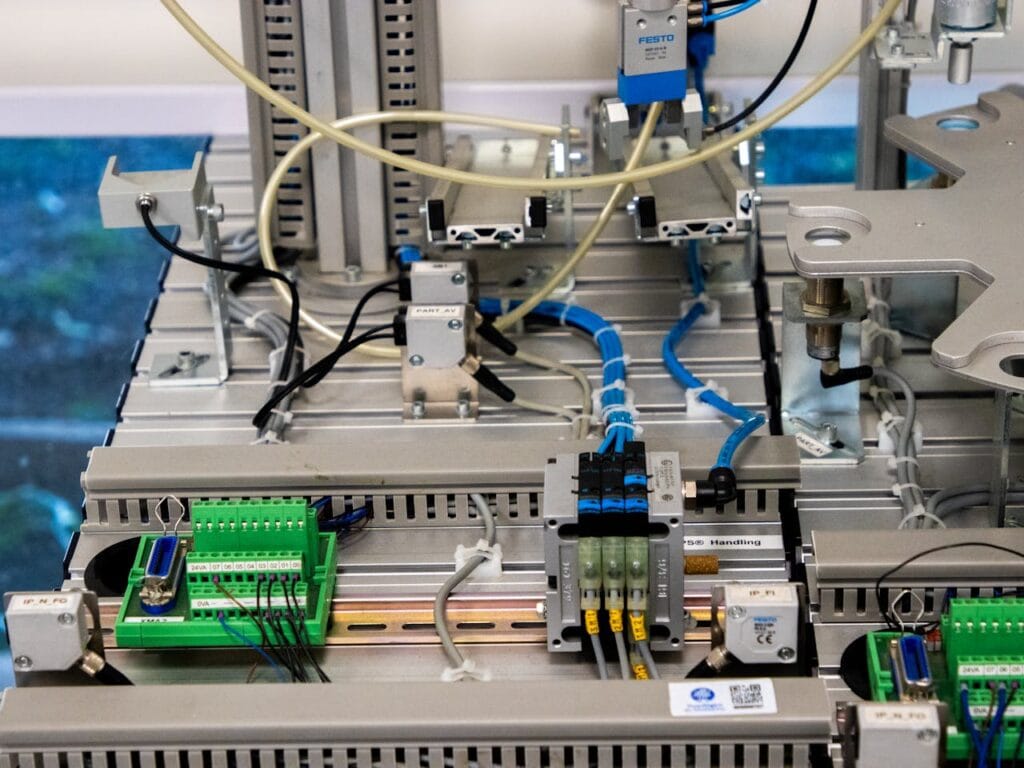
PROFINET, EtherCAT, and EtherNet/IP are the three dominant industrial Ethernet protocols used in factory automation, process control, and motion control applications worldwide. All three run on standard IEEE 802.3 Ethernet physical infrastructure — the same Cat cable, the same M12 connectors, the same switches — but they differ significantly in how they achieve real-time communication, where they are most commonly deployed, and which PLC and controller ecosystems they belong to. Understanding the differences helps both when specifying new installations and when maintaining or expanding existing ones.
This guide explains what each protocol is, what makes each one distinct, which connector each uses, and how DTECH’s industrial M12 connector and cable range covers all three.
Why industrial Ethernet needs dedicated protocols
Standard office Ethernet — the infrastructure that connects computers, servers, and access points in commercial buildings — is not designed for the deterministic, real-time communication that industrial automation requires. Standard Ethernet is a best-effort network: packets are delivered as quickly as possible, but there is no guarantee of exactly when they will arrive. For email, file sharing, and web browsing, this is perfectly acceptable. For a PLC sending a motion control command to a servo drive in a robotic assembly line, where the timing of that command is measured in microseconds, it is not.
Industrial Ethernet protocols solve this by adding a real-time communication layer on top of — or in place of — the standard TCP/IP stack, while keeping the same physical infrastructure. The cables, connectors, and switches are standard Ethernet hardware. The protocol running over them is adapted for deterministic, time-critical industrial communication. This is what allows a factory floor network to share physical infrastructure with the plant’s IT network while maintaining the timing precision that automation requires.
PROFINET, EtherNet/IP, and EtherCAT are the three most widely deployed industrial Ethernet protocols globally. Between them they cover the vast majority of new industrial installations — with protocol choice largely driven by PLC brand, geographic region, and application type.
PROFINET
PROFINET is the industrial Ethernet standard developed by Siemens and PROFIBUS & PROFINET International (PI). It is the dominant protocol in European automation environments and the standard for Siemens S7 and TIA Portal ecosystems — if the project uses Siemens PLCs, PROFINET is almost certainly the protocol.
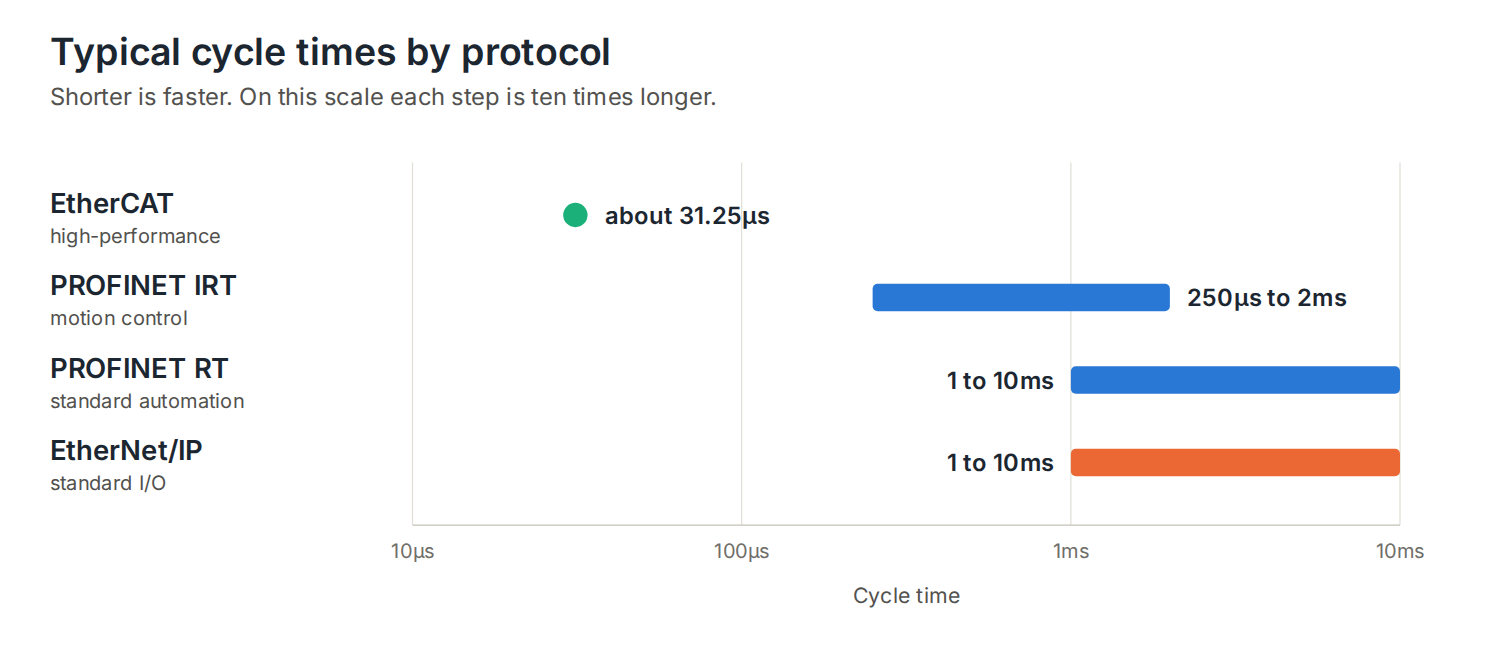
PROFINET is available in three performance variants. PROFINET RT (Real-Time) handles standard automation tasks with cycle times of 1 to 10 milliseconds — adequate for the majority of device-level I/O and sensor communication. PROFINET IRT (Isochronous Real-Time) provides deterministic sub-millisecond communication with cycle times of 250 microseconds to 2 milliseconds and jitter below 1 microsecond — used for motion control and synchronised multi-axis applications. PROFINET IRT Isochronous pushes this further, to cycle times as low as 250 microseconds for the most demanding motion control requirements.
PROFINET runs on standard 100Mbps Fast Ethernet hardware at the device level and supports Gigabit Ethernet for backbone and controller-level connections. It uses standard Ethernet switching, supports a wide variety of network topologies, and integrates with IT network infrastructure through standard TCP/IP alongside its real-time channels.
PROFINET is also the dominant protocol in UK and European manufacturing — panel builders, machine builders, and system integrators working in Siemens-heavy environments will encounter it constantly. Its widespread adoption, extensive device ecosystem, and deep integration with TIA Portal make it the default choice for European industrial automation.
EtherNet/IP
EtherNet/IP (Ethernet Industrial Protocol) was developed by Rockwell Automation and is maintained by ODVA — the Open DeviceNet Vendors Association. It is the dominant protocol in North American automation environments and the standard for Allen-Bradley and ControlLogix PLC ecosystems. Where PROFINET is Siemens, EtherNet/IP is Rockwell — and in most cases, the PLC brand determines the protocol.
EtherNet/IP uses standard TCP and UDP — making it the most IT-friendly of the three protocols. Standard Ethernet switches, standard IP addressing, and standard network management tools all apply directly, which reduces the barrier to integration between the plant floor and the wider IT infrastructure. EtherNet/IP supports Gigabit Ethernet and in newer implementations 10 Gigabit, providing high data throughput for installations with large I/O counts and data-intensive applications.
Real-time performance in EtherNet/IP is achieved through CIP Sync — a clock synchronisation extension — with cycle times typically in the 1 to 10 millisecond range for standard I/O. For motion control, CIP Motion extends EtherNet/IP with synchronised motion profiles. The protocol’s real-time performance is slightly less deterministic than PROFINET IRT or EtherCAT in demanding motion control applications, but for the vast majority of industrial I/O, process control, and drive applications it is more than sufficient.
EtherNet/IP is widely deployed in automotive, food and beverage, and oil and gas installations in North America, and is increasingly specified in international projects where Rockwell equipment is the plant standard.
EtherCAT
EtherCAT (Ethernet for Control Automation Technology) was developed by Beckhoff Automation and is the fastest industrial Ethernet protocol available. In typical high-performance implementations it achieves cycle times as low as 31.25 microseconds with jitter below 1 microsecond — and in extreme configurations sub-31µs cycle times are achievable. This level of performance makes it the protocol of choice for high-axis-count servo systems, pick-and-place robots, CNC machine tools, and any application where the speed and synchronisation of motion control is the primary requirement.
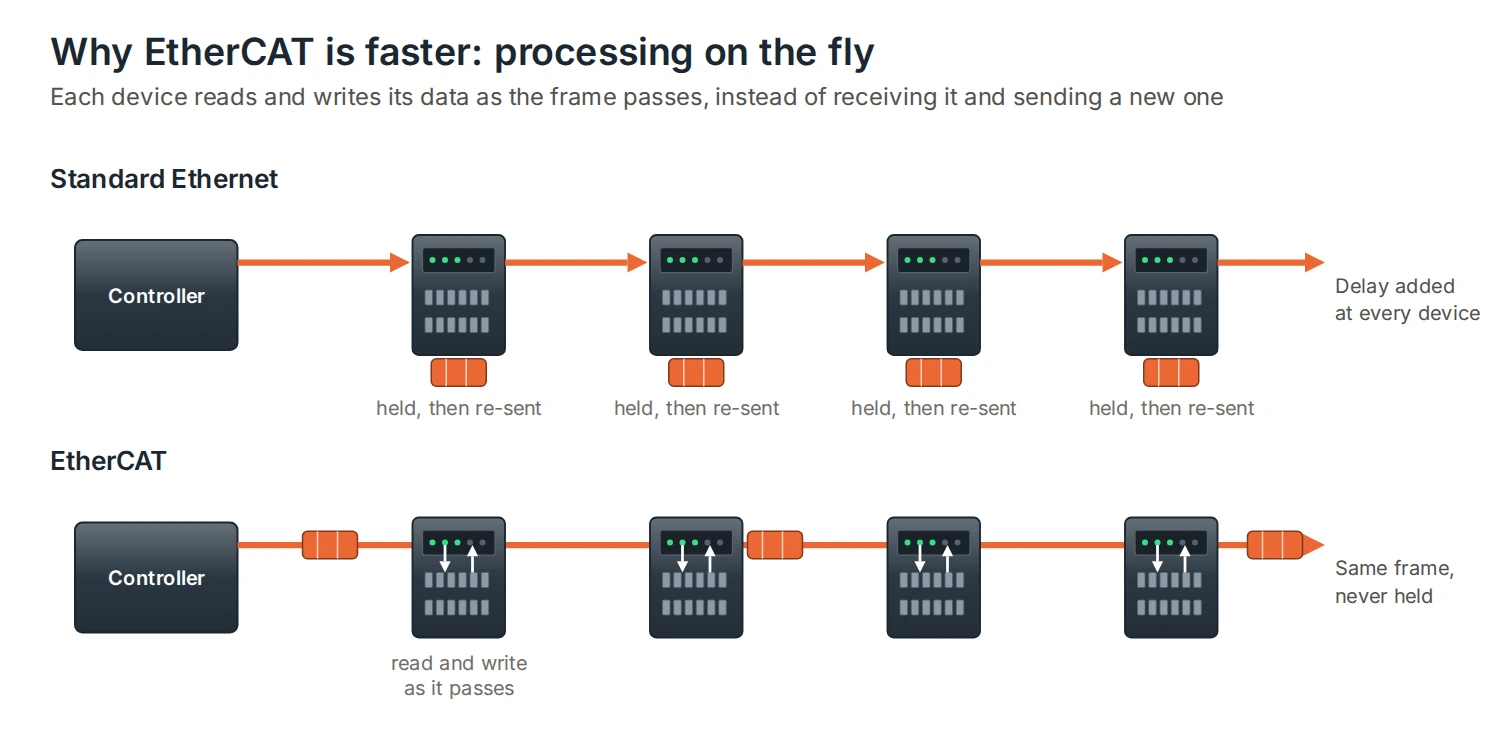
EtherCAT achieves its speed through a fundamentally different approach to frame processing. Rather than each device receiving a frame, processing it, and sending a new one — as in standard Ethernet — EtherCAT uses “processing on the fly”: each slave device reads and writes its data as the Ethernet frame passes through, without buffering or generating a new frame. This eliminates the latency introduced by frame generation and processing at each node, allowing the entire network to operate with the timing precision that high-speed motion control demands.
EtherCAT is topology-flexible — it supports line, star, tree, and mixed topologies, and the entire network can in principle run without switches, with each device forwarding the frame to the next. Up to 65,535 nodes are supported per network segment regardless of topology. The diagnostic capabilities built into the protocol are extensive — EtherCAT provides precise timing information and error detection at each node, making fault finding in large networks significantly faster than with protocols that rely on standard network management tools.
EtherCAT is open — the specification is freely available and the EtherCAT Technology Group has over 7,000 member companies. While Beckhoff TwinCAT is the most prominent master implementation, EtherCAT masters are available from many vendors, and the protocol is implemented in PLCs and motion controllers from Omron, Panasonic, Mitsubishi, and others alongside Beckhoff.
Which connector does each protocol use?
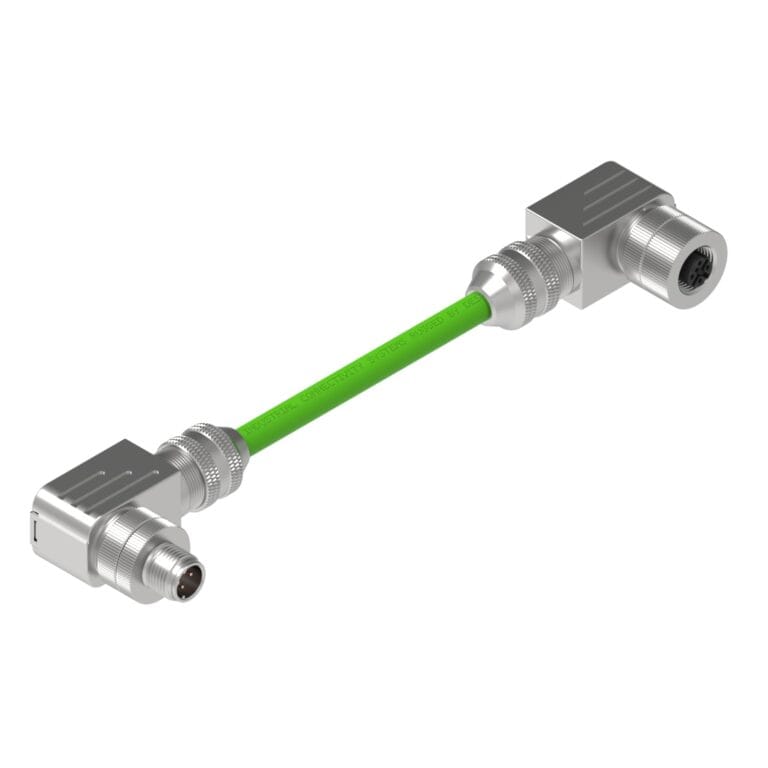
All three protocols use the same physical connector for device-level connections in industrial environments — the M12 circular connector. The M12’s threaded locking mechanism, IP67 ingress protection rating when mated, and metal housing make it the standard for industrial Ethernet wherever standard RJ45 cannot provide adequate mechanical or environmental protection.
The connector code — D-code or X-code — is determined by the required data rate, not by the protocol. At 100Mbps — the standard operating speed for PROFINET RT, EtherNet/IP device-level, and EtherCAT in most applications — the M12 D-code 4-pin connector is the standard. D-code uses four pins in two twisted pairs, compatible with Cat5e cabling, and is the connector found on the vast majority of industrial PLCs, I/O modules, drives, sensors, and actuators. PROFINET, EtherNet/IP, and EtherCAT all use D-code M12 at the device level.
Where higher bandwidth is required — Gigabit and 10 Gigabit backbone connections, high-speed switch-to-switch links, machine vision cameras, and data-intensive edge computing applications — the M12 X-code 8-pin connector is used. X-code’s eight pins support four shielded twisted pairs, compatible with Cat6A cabling, and supports data rates up to 10Gbps. X-code and D-code are not interchangeable — different pin counts, different keyways, and different bandwidth capabilities mean you cannot connect an X-code cable to a D-code port.
The practical rule is straightforward: device-level connections to PLCs, I/O modules, drives, and sensors = D-code. Backbone links, high-speed switches, machine vision, and 10G applications = X-code. Both are used in the same installation — D-code at the device level, X-code at the backbone level.
DTECH’s industrial M12 range
DTECH’s industrial connector range covers both D-code and X-code in field-wireable connectors, panel mount sockets, PCB mount variants, and pre-assembled cable assemblies — providing the complete connection solution for PROFINET, EtherNet/IP, and EtherCAT installations from a single supplier.
For device-level connections across all three protocols, DTECH’s M12 D-code connector range covers field-wireable plugs and sockets in straight and angled configurations, with metal housings for EMI shielding and IP67 protection when mated. Pre-assembled M12 D-code cable assemblies provide factory-terminated, tested cable runs for direct deployment — eliminating on-site termination and the risk of field termination errors in critical control network connections.
For backbone and high-speed applications, DTECH’s M12 X-code connector range covers 8-pin field-wireable and panel mount variants for Cat6A 10Gbps connections. Pre-assembled M12 X-code cable assemblies are available for backbone links, switch-to-switch connections, and machine vision installations where factory termination quality and guaranteed performance are required.
Industrial Ethernet leads and industrial plugs and glands complete the range — covering the cable entry and sealing solutions needed for panel and enclosure mounting in industrial environments.
Protocol comparison at a glance
| PROFINET | EtherNet/IP | EtherCAT | |
|---|---|---|---|
| Developed by | Siemens / PROFIBUS & PROFINET International | Rockwell Automation / ODVA | Beckhoff / EtherCAT Technology Group |
| Dominant region | Europe — especially Germany and UK | North America | Global — motion control applications |
| PLC ecosystem | Siemens S7 / TIA Portal | Allen-Bradley / ControlLogix | Beckhoff TwinCAT and others |
| Typical cycle time | 1–10ms (RT) / 250µs (IRT) | 1–10ms | ~31.25µs typical high-performance |
| Standard device speed | 100Mbps | 100Mbps / Gigabit | 100Mbps |
| Device connector | M12 D-code 4-pin | M12 D-code 4-pin | M12 D-code 4-pin |
| Backbone connector | M12 X-code (10G) or D-code (1G) | M12 X-code (10G) or D-code (1G) | M12 X-code (10G) or D-code (1G) |
| Best for | European automation, Siemens environments | North American automation, IT integration | High-speed motion control, robotics |
Frequently asked questions
Can PROFINET, EtherNet/IP and EtherCAT run on the same physical network?
They share the same physical infrastructure — the same Cat cable, the same M12 connectors, and in many cases the same switches. However, the three protocols are not directly interoperable at the application layer. Devices from one protocol ecosystem cannot natively communicate with devices from another without protocol converters or gateways. In practice, most installations use a single protocol throughout the automation layer, chosen by the PLC brand and the system integrator.
Is EtherCAT always faster than PROFINET?
EtherCAT achieves faster minimum cycle times in high-performance implementations — typically around 31.25 microseconds, with sub-31µs achievable in extreme configurations, versus PROFINET IRT’s 250 microseconds minimum. For most standard automation tasks — I/O scanning, drive communication, sensor data — both PROFINET RT and EtherNet/IP at 1–10ms cycle times are more than adequate. The speed advantage of EtherCAT is most significant in high-axis-count servo motion control, high-speed pick-and-place, and CNC applications where synchronisation at the microsecond level is a genuine requirement.
Why do all three protocols use D-code M12 at the device level?
All three protocols run on standard 100Mbps Fast Ethernet at the device level — the same physical layer as standard Ethernet. M12 D-code 4-pin provides the correct pin configuration for 100BASE-TX (two twisted pairs), in a form factor that provides IP67 ingress protection and mechanical locking for industrial environments. The connector is the standardised choice across the industry for this speed tier and has been designed into PLCs, I/O modules, sensors, and drives from virtually every major industrial automation manufacturer.
When do I need X-code instead of D-code?
X-code is required when the connection needs to carry Gigabit or 10 Gigabit Ethernet. This typically applies to switch-to-switch backbone links, controller-to-switch connections in high-performance installations, machine vision cameras with high-resolution or high-frame-rate requirements, edge computing devices with large data throughput, and any application where 100Mbps is insufficient for the data volumes involved. Device-level connections to standard PLCs, I/O modules, and sensors remain D-code in the vast majority of industrial installations.
Can I mix D-code and X-code in the same installation?
Yes — and in most industrial Ethernet installations you will. The typical architecture has D-code at the device level connecting sensors, actuators, and I/O modules, and X-code at the backbone level connecting switches and controllers. The switch itself will have both D-code ports for device connections and X-code ports for uplinks. D-code and X-code are not intermateable — they have different pin counts and keyways — so there is no risk of accidentally connecting the wrong cable to the wrong port.
Does the choice of industrial Ethernet protocol affect cable specification?
At the device level, no — all three protocols run on Cat5e or better cable with D-code M12 connectors at 100Mbps. The cable specification is the same regardless of whether the protocol is PROFINET, EtherNet/IP, or EtherCAT. At the backbone level, the required bandwidth determines the cable — Cat5e or Cat6 for Gigabit, Cat6A for 10 Gigabit — and the M12 X-code connector is used at either speed. The protocol does not change the cable or connector specification; the data rate does.
Summary
PROFINET, EtherNet/IP, and EtherCAT are the three dominant industrial Ethernet protocols — all running on standard Ethernet physical infrastructure but each taking a different approach to real-time communication and belonging to a different PLC and controller ecosystem. PROFINET is the European standard for Siemens environments. EtherNet/IP is the North American standard for Rockwell environments and the most IT-friendly of the three. EtherCAT is the fastest, with cycle times as low as 31.25 microseconds in typical high-performance implementations and sub-31µs in extreme configurations, making it the protocol of choice for high-speed motion control and robotics. All three use M12 D-code 4-pin connectors at the device level for 100Mbps connections. M12 X-code 8-pin is used for Gigabit and 10 Gigabit backbone connections regardless of protocol.
If you need help specifying M12 connectors or industrial Ethernet cable assemblies for a PROFINET, EtherNet/IP, or EtherCAT installation, get in touch with the DTECH team — we supply M12 D-code and X-code connectors and assemblies to industrial automation engineers and panel builders across the UK, Europe, and the Middle East.