
If you have priced copper data cable in the last eighteen months and noticed it costs more than it used to, you are not imagining it. Copper prices have surged significantly since early 2025 — rising nearly 40% over the course of the year to hit an all-time high of over $13,000 per tonne on the London Metal Exchange in January 2026. That is the largest annual gain since 2009, and it has fed directly through into the cost of copper wire, cable, and every structured cabling product manufactured from it. Copper electric wire costs are up over 18% year-on-year to Q2 2026 in the US market, and UK and European markets have seen similar upward pressure.
Unlike a temporary price spike driven by a single event, the current increase is structural — driven by multiple converging forces on both the demand and supply side that analysts broadly agree are not going away quickly. Understanding what is happening helps make better procurement and project decisions in a market where prices are unlikely to return to their pre-2025 levels any time soon.
What has happened to copper prices
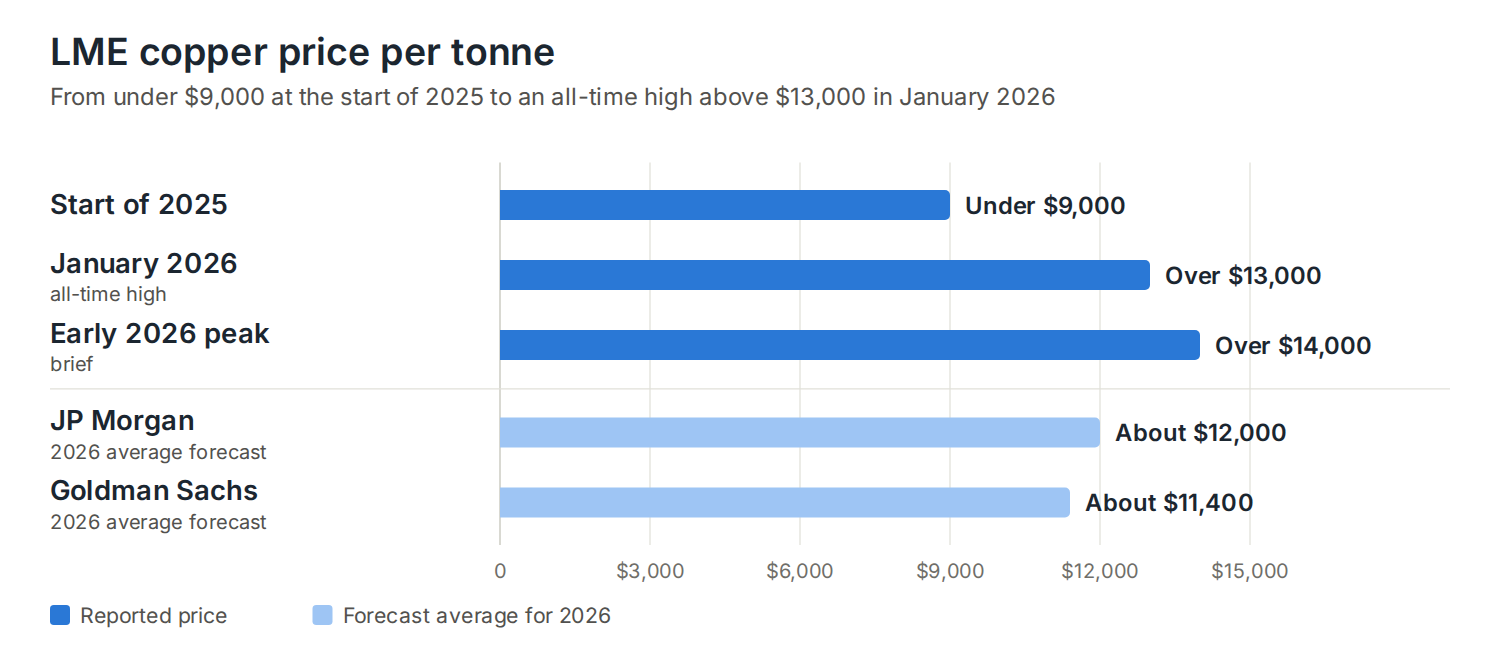
Copper opened 2025 at under $9,000 per tonne on the London Metal Exchange. By January 2026 it had surpassed $13,000 — an increase of more than 40% in twelve months. The LME price briefly exceeded $14,000 per tonne in early 2026 before moderating, with JP Morgan forecasting an average of around $12,000 per tonne for 2026 and Goldman Sachs projecting approximately $11,400. Both figures represent a sustained elevation well above the price levels that prevailed through 2023 and early 2024.
The US Comex market saw copper settle at a record $6.20 per pound in early 2026 — a price that would have been difficult to forecast even twelve months earlier. The moves have not been uniform in direction — prices moderated through parts of Q1 2026 amid geopolitical uncertainty and volatility in other commodity markets — but the underlying direction has been consistently upward and the structural drivers that pushed prices to these levels remain in place.
Why demand has surged
AI data centres
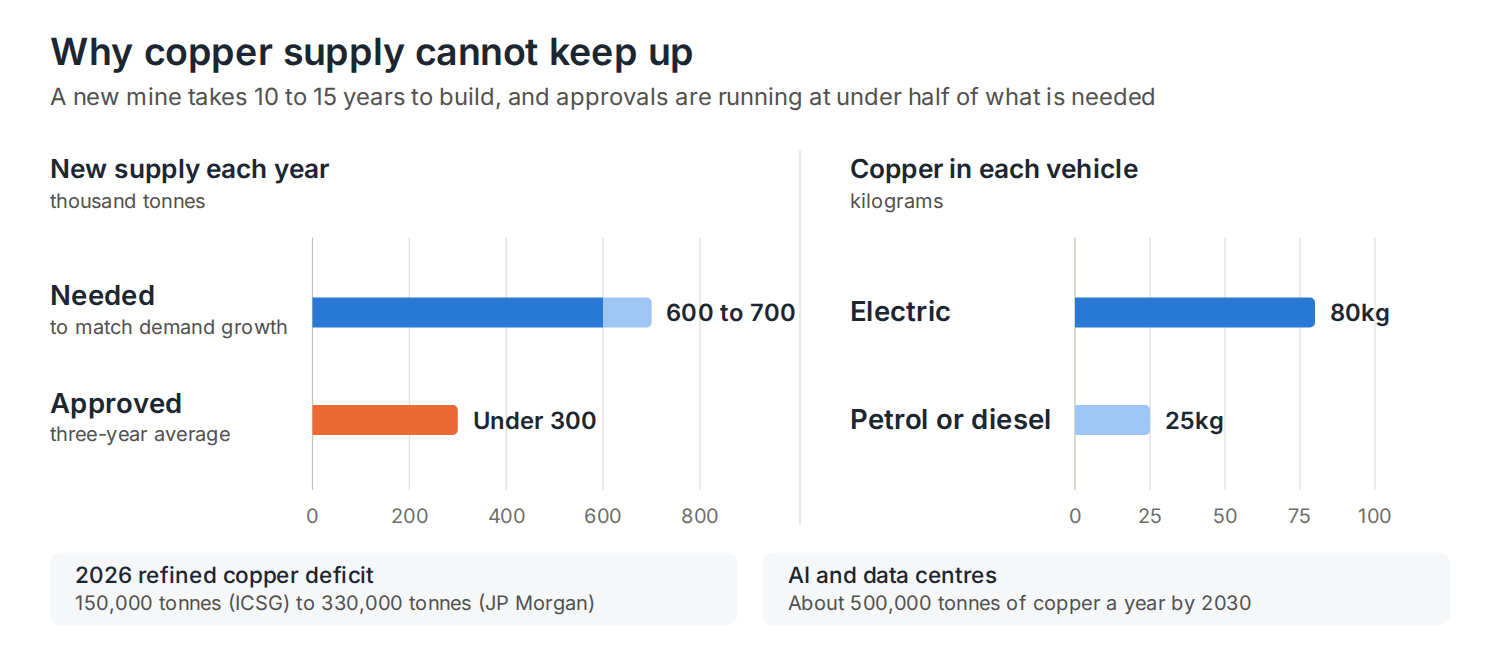
The same AI infrastructure build-out driving fibre optic price increases is also a significant driver of copper demand. Hyperscale data centres require substantial copper for power distribution, busbar systems, cooling infrastructure, and the structured cabling that connects thousands of servers. BloombergNEF’s December 2025 Transition Metals Outlook identifies data centre growth as one of the primary demand drivers alongside grid expansion and electric vehicle adoption, projecting that energy-transition demand for copper could triple by 2045. AI and data centres alone are expected to consume around 500,000 tonnes of copper per year by 2030 — a figure that has increased sharply as hyperscale investment has accelerated.
Electrification and energy transition
Electric vehicles require approximately 80 kilograms of copper each — more than three times the 25 kilograms used in a conventional petrol or diesel vehicle. Wind turbines, solar installations, grid-scale battery storage, and the expanded electricity grid infrastructure required to support all of these are all copper-intensive. As the energy transition has accelerated from policy aspiration into large-scale physical deployment, the copper demand that was always implied by net-zero targets has become real and immediate rather than theoretical and future.
The combination of AI data centre build-out and energy transition infrastructure creates a demand picture that is structurally different from historical copper demand cycles. Previous cycles were largely driven by construction and conventional industrial activity — sectors that contract in downturns, providing copper demand a natural release valve. The current drivers are policy-backed, government-funded, and largely insensitive to the kind of economic softening that would previously have moderated commodity prices.
Why supply cannot keep up
Building a new copper mine takes 10 to 15 years from discovery to production — one of the longest development timelines in the mining industry. This means the supply response to current high prices will not arrive at meaningful scale for the better part of a decade. The pipeline of new projects approved and under development is insufficient to meet projected demand growth. Annual demand growth requires an estimated 600,000 to 700,000 tonnes of new supply per year, but project approvals have averaged under 300,000 tonnes for three consecutive years.
The situation at existing major mines has compounded the problem. Chile — the world’s largest copper producer, accounting for around 25% of global supply — saw output declines in each of the last five months of 2025, with operational challenges at key projects including Quebrada Blanca and El Teniente. Peru’s operations have been disrupted by political instability and protest activity around several major mines. Indonesia’s Grasberg operation — the world’s second-largest copper mine — suspended production following a serious incident in September 2025, with Freeport-McMoRan estimating its 2026 output would be approximately 35% lower than previously projected. The Grasberg disruption alone removed hundreds of thousands of tonnes from global supply projections.
The International Copper Study Group has projected a 2026 refined copper deficit of approximately 150,000 tonnes. JP Morgan’s estimate for the same deficit is 330,000 tonnes. The range reflects genuine uncertainty about the pace of supply recovery and the trajectory of demand — but both figures point in the same direction. BloombergNEF warns the market could enter structural deficit as early as 2026, with a potential shortfall reaching 19 million tonnes by 2050 without major new investment in mines and recycling.
Chinese smelters announced a 10% output cut for 2026, adding further pressure to an already tight refined copper market. The combination of mine disruptions, slow permitting, and smelter reductions has created a supply picture that cannot respond quickly to elevated prices regardless of how compelling the investment case for new mine development becomes.
US tariffs and market distortion
A further complicating factor specific to 2025 and 2026 has been US trade policy. The Trump administration’s tariff agenda created expectations of import tariffs on refined copper, prompting significant pre-tariff stockpiling. An estimated 730,000 to 830,000 tonnes of copper cathode was diverted into US warehouses ahead of potential 2027 tariffs — tightening LME inventories in Europe and Asia, raising regional premiums, and supporting elevated global benchmark prices even as physical tightness in some markets was partially offset by this stockpiled material.
The distortion created by this stockpiling behaviour makes the true underlying supply-demand balance harder to read than in a normal market. What is clear is that the tariff uncertainty itself has added a layer of price support that would not exist in a more stable trade policy environment — and that this uncertainty is not fully resolved.
What this means for data cable buyers in the UK
Copper represents the primary raw material cost in structured data cable. Cat6, Cat6A, and other copper data cable products are priced off a raw copper cost base that has risen substantially over the past eighteen months and shows no clear near-term path back to pre-2025 levels. The analyst consensus — JP Morgan, Goldman Sachs, Fidelity, BloombergNEF — is broadly aligned on copper remaining elevated through 2026, with structural deficit conditions expected to persist or intensify beyond that point.
For installers and infrastructure teams buying copper data cable for commercial projects, the practical implications are the same as they were for fibre: current pricing is the baseline, not a temporary anomaly. Projects that are specified and budgeted at pre-2025 copper prices need to be revisited. Deferring in the expectation of meaningful near-term price falls is a position that requires an assumption the analyst community does not broadly support.
The pricing environment also reinforces the case for correct specification first time. Higher cable material costs make rework and remediation more expensive. An installation that fails test certification because the wrong cable was specified, or that needs to be recabled because CCA was installed instead of pure copper, costs significantly more to put right than it would have two years ago. Specifying correctly — pure copper, correct category, correct construction for the installation environment — avoids that cost.
DTECH’s position
We are not insulated from global commodity markets — no cable supplier is. What we can offer is transparent pricing on the pure copper data cable we stock and direct communication when market conditions change. Our Cat6, Cat6A, and specialist copper data cable ranges are available now. If you are pricing a project and want to confirm current pricing before committing, get in touch with the team directly — we would rather give you a firm number early than have pricing uncertainty create a problem later in the project.
Frequently asked questions
Why has copper price increased so much in 2025 and 2026?
The increase reflects multiple simultaneous drivers: surging demand from AI data centres, electric vehicle production, and energy transition infrastructure; supply disruptions at major mines in Chile, Peru, and Indonesia; a slow pipeline of new mine development; Chinese smelter output cuts; and US tariff-driven stockpiling behaviour that has tightened European and Asian market inventories. No single cause explains the full move — it is the convergence of all of these that has pushed prices to record levels.
When are copper prices likely to come down?
Analyst consensus from JP Morgan, Goldman Sachs, and BloombergNEF points to copper remaining elevated through 2026, averaging in the range of $11,000 to $12,000 per tonne. New mine supply sufficient to close the projected deficit will not arrive at scale before the late 2020s at the earliest, given the 10 to 15-year development timeline for major copper mining projects. Meaningful structural price normalisation is unlikely before new supply comes online in meaningful volume — which is a story for the 2030s, not the near term.
Does the copper price directly affect data cable pricing?
Yes — copper is the primary raw material in structured data cable and represents a significant proportion of the finished product cost. When LME copper rises 40% in a year, that increase feeds through into the cost of Cat6, Cat6A, and other copper cable products, though the degree of pass-through varies by manufacturer and market conditions. UK copper wire costs are up over 18% year-on-year to Q2 2026, reflecting the sustained elevation in raw material costs.
Should I defer a cabling project and wait for prices to fall?
Based on current analyst consensus, deferring in the expectation of meaningful near-term price falls is unlikely to be rewarded. Prices are expected to remain elevated or increase further through 2026, and the structural drivers are not short-term. If a project has a confirmed requirement, pricing and ordering ahead of the installation date is the more defensible position than waiting for a price correction that may not materialise within the project timeline.
Does the copper price increase affect all cable types equally?
The impact is proportional to the copper content of the product. Bulk data cable with 23AWG solid copper conductors has significant copper content and is directly affected. Patch leads and accessories have less copper by weight and are somewhat less sensitive to raw copper price movements, though they are not immune. Fibre optic cable has no copper content and is governed by a separate supply and demand picture — though as covered in our separate article on fibre price increases, the fibre market has its own elevated pricing driven by different structural factors.
Summary
Copper prices have risen approximately 40% since early 2025 to hit all-time highs above $13,000 per tonne, driven by surging demand from AI infrastructure and energy transition investment against a supply base that cannot respond quickly due to the decade-plus timelines involved in bringing new mine capacity online. Major disruptions at key mines in Chile, Indonesia, and Peru have tightened supply further. US tariff-driven stockpiling has added a further distorting layer. Analyst consensus points to prices remaining elevated through 2026 and beyond, with structural deficit conditions expected to persist. For installers and IT teams buying copper data cable, current pricing is the baseline to plan from — not a temporary peak to wait out.
If you have a cabling project in the pipeline and want to discuss current pricing and availability, get in touch with the DTECH team — we supply pure copper Cat6, Cat6A, and specialist data cable to installers and IT teams across the UK, Europe, and the Middle East.