Single mode fibre is specified by the ITU-T, the telecoms arm of the International Telecommunication Union. Two of its recommendations cover almost every single mode fibre in buildings today: G.652, standard single mode fibre, and G.657, bend-insensitive fibre that can be bent much more tightly without losing light.
Datasheets quote these codes alongside the cabling grade OS2. This guide explains what G.652.D and the G.657 categories mean, how they relate to OS2, and whether you can mix them.
G.652: standard single mode fibre
G.652 has four categories, A to D. The current edition, G.652 (08/2024), specifies only B and D; A and C remain in the 2009 edition. A and B were designed around the 1310 nm window. C and D add low water peak: the attenuation around 1383 nm, once high because of water in the glass, is held to the same level as the rest of the band, opening up every wavelength from about 1260 nm to 1625 nm. B and D also tighten polarisation mode dispersion, which matters at high speeds over long distances.
| G.652.D | Specification (cabled fibre) |
|---|---|
| Attenuation, 1310 to 1625 nm | 0.4 dB/km maximum |
| Attenuation at 1550 nm | 0.3 dB/km maximum |
| Water peak, 1383 nm | 0.4 dB/km maximum |
| Bend test | 100 turns at 30 mm radius |
G.652.D is the standard single mode fibre of today’s networks, and the one most others are measured against.
G.657: bend-insensitive fibre
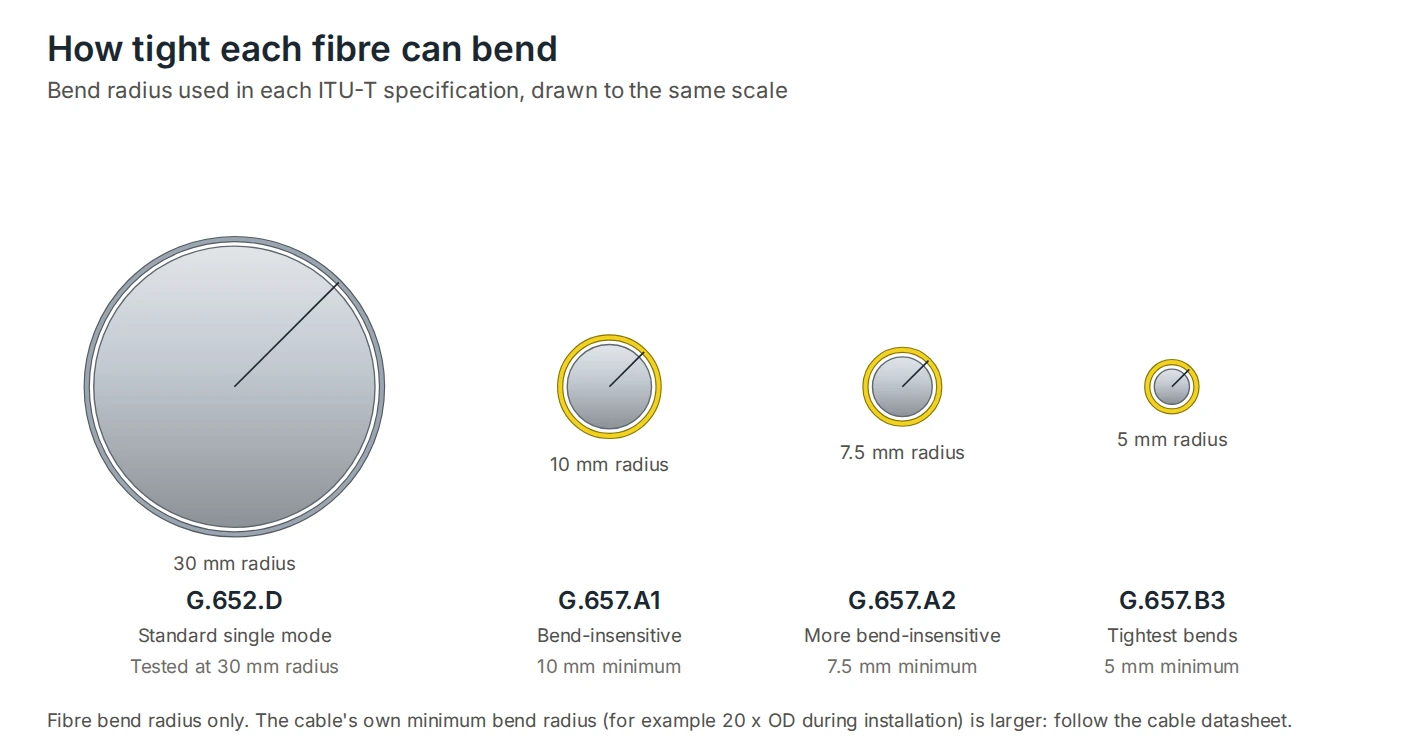
Standard fibre starts to leak light when it’s bent tightly. G.657 fibre uses a modified design that keeps the light in the core around much tighter bends. The current edition, G.657 (08/2024), has three categories. It merged the former B2 category into A2.
| Category | Minimum bend radius | Meets G.652.D? | Typical use |
|---|---|---|---|
| G.657.A1 | 10 mm | Yes | Patch leads, panels, building cabling |
| G.657.A2 | 7.5 mm | Yes | Tighter routing, FTTH inside buildings |
| G.657.B3 | 5 mm | Not required | Short runs, under 1 km, with the tightest bends |
Each category has a macrobend loss limit at its minimum radius; for G.657.A1 it’s 0.75 dB per turn at 1550 nm at 10 mm. In practice, bend-insensitive fibre makes a system far more forgiving: a lead pinched behind a cabinet door or a tight turn in a splice tray costs much less signal than it would with standard fibre.
Note that this is the bend radius of the fibre itself. The cable has its own minimum bend radius, set by its construction and usually much larger. DTECH OS2 cables, for example, specify 20 times the cable diameter during installation. Follow the cable datasheet when installing.
Can you mix G.652.D and G.657?
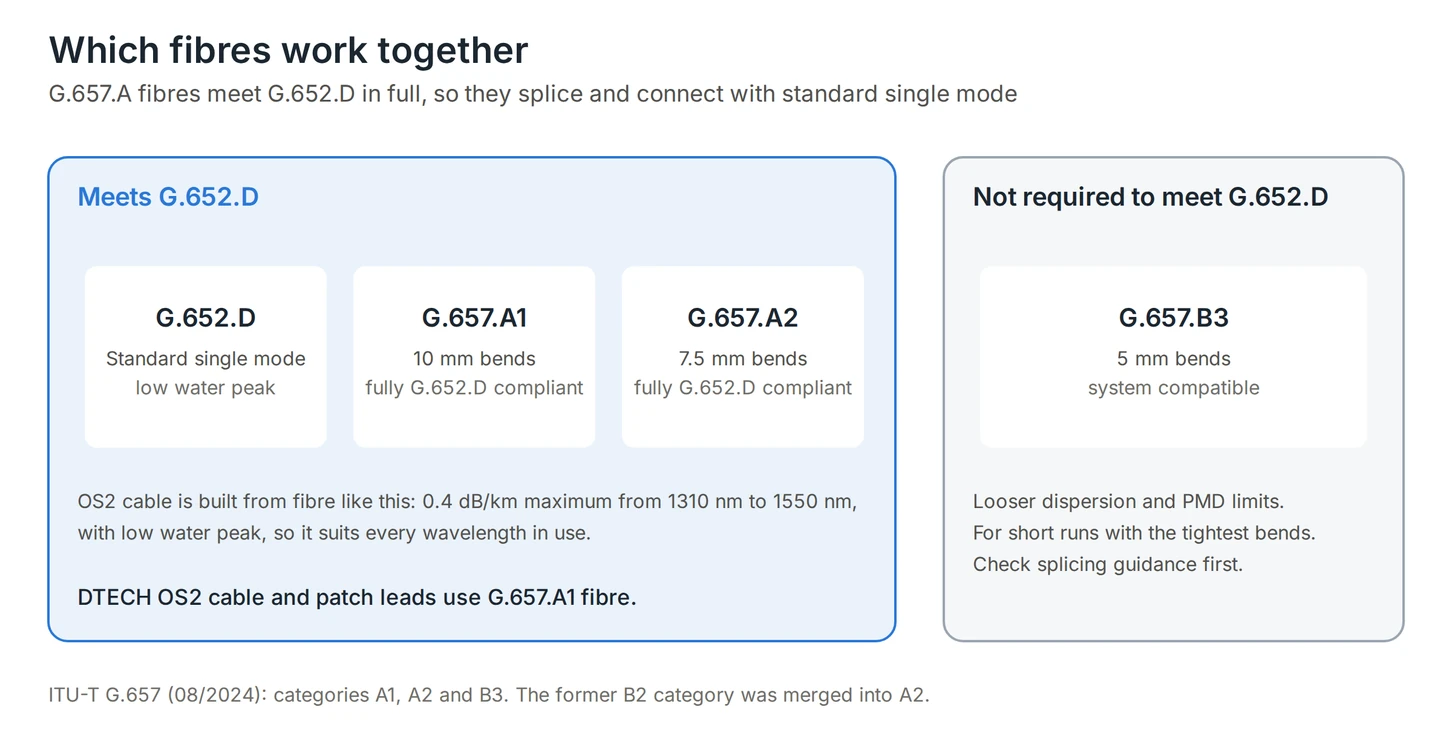
Yes, for the A categories. G.657.A1 and A2 fully meet the G.652.D recommendation, including its mode field diameter, so they splice and connect to standard single mode fibre with no special treatment.
G.657.B3 isn’t required to meet G.652.D. Its chromatic dispersion and PMD limits are looser, though it’s specified as system compatible with G.652.D. Check the manufacturer’s splicing guidance before joining it to existing fibre. Older stock labelled G.657.B2 had the same bend limits as A2 but looser dispersion and PMD limits, so check whether it’s also stated as G.652.D compliant.
How G.652 and G.657 relate to OS2
OS1 and OS2 are cabling grades from ISO/IEC 11801 and EN 50173, describing the performance of cabled single mode fibre. OS2 allows a maximum of 0.4 dB/km from 1310 nm to 1550 nm and requires low water peak, so it’s built from G.652.D or G.657 fibre. OS1, the older grade, allows 1.0 dB/km; the 2017 standards replaced it with OS1a, which adds low water peak. For new installations, OS2 is the grade to specify. Single mode vs multimode covers OS2 against OM3 and OM4.
DTECH OS2 tight buffered cable and DTECH OS2 loose tube cable use G.657.A1 fibre with attenuation of 0.4 dB/km at 1310 nm and 0.3 dB/km at 1550 nm, and DTECH OS2 patch leads use the same G.657.A1 fibre. DTECH pre-terminated OS2 cable is UK manufactured, 100% factory tested and made to order.
What about multimode?
ITU-T doesn’t cover multimode fibre in the same way; multimode grades OM3, OM4 and OM5 come from ISO/IEC 11801 and IEC 60793-2-10. Bend-insensitive multimode fibre exists too, and is backward compatible with standard multimode of the same grade. OM4 vs OM5 compares the multimode grades.
Frequently asked questions
What is G.652.D fibre?
Standard single mode fibre to ITU-T G.652 category D, with low water peak, so it works across all wavelengths from about 1260 nm to 1625 nm.
What is the difference between G.657.A1 and G.657.A2?
A1 is specified down to a 10 mm bend radius and A2 down to 7.5 mm. Both fully meet G.652.D.
Can G.657.A1 be spliced to G.652.D?
Yes. G.657.A1 fully meets G.652.D, so it splices and connects to standard single mode fibre normally.
Is OS2 the same as G.652.D?
Not exactly. OS2 is a cabling grade for installed fibre performance; G.652.D and G.657 are fibre specifications. OS2 cable is built from G.652.D or G.657 fibre.
Does bend-insensitive fibre mean I can ignore bend radius?
No. The fibre tolerates tight bends, but the cable has its own minimum bend radius, usually much larger, to protect its construction.
Summary
G.652.D is standard low water peak single mode fibre. G.657 is bend-insensitive fibre, with the A categories fully compatible with G.652.D and category B3 built for the tightest bends. OS2 cable is built from either. DTECH supplies G.657.A1 OS2 fibre cable, patch leads and pre-terminated assemblies.
If you need help choosing single mode fibre, get in touch with the DTECH team.