Contamination on a connector end face is the single most common cause of poor fibre link performance — more common than a bad splice, a damaged cable, or a faulty transceiver. A speck of dust sitting directly in the path of a fibre core, roughly the size of the core itself, is enough to cause measurable signal loss or a complete link failure. The good news is that this is also one of the easiest problems to prevent: a correct cleaning and inspection routine, applied consistently, removes contamination as a cause of fibre faults almost entirely.
This guide explains why fibre connectors need cleaning, the inspect-clean-inspect method that the industry has standardised around, the correct techniques for different connector types, and the mistakes that cause more harm than the contamination they were meant to fix.
Why fibre connectors are so sensitive to contamination
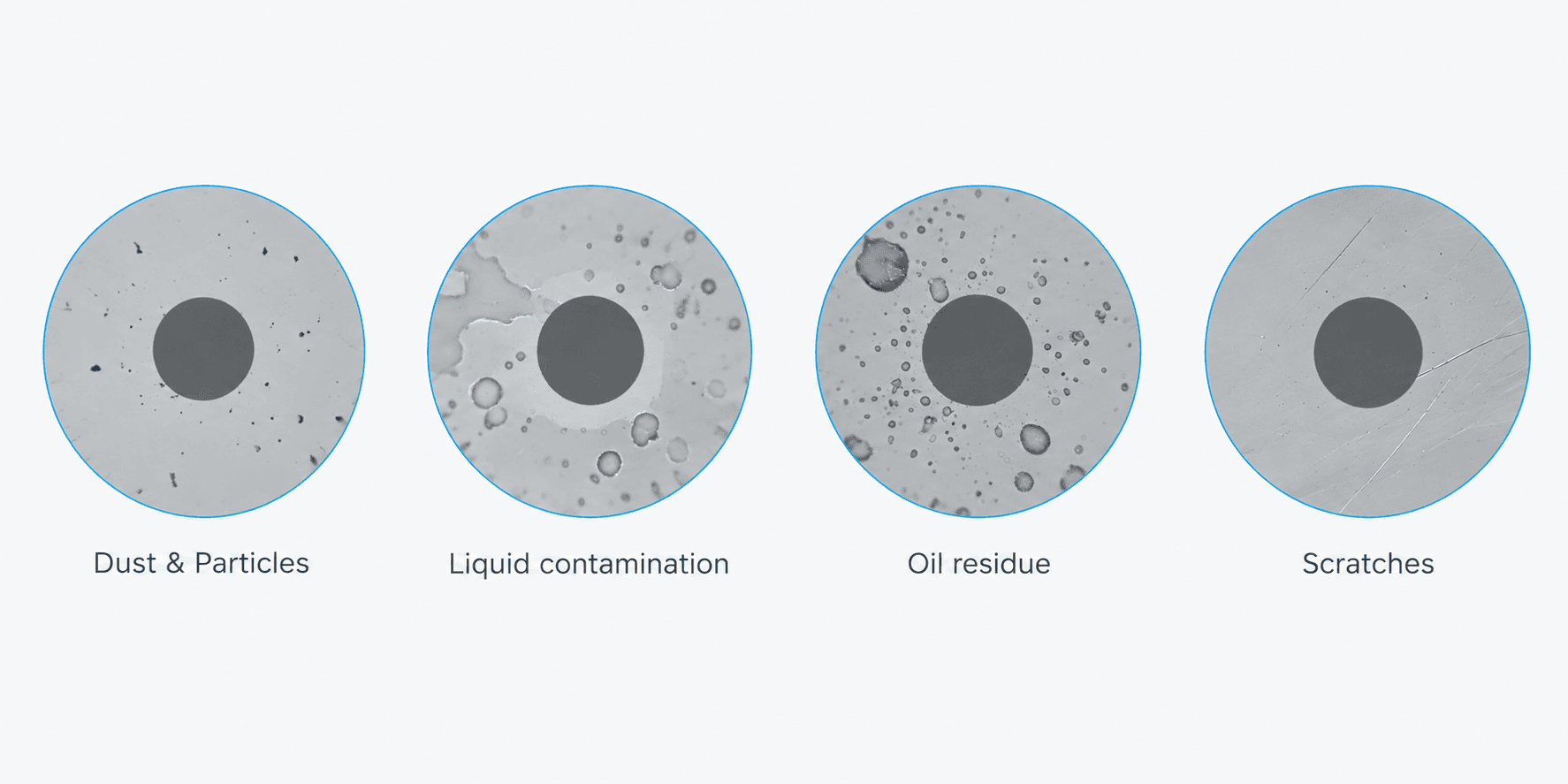
A single-mode fibre core is around 9 microns in diameter — roughly a tenth the width of a human hair. A multimode core is larger, typically 50 microns, but still tiny by any everyday standard. When two connectors are mated, the light travelling through one fibre has to pass directly across the tiny gap to the core of the next fibre. Any particle sitting on that end face — dust, a fibre from a wipe, a fingerprint, oil residue — sits directly in the path of the light, scattering it, absorbing it, or physically holding the two ferrules apart so they cannot make proper contact.
Because the core is so small, contamination that would be completely invisible to the naked eye — and often invisible even under moderate magnification — is large enough to significantly degrade or completely block the signal. A particle that looks like nothing on a desk under normal light can be directly comparable in size to the fibre core itself. This is why fibre connectors cannot be treated the way an electrical connector is: there is no equivalent tolerance for a bit of dust on an RJ45 pin.
Connectors also pick up contamination extremely easily. Dust caps protect against airborne dust while a connector is unmated, but they do not prevent contamination during handling — oil from fingertips, residue from a previous cleaning attempt, or static-attracted dust from the surrounding environment all accumulate on end faces that have not been recently cleaned and inspected, even ones that have never been mated.
The golden rule: inspect, clean, inspect
The industry-standard approach to fibre connector cleaning, aligned with the inspection criteria in IEC 61300-3-35, is a simple three-step sequence that should be followed every single time a connector is about to be mated: inspect the end face, clean only if contamination or defects are visible, then inspect again to confirm the connector is actually clean before connecting it.
This sequence matters in both directions. Skipping the first inspection and cleaning every connector automatically wastes time and — more importantly — introduces unnecessary handling risk to connectors that were already clean. Skipping the final inspection after cleaning is worse: a cleaning attempt can leave streaking, redistribute contamination rather than remove it, or introduce new lint from a wipe that was not lint-free. Without the second inspection, there is no way to know whether the cleaning actually worked.
A fibre inspection microscope or video probe, offering at least 200x magnification, is the correct tool for checking the end face — visual inspection with the naked eye or a basic magnifier is not sufficient to reliably catch the scale of contamination that affects fibre performance. If a connector passes inspection first time, it should be mated without cleaning — cleaning a connector that does not need it only increases the risk of introducing a problem that was not there before.
Dry, wet, and wet-to-dry cleaning methods
There are three recognised cleaning methods, and the correct approach is to start with the least aggressive and escalate only if inspection shows contamination remains.
Dry cleaning uses a clean, lint-free wipe or a one-click cleaning tool with no fluid — effective against loose dust and light particulate contamination on an accessible end face. It is the first method to try, and for the majority of routine contamination it is sufficient on its own.
Wet cleaning uses a small amount of fibre-optic-grade cleaning fluid applied to a wipe or swab, used to dissolve oils, fingerprint residue, and film that dry cleaning cannot lift on its own. Only fibre-specific cleaning fluid — or high-purity (99%+) isopropyl alcohol where a dedicated fluid is not available — should be used. Anything else risks leaving a residue that is worse than the original contamination.
Wet-to-dry cleaning combines both: a small amount of fluid is applied to loosen stubborn contamination, and the connector is then immediately wiped onto a dry section of the same or a fresh wipe so that no fluid residue is left behind. This is widely regarded as the most reliable method for anything beyond light dust, and it is the technique most cleaning tool manufacturers design their products around. The key discipline across all three methods is the same: never re-use the same section of a wipe, swab, or cleaning tape on more than one pass — doing so simply redistributes the contamination that has already been picked up rather than removing it.
Cleaning connectors, adaptors, and ports
A complete cleaning routine covers more than just the male connector end face. Bulkheads, adaptors, and the ports on active equipment and test instruments are just as prone to contamination and are more frequently overlooked, simply because they are less visible and harder to inspect directly.
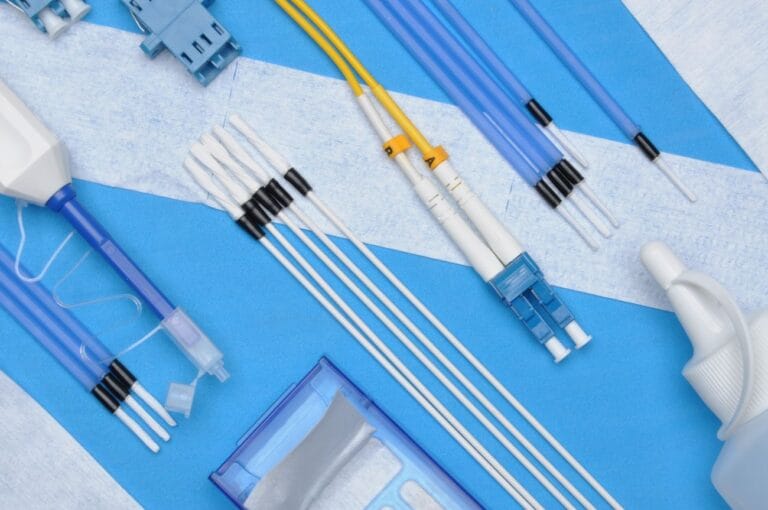
For simplex and duplex connectors — LC and SC being the most common in structured cabling and data centre work — a one-click cleaning tool is the standard approach. The connector ferrule is inserted into the corresponding size port on the tool, which advances a fresh section of cleaning fabric over a spring-loaded tip with each click, applying a controlled cleaning motion without the variability of manual wiping. Click cleaners are available matched to specific connector ferrule sizes — 1.25mm for LC, 2.5mm for SC — and using the correct size matters for a consistent, effective clean.
For bulkheads, adaptors, and recessed ports — including the ports on patch panels, media converters, and test equipment — cleaning sticks or swabs sized to the connector geometry are used to reach and clean the internal alignment sleeve without damaging the connector interface. Many one-click tools also have a fine tip designed specifically for this purpose, inserted directly into the port rather than used on an exposed connector end. MPO and other multi-fibre connectors require dedicated MPO-specific cleaning tools, since standard single-fibre cleaners cannot properly address the wider, multi-core ferrule face, and some MPO cleaners also address the alignment pins that a standard tool cannot reach.
Common mistakes that cause more harm than good
A number of well-intentioned habits actively make fibre contamination problems worse rather than better, and they are worth flagging explicitly because they are common on site.
Skipping inspection entirely and cleaning “just in case” increases handling of connectors that did not need it, raising the chance of introducing a scratch, static charge, or new contamination during a cleaning pass that was unnecessary in the first place. Inspection should always come before a cleaning decision is made, not after.
Using the wrong solvent — household isopropyl alcohol of uncertain purity, or any non-fibre-rated cleaning fluid — can leave residue, evaporate unevenly, or contain additives that are not present in fibre-optic-grade cleaning fluid, all of which can leave the end face worse than before cleaning began.
Re-using the same section of a wipe or cleaning tape on more than one connector, or more than one pass on the same connector, simply moves contamination around rather than removing it — the exact opposite of the intended effect.
Blowing on the connector or using uncontrolled compressed air as a substitute for proper cleaning is unreliable and risks introducing moisture or redistributing particles rather than removing them. Non-contact air cleaning has a limited, controlled place in the overall process but should never be relied on as the sole method.
Leaving a connector unmated without a dust cap, even for a short period, allows airborne dust and static-attracted particles to settle on the end face — meaning even a connector that has never been used can arrive at final termination already contaminated if caps were left off during handling and storage.
Why this matters for OM4 and OS2 loss budgets
The reason connector contamination matters so much in practice is that it directly affects the insertion loss and return loss figures that determine whether a fibre link will actually work at the speed it is designed for. A single contaminated connector can add far more loss than a well-executed splice, a length of correctly specified cable, or a quality factory-terminated patch lead ever would — turning a link that should comfortably pass into one that fails certification or performs unreliably under load.
This is particularly relevant on shorter OM4 backbone runs, where connector loss is typically the dominant contributor to total link loss rather than fibre attenuation itself — meaning a contaminated connector on a short run can have a proportionally larger impact than the same contamination would on a longer OS2 run where fibre attenuation makes up a bigger share of the loss budget. Whatever the fibre type, a properly cleaned and inspected connector is a precondition for the loss figures a quality patch lead or bulk cable is actually capable of delivering — not an optional extra step.
Frequently asked questions
Do I need to clean a brand new connector straight out of the packet?
It is good practice to inspect it, even if a cleaning pass is not always necessary. Factory-terminated connectors — including patch leads and pigtails — are polished and packaged under controlled conditions, but handling during packing, transit, and storage can still introduce contamination before the connector is opened. The inspect-clean-inspect sequence should be applied to every connector before it is mated, new or otherwise — if a fresh connector passes inspection immediately, no cleaning is needed, but the inspection step should never be skipped on the assumption that “new” means “clean.”
Can I use standard isopropyl alcohol wipes to clean fibre connectors?
High-purity isopropyl alcohol (99%+ electronic grade) can be used in some cleaning workflows, but dedicated fibre-optic cleaning fluids are generally preferred because they are formulated specifically to evaporate cleanly without residue. Standard household IPA, hand sanitiser, or general-purpose cleaning wipes are not appropriate — they are frequently a lower purity grade or contain additives such as fragrance or moisturiser that leave a film on the end face, which is itself a form of contamination.
How do I know if my cleaning actually worked?
The only reliable way is to re-inspect the end face with a fibre inspection microscope or video probe after cleaning, before mating the connector. Visual assessment with the naked eye is not sufficient — contamination at the scale that affects a fibre core is often below what is visible without magnification. This is why the “inspect” step appears both before and after cleaning in the standard sequence: the first inspection determines whether cleaning is needed, and the second confirms it actually worked.
Do MPO connectors need a different cleaning approach?
Yes. MPO and other multi-fibre connectors have a wider ferrule with multiple fibre cores arranged in a row, along with alignment pins for precise mating. A standard single-fibre click cleaner or wipe cannot properly clean this geometry. Dedicated MPO cleaning tools are designed to address the full width of the ferrule and, in many cases, the alignment pins as well — using a standard LC or SC cleaner on an MPO connector will not adequately clean it and may not reach all of the individual fibre positions.
Should I clean a connector that has never been used?
Yes, if it fails inspection — an unused connector is not automatically a clean one. Dust caps protect against large airborne particles but do not create a sealed, contamination-free environment, and handling during storage, transport, or simply sitting in a drawer for an extended period can introduce contamination even without the connector ever being mated. Always inspect before mating, regardless of whether the connector has been used before.
Summary
Contamination on the connector end face is the leading cause of fibre link performance problems — more common than damaged fibre, a poor splice, or faulty active equipment. The inspect-clean-inspect sequence, aligned with IEC 61300-3-35 inspection criteria, is the standard and reliable approach: inspect the end face under magnification, clean only if contamination is found, then inspect again to confirm the connector is actually clean before mating. Dry cleaning is the first method to try, escalating to wet or wet-to-dry cleaning for stubborn oils and film. Bulkheads, adaptors, and equipment ports need the same attention as exposed connectors, and MPO connectors require dedicated cleaning tools. Applied consistently, this routine removes contamination as a cause of fibre faults almost entirely — protecting the insertion loss and return loss performance that a correctly specified OM4 or OS2 link depends on.
If you need help specifying fibre patch leads, pigtails, or adaptors for your installation, get in touch with the DTECH team — we supply OM4 and OS2 fibre cable, patch leads, and pigtails to installers and IT teams across the UK, Europe, and the Middle East.