Armoured fibre optic cable adds a metal protective layer beneath the outer jacket, giving it resistance to crushing, rodent damage, and mechanical impact that standard unarmoured cable cannot offer. It costs more, weighs more, and is more work to terminate — so the decision to specify it should be based on what the installation route actually exposes the cable to, not applied as a blanket precaution or skipped to save cost on a route where it is genuinely needed.
This guide explains what armoured fibre actually is, the difference between the two main armour types, when armoured cable is worth the extra cost, and how DTECH’s CST armoured range covers the OM4 and OS2 routes that need it — as bulk cable or as a complete pre-terminated assembly.
What armoured fibre cable actually is
Unarmoured fibre cable relies on its outer jacket and internal strength members — typically aramid yarn — for mechanical protection. This is entirely adequate for the great majority of fibre routes: inside a building, in cable tray, in conduit, or anywhere the cable is not exposed to direct crushing forces, sharp impact, or rodent activity. It is lighter, more flexible, and cheaper than armoured cable, and it is the correct choice for internal backbone and campus routes that run inside protected containment.
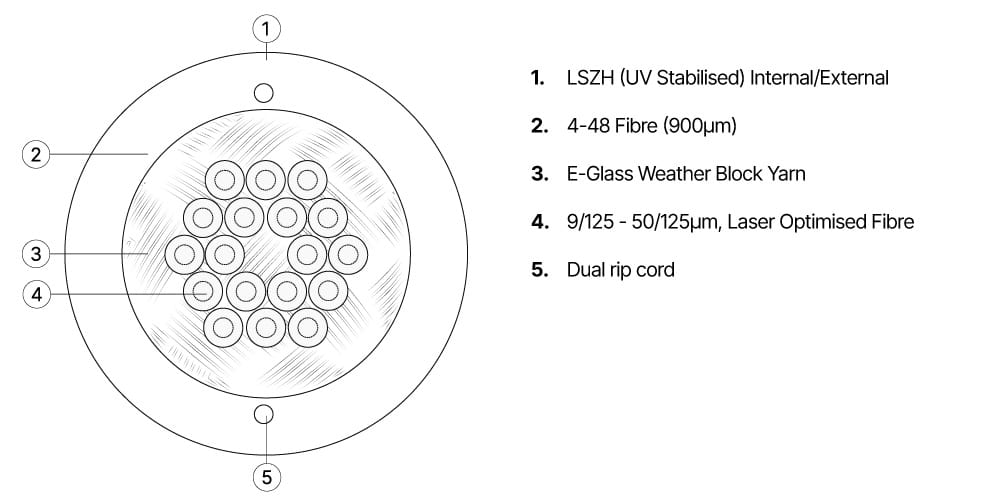
Cross-section of a standard tight buffered cable — no armour layer, just jacket and strength members
Armoured fibre cable adds a metal layer between the cable core and the outer jacket, specifically to resist the kind of physical threats an unarmoured jacket cannot withstand on its own. There are two main armour types in commercial use, and they are built for different jobs — understanding the difference is the key to specifying correctly rather than defaulting to “armoured” as a generic upgrade.
CST vs interlocking armour — two different jobs
Corrugated steel tape (CST) armour is a thin steel ribbon, corrugated for flexibility, wrapped longitudinally around the cable core and sealed beneath the outer jacket. The corrugation is what gives CST armour its practical pulling flexibility — a flat, uncorrugated steel tape would be rigid and difficult to route around bends, but the corrugated profile flexes with the cable during installation while still delivering high crush resistance once installed, with independent test data putting CST crush resistance up to 1,500N/100mm. CST is the standard armour type for direct burial, duct installation, and outdoor routes where rodent activity and soil or duct crushing forces are the primary risks — it is the default armour construction for direct-buried fibre in commercial and telecoms outside-plant installations.
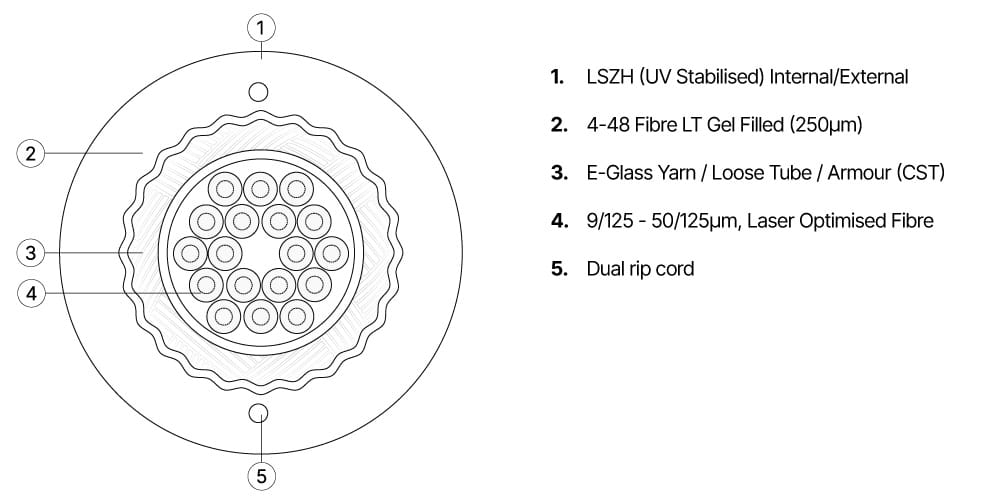
Cross-section of a CST armoured loose tube cable — the corrugated steel tape sits between the gel-filled tube and the outer jacket
Interlocking armour — typically aluminium, helically wound in an interlocking spiral around the cable core — takes a different approach. It is lighter and considerably more flexible than CST, making it easier to route through tight indoor spaces, ceiling voids, and areas requiring frequent reconfiguration, such as data centres and commercial office fit-outs. It provides good crush and impact resistance for indoor and indoor/outdoor environments but is not generally specified for direct burial, where CST’s rodent and moisture-sealed construction is the better fit. In short: CST for outdoor, buried, and duct routes; interlocking for indoor and indoor/outdoor routes where flexibility and ease of routing matter more than maximum crush resistance.
What armour actually protects against
The case for armoured cable rests on three specific risks that unarmoured cable is genuinely vulnerable to.
Rodent damage. Rodents will gnaw through unarmoured fibre jackets — this is one of the most common causes of fibre outages on buried and exposed outdoor routes, and it is not a theoretical risk; it is a routine, documented failure mode for unprotected cable in the ground or in accessible ducts. A metal armour layer, whether CST or interlocking, is what stops a rodent getting through to the fibres.
Crush resistance. Independent comparative data shows armoured cable delivering roughly double the crush resistance of unarmoured cable of equivalent construction — a meaningful difference on any route where the cable could be compressed by ground settlement, vehicle loading over a shallow burial, or being trodden on or knocked in a busy plant room or warehouse floor.
Direct burial without conduit. Unarmoured cable is not rated for direct burial — it needs a protective duct. Armoured cable, particularly CST construction with a water-blocking gel-filled loose tube, is designed to be buried directly in the ground without conduit, which can significantly simplify and reduce the cost of an underground route where excavating for a full duct run is not practical or cost-effective.
The tradeoffs — why not just always specify armoured
Armoured cable is not a free upgrade. It carries a real cost premium — typically in the region of 30–50% over equivalent unarmoured cable — and it is heavier, generally 50–100% heavier than the unarmoured equivalent, which matters on longer pulls and where cable weight affects containment loading or pulling tension limits. Some manufacturers also specify a larger minimum bend radius during pulling for armoured cable versus unarmoured — commonly cited as around 20 times the cable diameter for armoured versus around 15 times for unarmoured — which needs to be accounted for at every bend and entry point on the route.
Termination is also more involved. The armour layer has to be correctly stripped back, dressed, and — where it is metallic — bonded to earth at the entrance facility, since a conductive armour can carry induced or fault currents from nearby power infrastructure or lightning strikes. This grounding requirement adds a step to termination that unarmoured cable simply does not need, and it needs to be planned into the installation rather than treated as an afterthought at the patch panel.
DTECH’s CST armoured fibre range
DTECH supplies CST armoured fibre across both OM4 multimode and OS2 single mode in loose tube construction — the correct base construction for armoured cable, since the gel-filled loose tube provides the moisture protection that complements the mechanical protection the armour adds. Both are rated for internal and external installation with an LSZH outer jacket over the steel tape armour, giving fire performance for the sections of a route that pass through occupied buildings alongside the crush and rodent protection needed on the exposed or buried sections.
The OM4 CST armoured loose tube cable is the correct specification for armoured intra-building or campus backbone runs where multimode’s distance and cost profile fits the application — a plant-to-building link across a car park, or a route through an area with known rodent activity, for example. The OS2 CST armoured loose tube cable covers the same construction for longer single-mode campus links, direct burial between buildings, or any route where OS2’s distance capability is required alongside armoured protection.
Armoured pre-terminated assemblies
Armoured cable is exactly the kind of route where pre-terminated assemblies earn their keep. A buried or externally routed armoured link is one of the more difficult and disruptive places to carry out on-site splicing — if a fault is found after the armour has been buried or sealed into a duct, remediation is significantly more costly than it would be on an internal run. Having the entire assembly factory terminated, tested, and confirmed working before it ever goes in the ground removes that risk at the point it matters most.
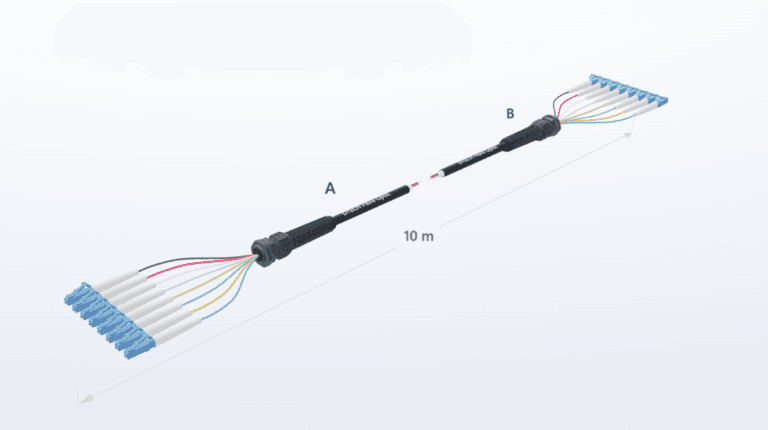
DTECH’s OS2 CST armoured pre-terminated assembly combines the corrugated steel tape armour construction with factory termination and 100% testing — exact length, connector type, and polish specified to order, manufactured in the UK and delivered in 2 to 4 days. The OM4 CST armoured pre-terminated assembly is available on the same basis. This removes on-site splicing entirely from a route that is already the hardest one to go back and fix.
Armoured vs unarmoured: when to specify each
| Route | Recommended | Why |
|---|---|---|
| Internal backbone — protected containment, cable tray, conduit | Unarmoured | No mechanical threat to justify the cost, weight, or bend radius penalty |
| Direct burial, no conduit | CST armoured | Rodent and crush protection without needing a duct run |
| Buried in duct, known rodent activity | CST armoured | Duct alone does not stop rodents; armour does |
| Exposed plant room, warehouse floor, high foot/vehicle traffic | CST or interlocking armoured | Crush and impact resistance well beyond unarmoured jacket |
| Indoor, requires frequent reconfiguration or tight routing | Interlocking armoured (or unarmoured if no threat present) | Better flexibility than CST for indoor handling |
| Campus link, above ground, protected duct | Unarmoured internal/external | Duct provides the mechanical protection; armour adds cost with limited additional benefit |
View the full DTECH fibre range: DTECH fibre optic systems
Frequently asked questions
Does armoured fibre cable need to be grounded?
Yes, where the armour is metallic — CST or interlocking steel/aluminium armour is electrically conductive and can carry induced currents from nearby power infrastructure or lightning strikes, so it must be bonded to the building’s earthing system at the entrance facility. This is a standard part of a correctly installed armoured fibre termination and needs to be planned into the installation. All-dielectric armoured constructions using fibreglass rod or aramid yarn instead of metal do not require grounding, though they also do not offer the same level of crush and rodent protection as metallic armour.
Can armoured cable be direct buried without conduit?
Yes — this is one of CST armoured cable’s primary applications. The gel-filled loose tube construction combined with the corrugated steel tape armour and outer jacket provides sufficient mechanical and moisture protection for direct burial without needing a protective duct, which can simplify and reduce the cost of underground routes. Unarmoured cable is not rated for direct burial and always requires conduit if run underground.
Is CST or interlocking armour better?
Neither is universally better — they suit different routes. CST offers higher crush resistance and is the standard choice for outdoor, buried, and duct installations where maximum mechanical protection matters most. Interlocking armour is lighter and considerably more flexible, making it the better choice for indoor routes, tight spaces, and installations that may need reconfiguring, where CST’s stiffness would be a genuine handling disadvantage.
Why does armoured cable need a larger bend radius during installation?
The metal armour layer is stiffer than the aramid strength members in unarmoured cable, and bending it too tightly during a pull can permanently deform the armour and, in turn, stress the fibres inside it. Some manufacturers specify a minimum installation bend radius of around 20 times the cable’s outer diameter for armoured cable, compared to around 15 times for unarmoured — this needs to be factored into route planning at every corner, conduit entry, and cabinet the cable passes through.
Is it worth specifying armoured cable “just in case” on a route with no obvious risk?
Generally no. Armoured cable carries a real cost premium, added weight, a larger required bend radius, and additional termination and grounding work — none of which are justified on a route that runs through protected internal containment or a properly ducted external path with no rodent or crush exposure. Armoured cable earns its cost on routes with a specific, identifiable mechanical threat: direct burial, known rodent activity, exposed plant room floors, or heavy foot and vehicle traffic. Specifying it as a blanket default adds cost without a corresponding benefit on routes that do not need it.
Summary
Armoured fibre cable adds a metal protective layer — corrugated steel tape for outdoor, buried, and duct routes, or lighter interlocking armour for indoor installations — giving significantly better crush and rodent resistance than unarmoured cable at the cost of extra weight, a larger bend radius, higher price, and more involved termination and earthing. The decision to specify it should be driven by the actual mechanical threat the route presents: direct burial, rodent activity, or exposed high-traffic areas justify armoured; protected internal containment and properly ducted external routes generally do not. DTECH supplies CST armoured OM4 and OS2 fibre as bulk loose tube cable and as complete pre-terminated assemblies, UK manufactured and delivered in 2 to 4 days, removing the on-site splicing risk from exactly the routes where a fault is hardest to fix after installation.
If you need help specifying armoured fibre for a direct burial, industrial, or high-risk route, get in touch with the DTECH team — we supply CST armoured OM4 and OS2 fibre cable and pre-terminated assemblies to installers and IT teams across the UK, Europe, and the Middle East.