How far should data cable be kept from power cable? The honest answer is that it depends: on how well screened the data cable is, what’s between the two, and how much power is running alongside. The figures come from BS EN 50174-2, the installation planning standard for cabling inside buildings, with a separate safety minimum from BS 6701 and BS 7671.
This guide covers what the BS EN 50174 series asks for, how to work out the separation from power, and where BS 6701 fits.
The BS EN 50174 series
| Standard | Covers |
|---|---|
| BS EN 50174-1:2018+A1:2020 | Installation specification, quality assurance, documentation and administration |
| BS EN 50174-2:2018 | Installation planning and practices inside buildings, copper and fibre |
| BS EN 50174-3:2013+A1:2017 | Installation planning and practices outside buildings |
BS EN 50173 says what the finished cabling must achieve; BS EN 50174 says how to plan and install it so that it does. Part 2 covers pathways and spaces, bend radius, containment fill, fire stopping, bundle sizes for remote powering such as PoE, and separation from power and other sources of interference. A new edition of Part 2 is in development.
Separation from power under BS EN 50174-2
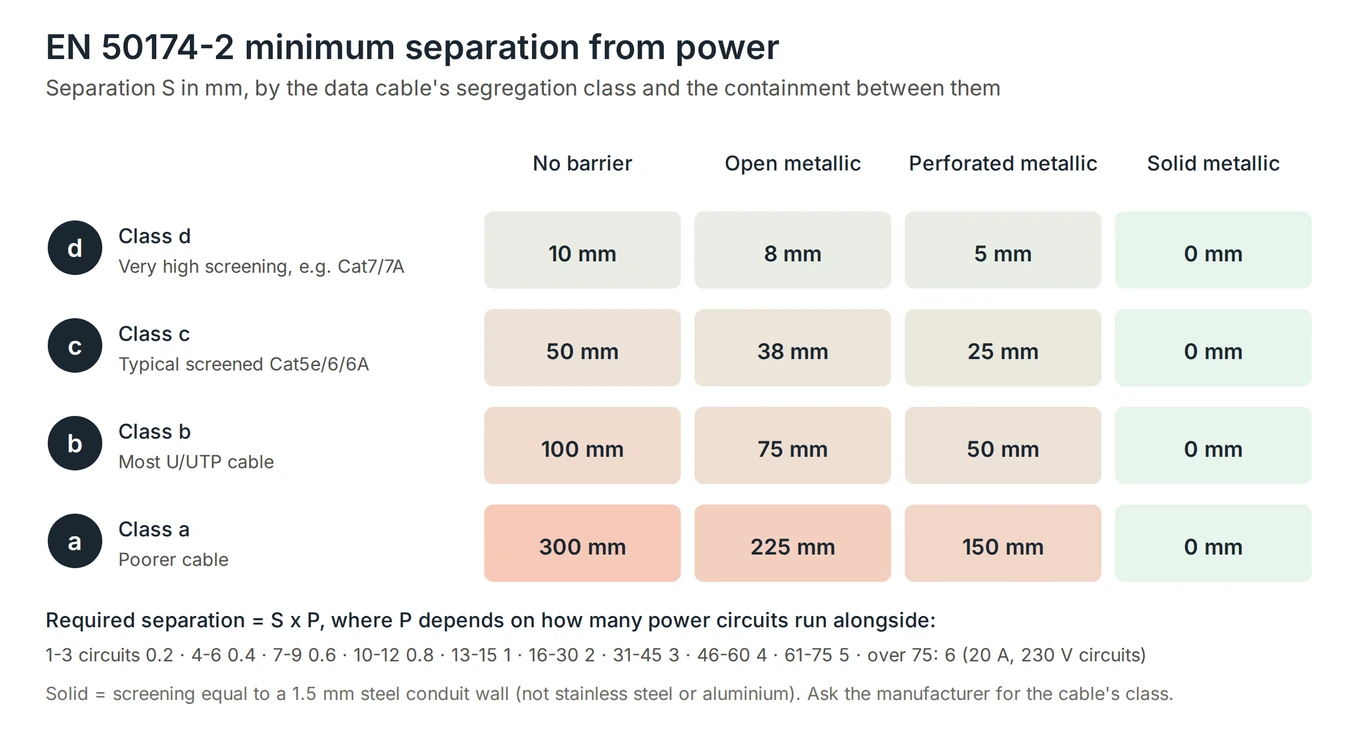
BS EN 50174-2 works in three steps.
- Find the segregation class of the data cable. It runs from d, the best, to a. Screened cable is classed by its measured screening (coupling attenuation), unscreened cable by its balance. Most U/UTP is class b, and screened Cat5e, Cat6 and Cat6A cables are typically class c. Class d needs very high screening (coupling attenuation of 80 dB or more), typical of Cat7 and Cat7A cable. If the datasheet doesn’t state the class, ask the manufacturer.
- Read the separation S from the table for that class and the containment between the two cables: no barrier, open metallic, perforated metallic or solid metallic.
- Multiply by the power factor P for the number of power circuits alongside, counted as 20 A, 230 V single-phase circuits.
| Power circuits | 1-3 | 4-6 | 7-9 | 10-12 | 13-15 | 16-30 | 31-45 | 46-60 | 61-75 | Over 75 |
|---|---|---|---|---|---|---|---|---|---|---|
| Factor P | 0.2 | 0.4 | 0.6 | 0.8 | 1.0 | 2 | 3 | 4 | 5 | 6 |
A three-phase circuit counts as three, and higher currents count in multiples of 20 A. Solid metallic containment brings the separation to zero, provided its screening is equivalent to steel conduit with a 1.5 mm wall. Stainless steel and aluminium don’t qualify. For perforated containment, the top of the cables must be at least 10 mm below the top of the barrier.
A worked example
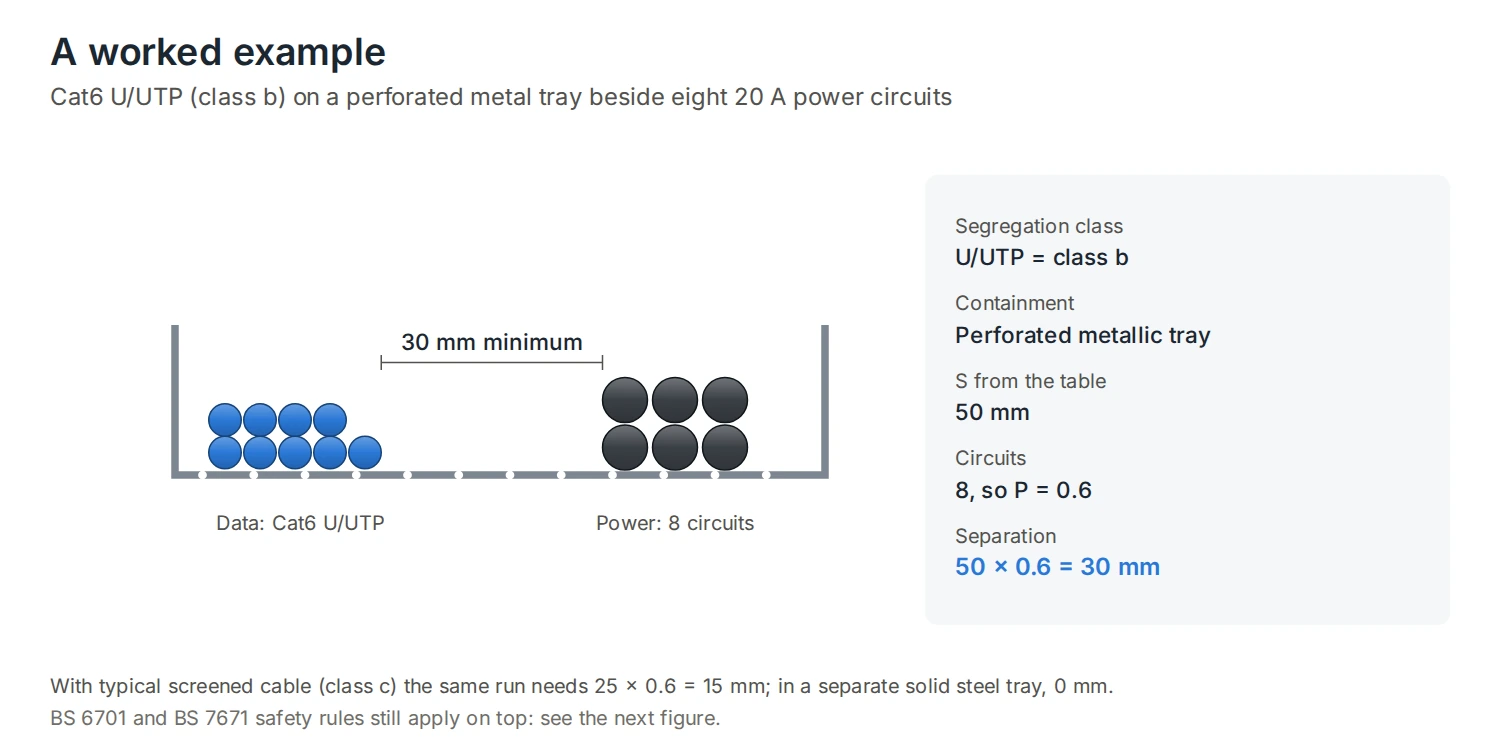
Take Cat6 U/UTP, class b, on a perforated metal tray beside eight power circuits. S for class b on perforated metallic containment is 50 mm, and P for eight circuits is 0.6, so the minimum separation is 30 mm. With a class c screened cable, the same run needs 25 x 0.6 = 15 mm. In separate solid steel containment with screening equivalent to 1.5 mm steel conduit, it needs none.
The standard also sets distances from other sources of interference. Fluorescent and neon lamps, for example, need 130 mm. Other noisy equipment has distances of its own, so check the standard for what’s on your site.
BS 6701 and BS 7671: separation for safety
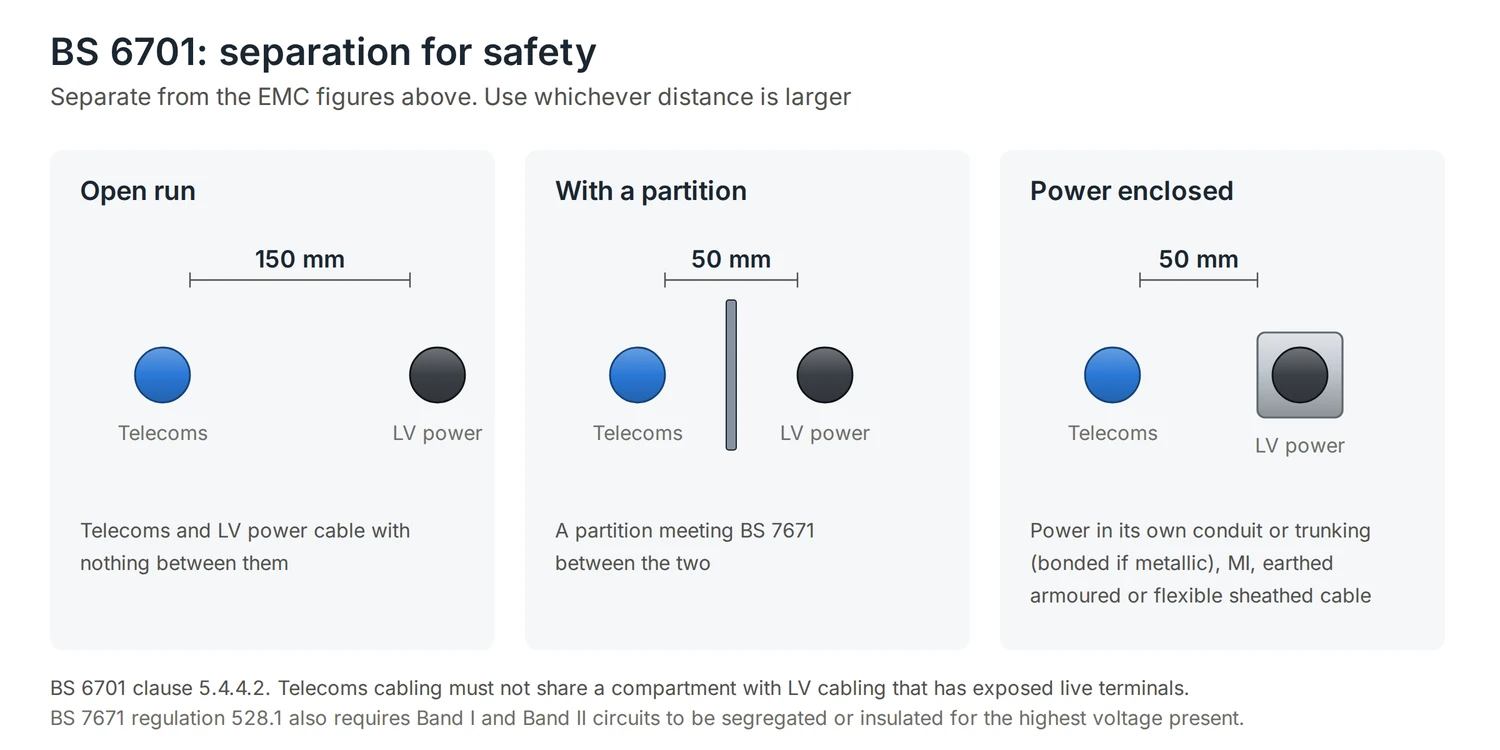
BS EN 50174-2 is about interference. Electrical safety is a separate question. BS 6701, the British Standard for installing and maintaining telecoms cabling, refers to BS EN 50174-2 for interference and adds a safety minimum between telecoms cable and low-voltage power cable:
- 150 mm where nothing separates them.
- 50 mm where there’s a partition that meets BS 7671 between them.
- 50 mm where the power cable is in its own conduit or trunking (bonded to BS 7671 if metallic), is MI or earthed armoured cable, or is a flexible insulated and sheathed cable such as an equipment lead in a cabinet.
Telecoms cables must not share a compartment with LV cabling that has exposed live terminals. BS 7671, regulation 528.1, also requires telecoms (Band I) and mains (Band II) circuits not to share a wiring system unless they’re segregated or every cable is insulated for the highest voltage present. Where the EMC and safety figures differ, use the larger.
Other planning points in BS EN 50174-2
- Bend radius: follow the cable datasheet, both during installation and once installed.
- Containment fill: leave room for future cables and avoid crushing the bottom layer.
- Bundle size and PoE: large bundles of powered cables run warmer, so the standard limits bundle size for remote powering.
- Fire stopping: restore fire barriers wherever cabling passes through them.
- Documentation: BS EN 50174-1 sets out the records, labelling and quality plan to hand over with the test results.
Choosing cable with separation in mind
Where space is tight beside power, a better segregation class shrinks the separation. DTECH Cat6 U/UTP suits most office runs with normal separation. Screened cables such as Cat XG F/UTP, DTECH Cat6A U/FTP and DTECH Cat6A F/FTP are typically class c, so they can run considerably closer to power; screened systems also need correct bonding. Cable shielding explained covers the screen types.
Frequently asked questions
How far should data cable be from power cable in the UK?
It depends on the cable, the containment and the number of circuits, using BS EN 50174-2: from 0 mm in solid steel containment to well over 300 mm for poorly screened cable beside many circuits. BS 6701 also sets a safety minimum of 150 mm, or 50 mm with a partition or enclosed power cable. Use the larger figure.
Can data and power cables share a tray?
Yes, with the right separation or a divider. With a solid steel divider giving screening equivalent to 1.5 mm steel conduit, the BS EN 50174-2 separation is zero, but the BS 6701 and BS 7671 safety rules still apply.
Does screened cable need less separation?
Usually. Screened Cat6 and Cat6A are typically class c, which halves the separation compared with U/UTP. Check with the manufacturer.
Is BS 6701 a legal requirement?
No. It’s a British Standard that’s often called up in specifications and contracts. BS 7671 segregation rules apply to the electrical installation.
What is a segregation class?
A grade from a to d in BS EN 50174-2 for how well a data cable resists interference from power cables. Class d needs the least separation.
Summary
BS EN 50174-2 sets the separation between data and power from the cable’s segregation class, the containment and the number of power circuits. BS 6701 and BS 7671 add a separate safety minimum, and the larger figure wins. Better-screened cable and solid metal dividers let you run closer. DTECH supplies unscreened and screened data cable and keystones for both.
If you need help planning cable routes beside power, get in touch with the DTECH team.