Fibre optic connectors come up on every installation project, and the terminology around them trips people up more than it should. LC or SC? UPC or APC? Blue or green? The choices seem technical but the logic behind them is straightforward once the key differences are clear.
This guide covers the two decisions that come up most often: which connector type to use and which polish type to specify. Get both right and you will avoid the two most common specification mistakes in fibre installations.
LC vs SC: connector type
LC and SC are the two most widely used fibre optic connector types in commercial and enterprise installations. They perform the same function — aligning two fibre cores to allow light to pass between them — but they differ significantly in size, and that difference has practical consequences.
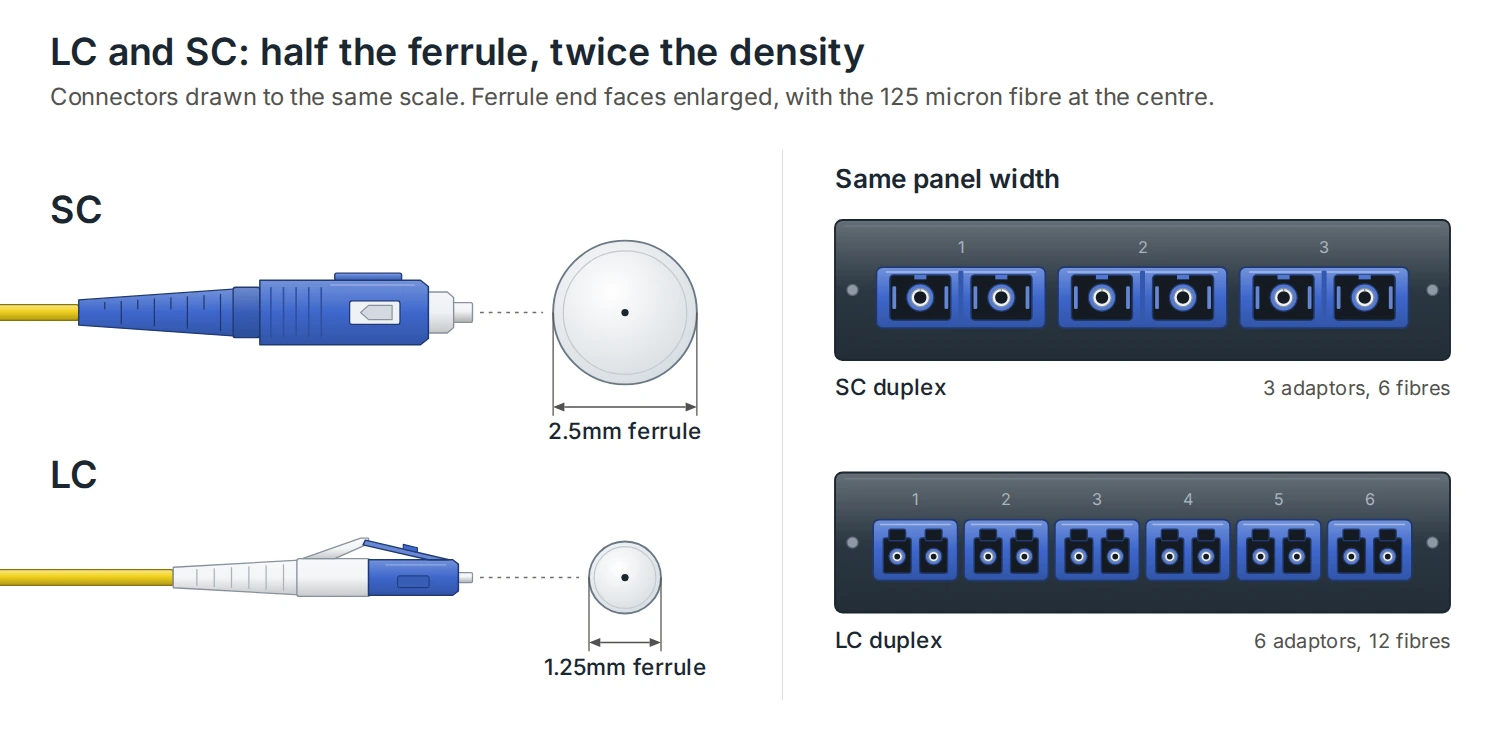
The SC connector (Subscriber Connector) was developed by NTT in the 1980s and became the dominant fibre connector through the 1990s. It has a 2.5mm ceramic ferrule and a push-pull locking mechanism — press to insert, pull to remove. It is robust, simple to use, and has a proven track record across telecommunications, GPON networks, and general fibre deployments. SC connectors are still widely installed, particularly in legacy infrastructure and passive optical networks.
The LC connector (Lucent Connector) was developed in the early 2000s as a response to the growing need for higher density. Its ferrule is 1.25mm — exactly half the diameter of the SC — which means twice as many LC ports can fit into the same panel space as SC. LC uses a latch mechanism similar to an RJ45 plug, securing with a click and releasing with a tab. It has become the dominant connector for modern enterprise networks, data centres, and any installation where port density matters.
In practice, LC is now the default specification for new structured cabling installations. SFP, SFP+, and higher-speed transceiver modules in switches and routers almost universally use LC connections, which means new network equipment will typically dictate LC at the device end regardless of what is specified elsewhere.
SC retains relevance in GPON and EPON passive optical networks, in legacy systems where the existing infrastructure is SC-terminated, and in some outdoor and access network applications. If the equipment specifies SC, use SC. If you are starting from scratch and the equipment has no specific requirement, LC is the right choice for almost all new installations.
LC vs SC: side-by-side
| SC | LC | |
|---|---|---|
| Ferrule diameter | 2.5mm | 1.25mm |
| Locking mechanism | Push-pull tab | Latch clip |
| Panel density | Lower | Twice that of SC |
| Insertion loss | 0.25–0.5dB | 0.25–0.5dB |
| Typical use | GPON, legacy, access networks | Enterprise, data centre, SFP equipment |
| New installations | Where equipment requires it | Default recommendation |
View our range of fibre optic products: Fibre optic patch leads·Fibre optic adaptors
UPC vs APC: polish type
Once the connector type is decided, the next choice is the polish type — the way the end face of the ferrule is finished. This is where UPC and APC come in. Both apply to single mode fibre connectors. The distinction matters because the polish type directly affects how much light reflects back toward the source when two connectors are mated — a characteristic called return loss.
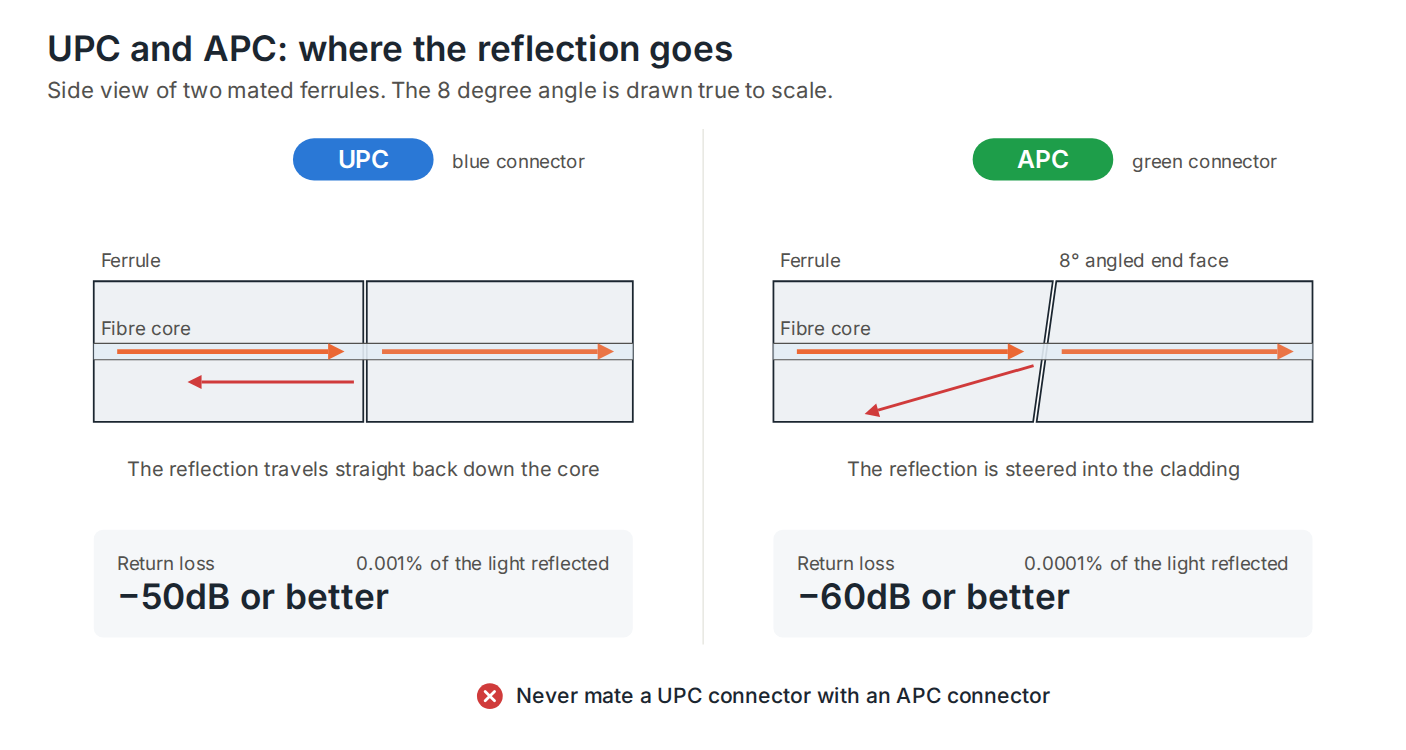
Return loss is expressed as a negative dB value. The more negative the number, the less light is reflected and the better the performance. A return loss of -60dB means only 0.0001% of light is reflected — effectively negligible. At -50dB it is 0.001%, which is still acceptable for most digital applications but becomes a concern in systems sensitive to back reflection.
UPC (Ultra Physical Contact) connectors have a slightly domed end face — not perfectly flat, but polished with a gentle curvature that ensures tight contact between two mated ferrules. This minimises the air gap and reduces back reflection. UPC connectors are colour-coded blue and achieve a return loss of -50dB or better. They are the standard choice for the majority of enterprise fibre installations — data centres, structured cabling, LAN environments, digital telephony, and AV distribution.
APC (Angled Physical Contact) connectors have their end face polished at an 8-degree angle. That angle means any reflected light is directed into the cladding of the fibre rather than straight back toward the source. The result is a return loss of -60dB or better — a significant improvement over UPC. APC connectors are colour-coded green and are the correct specification for applications that are particularly sensitive to back reflection.
The applications where APC is typically required include passive optical networks (GPON, EPON), fibre-to-the-premises (FTTP/FTTH) connections, RF video signal transmission, CATV networks, and wavelength division multiplexing (WDM) systems. If your installation involves any of these, APC is the correct specification. For general enterprise structured cabling and data centre applications with standard digital data, UPC is appropriate.
UPC vs APC: side-by-side
| UPC | APC | |
|---|---|---|
| End face angle | 0° (slightly domed) | 8° angled |
| Return loss | -50dB or better | -60dB or better |
| Colour code | Blue | Green |
| Fibre type | Single mode and multimode | Primarily single mode |
| Can mate with each other? | No — never mate UPC with APC | |
| Typical use | Enterprise LAN, data centres, digital telecoms | GPON, FTTP, CATV, RF video, WDM |
The one rule you cannot break
UPC and APC connectors must never be mated together. Their end face geometries are incompatible — when an angled APC face meets a flat UPC face, the fibre cores cannot align properly. The result is severe signal loss and, in some cases, physical damage to both connectors. This is not a recoverable situation.
The colour coding exists specifically to prevent this. Green is always APC. Blue is always UPC. If an adapter or patch panel port is green, only green connectors should be plugged into it. The same applies in reverse. On any installation where both UPC and APC connectors are present — which is common on sites with both enterprise cabling and a GPON broadband connection — labelling and separation of the two types at every termination point is essential.
Simplex vs duplex: a quick note
Both LC and SC connectors are available in simplex and duplex configurations. A simplex connector terminates a single fibre. A duplex connector holds two fibres side by side in a single housing — one for transmit, one for receive — which is how most standard data links work.
LC duplex is by far the most common format in enterprise and data centre installations, and is what most people mean when they refer to an LC patch lead. SC duplex is similarly the standard for SC applications. If ordering patch cables or specifying pre-terminated assemblies, confirm simplex or duplex before ordering — the connectors look similar at a glance but are not interchangeable.
Frequently asked questions
Can I use an LC to SC patch lead to connect different equipment?
Yes. LC to SC patch leads are available as standard and are the correct solution when connecting equipment with different connector types — for example, an SC-terminated patch panel to an LC SFP port on a switch. These are hybrid cables with an LC connector on one end and an SC on the other. Ensure the polish type matches on both ends (both UPC or both APC) when ordering.
How do I identify which connector type I have installed?
Size is the quickest indicator — SC connectors are noticeably larger with a square profile, LC connectors are compact with a small latch tab. For polish type, colour is the reliable guide: green indicates APC, blue indicates UPC. If there is any doubt, the cable or connector body will have the type printed on it, and any certified installation will have a test schedule confirming the connector specification throughout.
Does the connector type affect performance?
LC and SC connectors deliver comparable insertion loss — both typically 0.25 to 0.5dB — so the connector type itself does not affect data throughput or link distance in normal circumstances. The polish type (UPC vs APC) does affect return loss, which matters in reflection-sensitive applications. In standard enterprise or data centre installations with digital data, the performance difference between UPC and APC is not operationally significant — both will perform reliably. APC becomes the correct choice when the application specifically requires it.
My ISP connection uses a green connector — does that affect my internal cabling?
This is a common situation in commercial buildings with an FTTP broadband connection. The green connector on the ISP-provided equipment is APC — standard for GPON-based fibre broadband. Your internal structured cabling will almost certainly use UPC (blue). These two systems are connected through the ISP’s optical network terminal (ONT) and are electrically and optically separate. Your internal UPC cabling is unaffected by the APC connection at the building entry point. The two should never be directly connected.
What is the difference between a patch lead and a trunk cable?
A patch lead (or patch cord) is a short, flexible cable with connectors already fitted at each end — used to make connections at patch panels, switches, and equipment ports. A trunk cable is a longer, higher-fibre-count cable used for the permanent infrastructure runs between comms rooms and distribution points. Trunk cables are typically terminated using pre-terminated assemblies with MPO connectors, or terminated on site into a patch panel. Patch leads then make the individual connections at each end. Both are essential components of a complete fibre installation and are specified separately.
Summary
For new commercial and enterprise installations, LC duplex UPC is the standard specification in most cases — it is compatible with modern switching equipment, offers high panel density, and performs reliably across all standard data applications. SC has its place in legacy systems and specific access network applications where the equipment requires it.
APC is the correct polish type for GPON, FTTP, CATV, RF video, and WDM applications where back reflection must be minimised. For everything else — enterprise structured cabling, data centre interconnects, and standard digital telecoms — UPC is the appropriate specification and the more cost-effective choice.
The one thing to get right regardless of which combination you specify: never mix UPC and APC in the same link. Green stays with green, blue stays with blue.
If you need help specifying the right connectors and patch assemblies for your installation, get in touch with the DTECH team — we supply pre-terminated fibre assemblies and bulk fibre cable to installers and IT teams across the UK, Europe, and the Middle East.