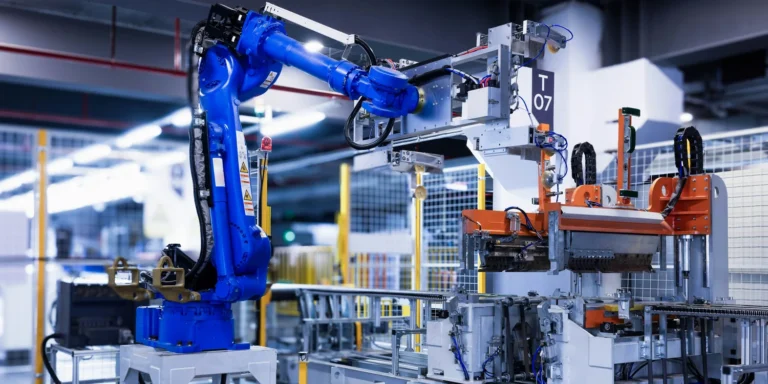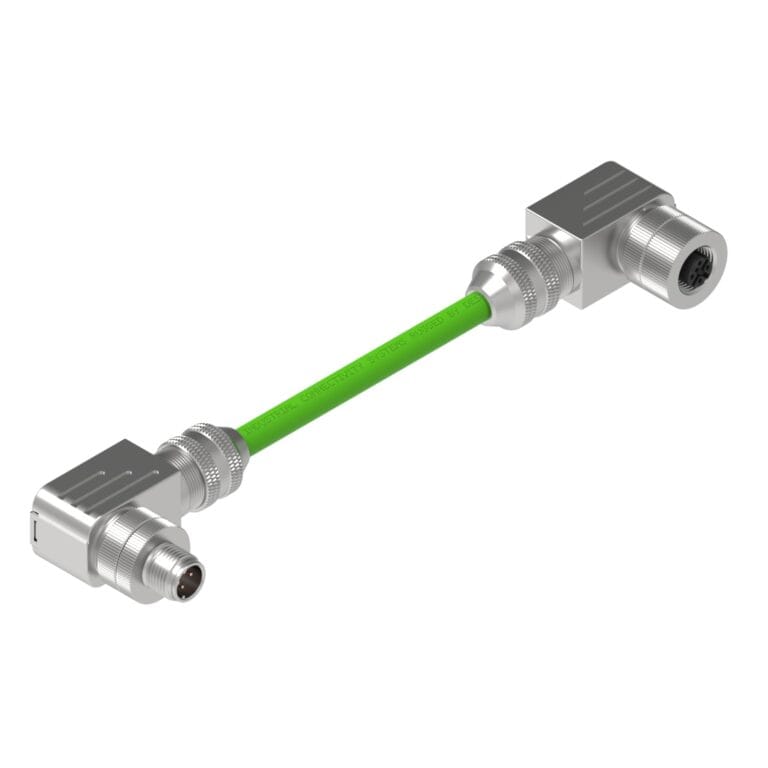
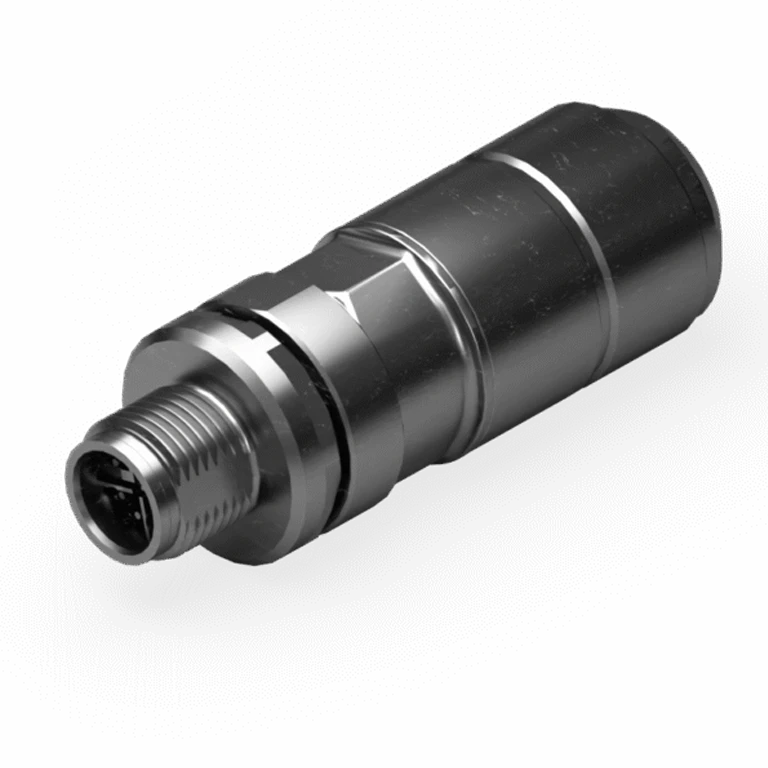
Industrial Ethernet connectivity comes down to one question before anything else: what environment is the connection actually living in? A standard RJ45 connector — the type on every office patch lead — offers no ingress protection at all. Put it on a machine tool, a robot arm, or anywhere near washdown, vibration, or dust, and it will fail. The question is not whether to use an industrial-grade connector in those environments — it is which type makes more sense for the specific application.
This guide breaks down the practical differences between industrial RJ45 connectors and M12 connectors, explains where each performs best, and helps you make the right call for your installation rather than defaulting to whichever connector the datasheet happens to mention first.
Why a standard RJ45 is not enough in industrial environments
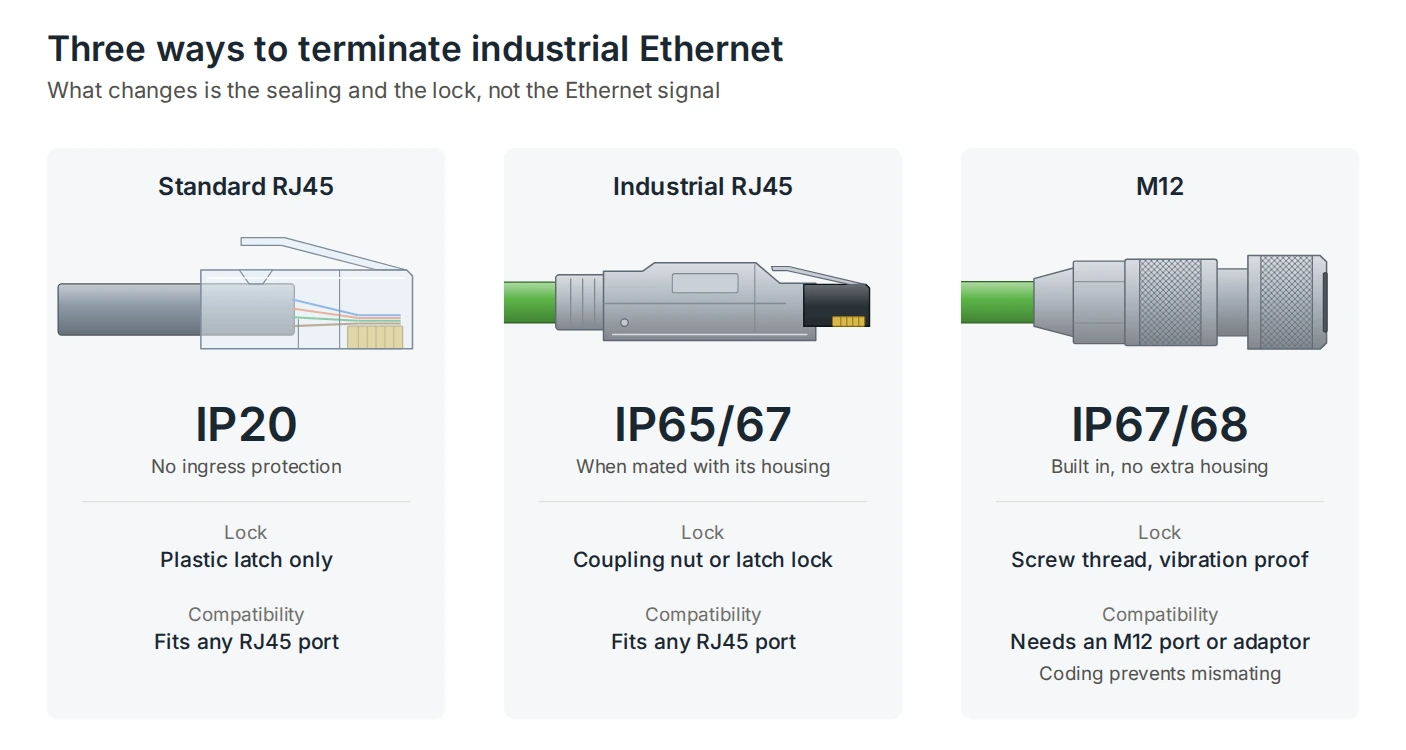
The standard RJ45 connector — defined by IEC 60603-7 — was designed for structured cabling in controlled environments: offices, server rooms, data centres. Its plastic latch clicks into a port and relies on nothing more than that clip to hold it in place. There is no seal, no locking mechanism, and no protection against dust, moisture, oil, or vibration.
In a factory environment, that becomes a problem quickly. Vibration loosens the latch. Dust accumulates in the port. Coolant, oil, or cleaning fluids find their way into the connection. The result is intermittent faults, network dropouts, and in some cases complete link failure — often at the worst possible moment in a production cycle.
This is why both industrial RJ45 connectors and M12 connectors exist. They solve the same fundamental problem — making Ethernet connections that survive the industrial environment — but they approach it differently, and that difference matters when choosing between them.
What is an industrial RJ45 connector?
An industrial RJ45 is a field-wireable or pre-assembled connector that uses the standard 8-pin RJ45 interface — the same pinout and mating geometry as any office patch lead — but housed in a robust metal or reinforced plastic shell with sealing gaskets and a locking mechanism that replaces the plastic clip.
The key advantage is backward compatibility. An industrial RJ45 mates with any standard RJ45 port on a switch, PLC, or network device. No adapters, no specialist transceivers, no protocol-specific wiring. The Ethernet signal is identical whether the connector is a standard office plug or a metal-shelled industrial unit rated to IP67.
Industrial RJ45 connectors are available in several forms:
- Field-wireable — terminated on site directly onto the cable. DTECH’s 8-pin industrial RJ45 connector uses a tool-free IDC termination system with a metal housing and 360-degree shielding, rated to IP67 when mated. It accepts Cat5e through Cat6A cable and terminates in the field without specialist equipment — which matters on a busy installation where speed and consistency of termination directly affect network reliability.
- Pre-assembled leads — factory-terminated to a specified length, tested before despatch, and ready to plug in. DTECH’s industrial Ethernet lead range is available in M12 X-code to RJ45, M12 D-code to RJ45, and RJ45 to RJ45 configurations — covering the most common industrial network connection requirements without on-site termination risk.
- IP-rated housing versions — the connector itself may be IP20 rated, but when used with a sealed coupling nut or IP67 housing, the mated connection achieves IP65 or IP67.
The metal housing on a quality industrial RJ45 also provides 360-degree shielding continuity — important in environments with significant electromagnetic interference (EMI) from motors, drives, and high-current equipment, where a poorly shielded connection can introduce noise into the data link.
What is an M12 connector in this context?
M12 connectors are circular industrial connectors with a 12mm screw-locking thread, designed from the outset for harsh environments. Unlike industrial RJ45 — which takes a standard connector and makes it rugged — M12 was built for industrial conditions as its primary purpose. The threaded locking mechanism creates a mechanically secure, vibration-proof connection that cannot be accidentally dislodged, and the O-ring seal achieves IP67 as a baseline without any additional housing.
For industrial Ethernet, two M12 coding types are relevant: D-code (4-pin, 100 Mbps, Cat5e) and X-code (8-pin, 10 Gbps, Cat6A). The coding physically prevents mismating with power or signal connectors on the same panel or machine — a safety feature that has no equivalent in the RJ45 world.
The trade-off is that M12 requires matching ports on both ends. A device with an M12 port needs an M12 cable. Connecting an M12 cable to a standard RJ45 switch port requires either an M12-to-RJ45 assembly or an adapter — which is a very common and practical solution, but it is an additional element in the link that needs to be accounted for.
Industrial RJ45 vs M12: side-by-side
| Industrial RJ45 | M12 (D-code / X-code) | |
|---|---|---|
| IP rating | IP65/IP67 (mated with housing) | IP67/IP68 inherent |
| Locking mechanism | Coupling nut or latch lock | Screw thread — vibration proof |
| Compatibility | Mates with any RJ45 port | Requires matching M12 port or adapter |
| Max speed | 10 Gbps (Cat6A variants) | 100 Mbps (D) / 10 Gbps (X) |
| PoE capable | Yes | Yes |
| Mismating protection | None | Physical coding prevents wrong connections |
| Field termination | Tool-free options available | Tool-free options available |
| Best for | Control cabinets, edge of network, RJ45-native equipment | On-machine, outdoor, high-vibration, wash-down |
View our range of industrial connectors and leads: Industrial RJ45 connector·Industrial Ethernet leads·M12 X-code connectors·M12 D-code connectors
Where industrial RJ45 makes more sense
Industrial RJ45 is the right choice when the equipment you are connecting has standard RJ45 ports — which is the majority of industrial switches, PLCs, HMIs, and network devices. The connection at the device end is RJ45 regardless of what you run between. Using an industrial RJ45 at both ends of the link keeps the installation consistent, avoids adapters, and maintains full compatibility with any standard network equipment.
It is also the more practical option inside control cabinets. The cabinet itself provides the environmental protection — dust exclusion, temperature control, physical security — which means the connector does not need to achieve IP67 on its own. A quality industrial RJ45 in a well-sealed cabinet is an entirely appropriate specification and significantly easier to work with than M12 in a high-density panel.
Where the network edge meets standard infrastructure — a managed switch in a machine cabinet connecting to a factory backbone, for example — industrial RJ45 allows that transition without requiring specialist cabling on the infrastructure side. Pre-assembled industrial Ethernet leads with RJ45 at both ends are stock items, quick to replace, and require no specialist termination knowledge on site.
Where M12 makes more sense
M12 is the better specification when the connection is directly on the machine rather than in a protected cabinet. Robot joints, conveyor drive units, machine vision cameras, and field-mounted sensors all represent environments where vibration, shock, coolant, and cleaning fluids are a continuous reality. The threaded locking mechanism of an M12 connector will not loosen under sustained vibration the way a latched RJ45 can, and IP67 is achieved inherently rather than relying on a correctly fitted coupling nut.
Outdoor installations and wash-down environments are also natural M12 territory. Food and beverage processing plants, outdoor machine enclosures, and agricultural equipment all involve direct water exposure — sometimes high-pressure — that requires the most reliable seal available. M12 IP67 or IP68 connectors meet those requirements without qualification.
Machine vision is the other clear M12 application. Industrial cameras using GigE Vision protocols almost universally ship with X-coded M12 ports, and the cable assemblies running from camera to switch are X-coded M12 to RJ45 as standard. There is no practical alternative to M12 in that specific application.
How most industrial installations actually work
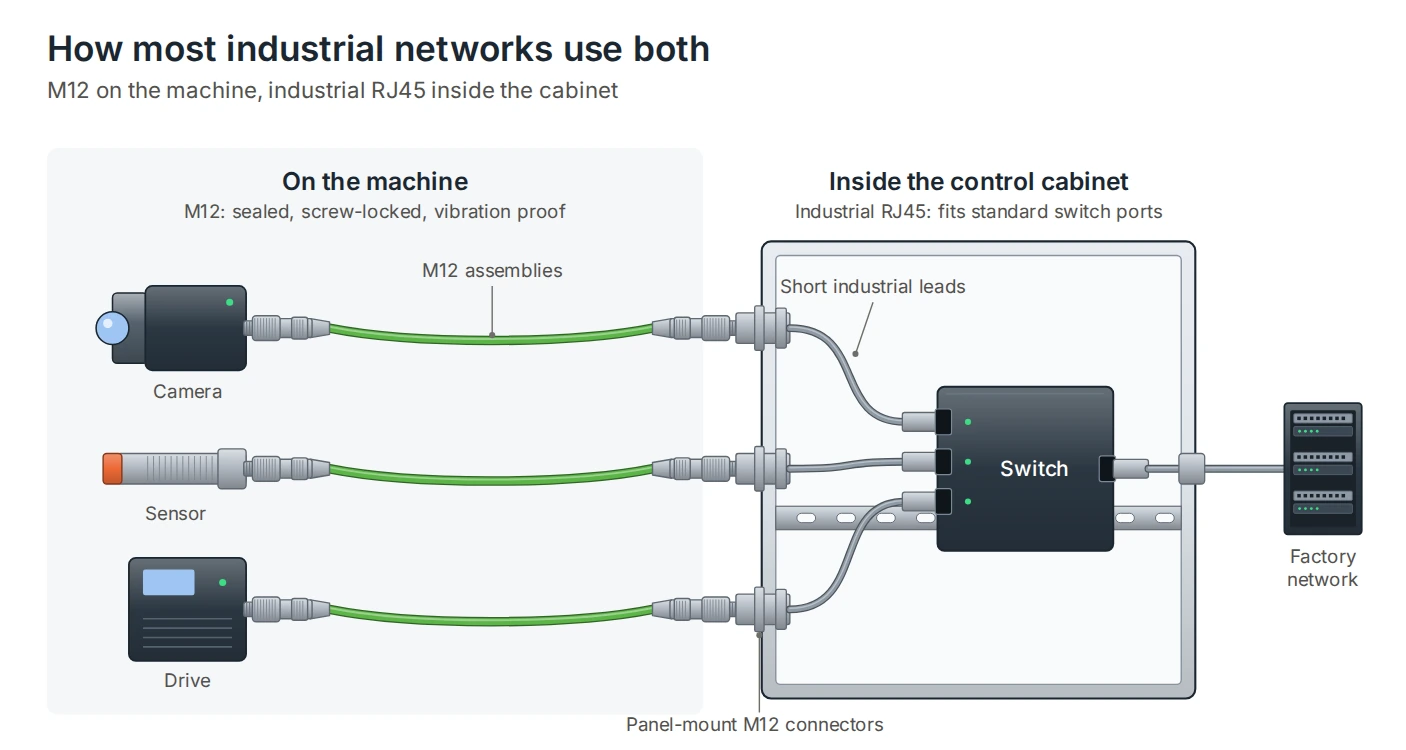
In practice, the answer is rarely one or the other exclusively. Most well-designed industrial networks use both, with each connector type deployed where it performs best.
A typical architecture might look like this: field devices — cameras, sensors, drives — connect via M12 assemblies to a panel-mounted M12 panel connector. That panel connector feeds through to the inside of the control cabinet via a short industrial lead, where it connects to the switch using an industrial RJ45. The switch then connects into the factory network backbone via standard or industrial RJ45. The M12 handles the hostile on-machine environment; the industrial RJ45 handles the cleaner, denser environment inside the cabinet.
This hybrid approach is not a compromise — it is deliberate engineering. Each connector type is used where its specific characteristics are needed, and the result is a network that is both robust where robustness matters and practical where practicality matters.
Frequently asked questions
Can I use an industrial RJ45 lead with a standard office switch?
Yes. The mating interface is identical to a standard RJ45 — 8-pin, same pinout, same physical geometry. An industrial RJ45 lead will plug directly into any standard switch port without modification. The industrial housing simply makes the cable end more robust; it does not change the electrical characteristics or the protocol.
Do industrial RJ45 connectors support PoE?
Yes. PoE is a function of the cable and switch, not the connector type. A Cat6A industrial RJ45 lead supports PoE, PoE+, and PoE++ in the same way a standard patch lead does. The metal housing and shielding on a quality industrial RJ45 also improves thermal performance on high-power PoE runs by providing better heat dissipation than a plastic connector body.
What IP rating do I actually need?
IP67 is the standard for most industrial on-machine and field applications — it covers complete dust exclusion and temporary water immersion to one metre for up to 30 minutes. IP65 is sufficient where the connection needs protection from water jets and heavy spray but is not at risk of immersion, such as a cabinet door that may get hosed down. IP68 is specified for applications involving prolonged submersion beyond one metre. For most factory automation and machine tool installations, IP67 is the correct specification. Inside a sealed control cabinet, IP20 is typically adequate.
What is the difference between a field-wireable and a pre-assembled industrial connector?
A field-wireable connector is terminated on site — the cable is cut to length and the connector assembled directly onto the cable end, typically tool-free. This gives flexibility on exact lengths but requires care on termination, particularly on Cat6A where all eight conductors must be correctly seated for 10Gb performance. A pre-assembled lead is factory-terminated and tested — the cable and connectors arrive as one ready-to-install unit. For critical or high-speed links, pre-assembled leads remove termination risk entirely and are the lower-effort, lower-risk option.
Can I connect an M12 cable directly to a standard RJ45 switch?
Not directly — the connectors are physically incompatible. The standard solution is an M12-to-RJ45 cable assembly, terminated with M12 at the field device end and RJ45 at the switch end. These are standard stock items and the most common way of connecting M12-ported field devices to RJ45-ported switches. Alternatively, M12 panel mount connectors allow the M12 cable to terminate at a panel, with a standard RJ45 lead continuing into the cabinet from the panel socket.
Summary
Standard RJ45 has no place in a genuinely harsh industrial environment. The choice is between industrial RJ45 and M12 — and in most installations, the answer is both.
Industrial RJ45 is the practical choice where equipment has RJ45-native ports, inside control cabinets, and anywhere that backward compatibility with standard network infrastructure matters. M12 is the correct specification for on-machine connections, outdoor and wash-down environments, high-vibration applications, and machine vision systems. Used together — M12 in the field, industrial RJ45 at the cabinet — the result is a network that is robust where it needs to be and straightforward where it can be.
If you need help specifying the right connectors for your installation, get in touch with the DTECH team — we supply industrial RJ45 connectors, M12 X-code and D-code assemblies, and pre-assembled industrial Ethernet leads to installers and automation engineers across the UK, Europe, and the Middle East.