LSZH stands for Low Smoke Zero Halogen. It describes a cable jacket compound that behaves fundamentally differently from standard PVC when it burns — producing significantly less smoke and releasing none of the toxic halogen gases that make conventional cabling so dangerous in a fire. For anyone specifying or installing data cabling in commercial buildings, LSZH is not an optional upgrade. It is the baseline expectation, and understanding what it means — and where it sits within the Euroclass certification framework — is essential for specifying the right cable for the right environment.
This guide explains what LSZH cable is, how it differs from PVC and LSF alternatives, what EN 50575 requires, and which cable is appropriate for which type of installation.
Why cable jacket material matters in a fire
A typical commercial building contains a substantial volume of installed data cable — hundreds of metres of it running through walls, ceilings, floor voids, and risers. In a fire, all of that jacket material burns. What it releases when it burns determines how survivable the building is for the people inside.
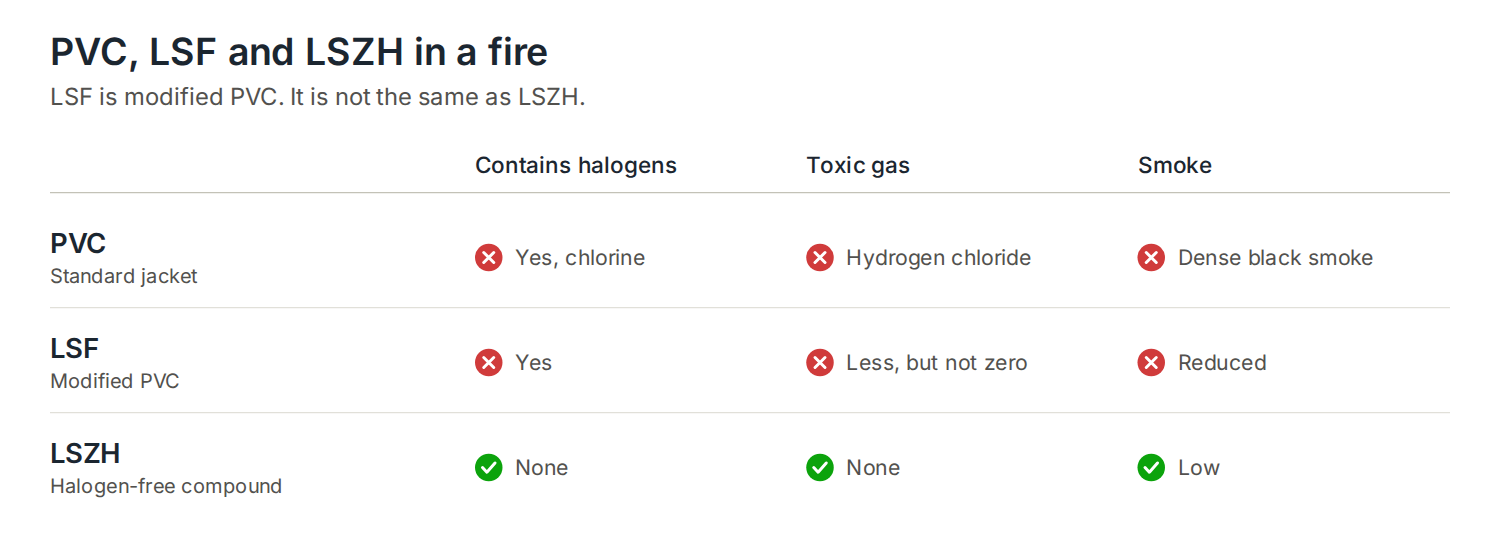
Standard PVC cable jackets contain chlorine, a halogen. When PVC burns it releases hydrogen chloride gas — a corrosive, toxic substance that is lethal at sufficient concentration and causes serious injury well before that threshold. PVC fires also produce dense black smoke that rapidly eliminates visibility, obscuring exit signs and escape routes. Most fire fatalities result from smoke inhalation rather than direct flame contact, and the early minutes of a fire — before smoke fills a space — are when most people escape. Cable that generates toxic smoke in quantity directly shortens that window.
PVC also burns readily and can propagate flame along its length through containment, carrying fire between rooms and floors. In buildings with large cable volumes routed through risers and voids, this is a meaningful risk.
LSZH jackets are formulated from halogen-free compounds — no chlorine, bromine, or other halogen elements. When they burn, they produce no HCl or other corrosive gases, generate significantly less smoke than PVC, and are flame-retardant by design. The combined effect is more time for occupants to see and reach exits safely, and less corrosive damage to equipment if the fire is contained.
LSZH vs LSF: not the same thing
LSF — Low Smoke and Fume — is frequently confused with LSZH, and the two are sometimes used interchangeably in product listings and specification documents. They are not equivalent and should not be treated as such.
LSF cable is made from modified PVC. The base material is the same as standard cable, with additives included to reduce smoke emission. Because it is still PVC-based, LSF cable still contains halogens and will still release toxic gases in a fire — less than standard PVC, but not zero. The smoke output is lower, but it is not low smoke in the same sense as LSZH.
LSZH uses a genuinely different compound — a halogen-free thermoplastic or thermoset material. When it burns, it produces no halogen gases and markedly less smoke than either PVC or LSF. The performance difference in a real fire is significant.
Other terms — LSOH, OHLS, HFFR (Halogen-Free Flame Retardant) — all refer to the same class of material as LSZH and can be treated as equivalent. LSF does not belong in this group. If a cable is described as LSF rather than LSZH, it is a different product with meaningfully lower fire safety performance.
EN 50575 and the Euroclass system
EN 50575 is the harmonised European standard that governs the fire performance testing and classification of power, control, and communications cables intended for permanent installation in buildings. Under the Construction Products Regulation, any cable of this type placed on the market must be independently tested, carry a Declaration of Performance, and be CE or UKCA marked with its Euroclass rating. This has been a legal requirement since July 2017.
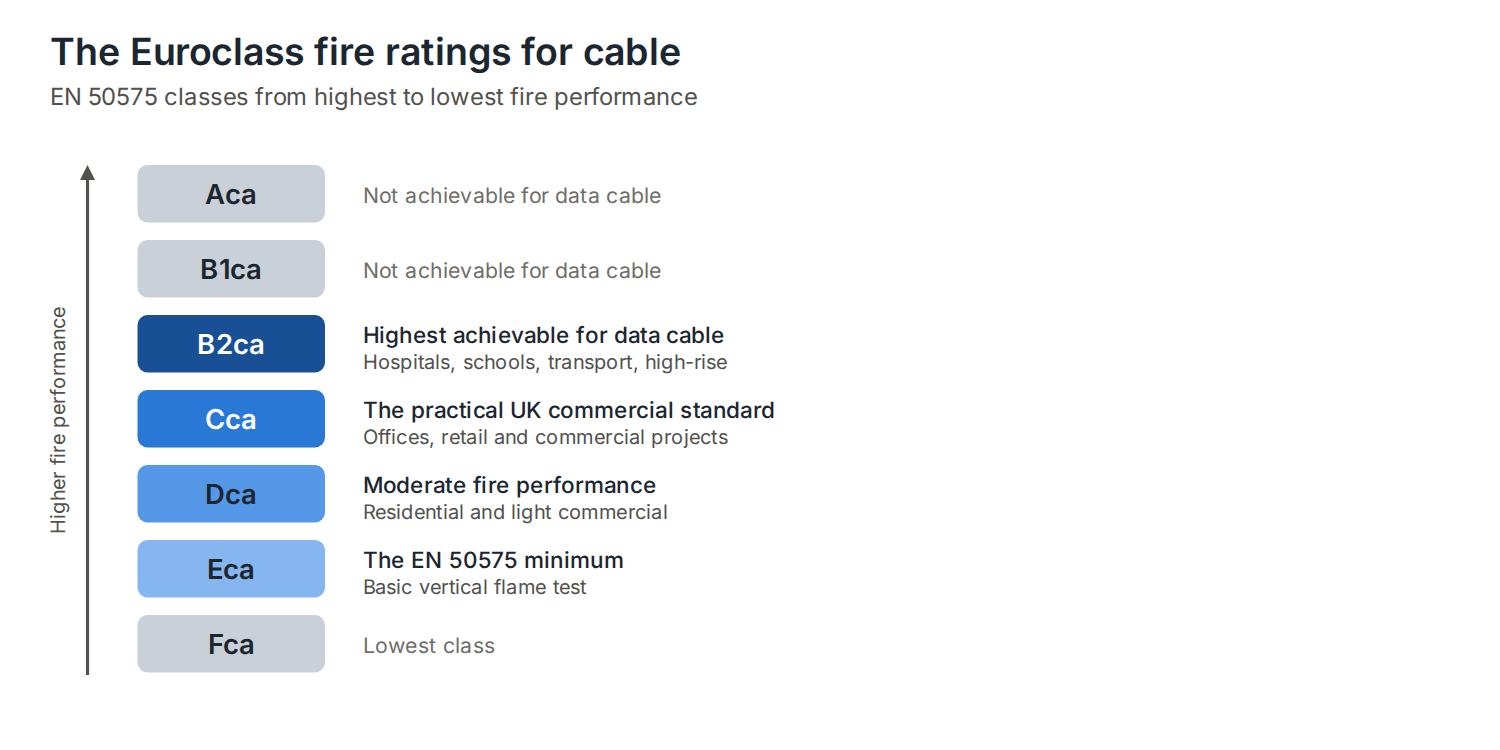
The Euroclass system ranks cable fire performance from highest to lowest: Aca, B1ca, B2ca, Cca, Dca, Eca, Fca. For data and telecoms cables, the highest achievable class in practice is B2ca — the glass and copper materials in structured cabling preclude the non-combustible Aca and B1ca ratings. Eca is the minimum entry level, requiring the cable to pass a basic vertical flame test conducted by an independent notified body.
Each class above Eca adds progressively more demanding criteria — heat release, flame spread, smoke production, flaming droplets, and acid gas content are all measured and rated. Cables at Cca and above are also subject to ongoing factory auditing and periodic retesting, providing assurance that the certified performance is maintained in production rather than demonstrated once at a single test.
The Euroclass on a cable jacket tells you exactly what that cable will do in a fire, verified independently. An LSZH label without a Euroclass rating tells you about the jacket compound but gives no independently verified information about flame spread, heat release, or smoke output. For any permanently installed cable in a commercial building, the Euroclass marking is the specification that matters.
Which Euroclass for which environment
EN 50575 does not prescribe which Euroclass must be used in which building type — that is left to specifiers, designers, and clients based on the fire risk profile of the installation. What it requires is that the cable is tested, rated, and marked, so that an informed choice can be made.
In practice, the selection is driven by building type and occupancy:
- Eca — the EN 50575 minimum. Passes the basic flame test. Suitable for low-risk environments and some residential applications, but the starting point rather than the specification for most commercial work.
- Dca — moderate fire performance. Meets EN 50399 flame spread testing in addition to the Eca vertical flame test. Used in standard residential and light commercial installations across much of Europe.
- Cca — robust fire performance with low flame propagation, reduced smoke, limited flaming droplets, and low acid gas. The practical standard for commercial structured cabling in the UK and the specification most frequently called for on office, retail, and commercial projects.
- B2ca — the highest achievable class for data cable. Specifies very low heat release, minimal flame spread, and the tightest smoke and acidity criteria. Required or specified for hospitals, schools, transport infrastructure, high-rise buildings, and any project where the fire risk profile or client specification demands the highest available rating.
Higher Euroclass cable can always substitute for a lower rated requirement — a B2ca cable meets and exceeds a Cca specification, and a Cca cable meets and exceeds Dca. The reverse is not true.
LSZH copper data cable
For structured copper cabling in commercial installations, LSZH is the standard jacket compound. The majority of quality bulk data cable sold into the UK market now carries LSZH as a baseline, reflecting both the regulatory environment and the reasonable expectation of specifiers and building owners that installed infrastructure should not add to the hazard in a fire.
DTECH’s AV-ready LSZH copper cable range covers Cat5e, Cat6, and Cat6A with LSZH jackets throughout. The AV-ready rating reflects extended bandwidth performance — Cat6 rated to 500MHz and Cat6A to 650MHz, both above the standard category minimums — making the same cable appropriate for AV over IP, HDBaseT, and high-bandwidth applications alongside standard data and PoE runs, without needing a separate cable specification for AV infrastructure.
For installations where the highest fire performance rating is specified — hospitals, schools, transport hubs, high-rise buildings, or any project where B2ca is called for — DTECH’s Cat6 B2ca LSZH cable is independently certified to B2ca Euroclass — the highest rating available for copper data cable. Rated to 500MHz with full LSZH compound, it delivers the same electrical performance as standard LSZH cable while meeting the most demanding fire safety specification. The violet jacket provides immediate on-site identification, visually distinguishing B2ca rated cable from Cca in installations where both specifications are in use across different areas of the same building.
LSZH fibre optic cable
EN 50575 applies equally to fibre optic cable. There is no distinction in the regulation between copper and fibre for permanently installed cables within a building — both must be tested, rated, and CE or UKCA marked. The glass fibre itself is non-combustible, but the jacket, fillers, and strength members that make up the cable construction are not, and it is the cable as a whole that is tested and classified.
DTECH’s Cca rated fibre optic bulk cable range covers tight buffered OS2 single mode and OM4 multimode in 4, 8, 12, and 24 fibre counts — providing the full range of configurations for backbone and riser installations from small single-floor runs through to larger multi-storey and campus systems. Tight buffered construction means each fibre is individually protected, allowing direct termination on site without breakout kits and reducing both installation time and the risk of fibre damage during termination.
LSZH vs LSF vs PVC: side-by-side
| PVC | LSF | LSZH | |
|---|---|---|---|
| Base material | PVC compound | Modified PVC | Halogen-free compound |
| Halogen content | Yes | Yes | No |
| Toxic gas on burning | HCl and others | Reduced but present | None |
| Smoke production | Dense black smoke | Reduced | Low |
| Flame retardant | Limited | Moderate | Yes |
| EN 50575 Euroclass | Eca / Fca | Eca / Dca | Dca through B2ca |
| Commercial buildings | Not appropriate | Not appropriate | Standard specification |
View our LSZH cable range: LSZH copper bulk cable·Cat6 B2ca LSZH copper·Cca LSZH fibre optic cable
Frequently asked questions
Does LSZH affect data performance?
No. LSZH is a jacket material specification, not an electrical one. The data performance of a cable — its category rating, bandwidth, insertion loss, and crosstalk — is determined by the conductor gauge, pair geometry, and insulation, not the outer jacket. An LSZH Cat6A cable performs identically to a PVC Cat6A cable electrically. The only difference is fire behaviour.
Is LSZH the same as a Euroclass rating?
No, and the distinction matters. LSZH describes the jacket material — halogen-free compound, low smoke when burned. Euroclass is an independently tested and certified fire performance classification under EN 50575, covering heat release, flame spread, smoke production, flaming droplets, and acid gas content. A cable can be LSZH in compound without carrying any Euroclass certification. For permanently installed cables in buildings, the Euroclass marking is the relevant specification — it is the independently verified number, not the material description on the reel.
Do patch leads need to be LSZH?
Patch leads are not within the scope of EN 50575 — the regulation applies to permanently installed cables, and patch leads are treated as non-permanent connections. That said, specifying LSZH patch leads in commercial environments is straightforward good practice, particularly in comms rooms where the density of patch cable in an enclosed space represents a meaningful volume of jacket material.
Can I use a higher Euroclass cable than the specification requires?
Yes, always. Higher Euroclass cables can substitute for lower rated requirements without issue — B2ca meets and exceeds a Cca requirement, Cca meets and exceeds Dca, and so on. The reverse is not true. Specifying upward is never a compliance problem and is often sensible on projects where future-proofing or a conservative approach to fire risk is appropriate.
Is LSZH cable suitable for outdoor use?
Standard LSZH compound has lower UV resistance and moisture tolerance than PVC, making it less suitable for directly exposed outdoor routes. For external runs, a UV-stabilised LSZH jacket is required, or the cable should be routed in suitable containment. DTECH’s Cat XG F/UTP cable uses a UV-stabilised LSZH jacket rated for both internal and external installation, removing the need for a separate external cable specification on runs that pass through building fabric and outside.where
Summary
LSZH is the correct jacket specification for data cable in any occupied commercial building. It eliminates halogen gas release and significantly reduces smoke output compared to PVC, giving building occupants more time to evacuate safely and reducing corrosive damage to equipment in the event of a fire. It is not the same as LSF, which still contains halogens and should not be treated as an equivalent.
EN 50575 requires all permanently installed building cables to be independently tested and CE or UKCA marked with their Euroclass — from Eca as the entry level through to B2ca as the highest achievable for data cable. The Euroclass is the independently verified fire performance specification; LSZH describes the material. Both matter, and for commercial structured cabling they belong together.
If you need help specifying the right cable for your installation, get in touch with the DTECH team — we supply LSZH copper and fibre cable to installers and IT teams across the UK, Europe, and the Middle East.