Cable shielding is one of those topics that generates more confusion than it should. The acronyms — UTP, FTP, STP, S/FTP, U/FTP — get used interchangeably and incorrectly so often that specifying the right cable for an installation can feel like guesswork. It does not need to be.
This guide explains what cable shielding actually does, decodes the naming system properly, and makes clear which shielding type is appropriate for different environments and applications.
Why shielding exists
Copper data cables transmit data as electrical signals, and electrical signals are susceptible to electromagnetic interference (EMI) and radio frequency interference (RFI). Sources of interference include fluorescent lighting, power cables running in parallel, motors, transformers, industrial machinery, and dense bundles of other data cables. When interference couples into a data cable, it degrades signal quality — causing errors, reducing throughput, and in severe cases dropping links entirely.
Twisted pair cable has a built-in defence against this. The act of twisting two conductors together means interference affects both wires almost equally, and because the receiving equipment reads the difference between the two conductors rather than an absolute voltage, that common-mode noise largely cancels out. This is why unshielded twisted pair cable works reliably in most office and commercial environments without any additional protection.
Shielding adds a metallic layer — foil, braided screen, or both — around the twisted pairs to further reduce interference. It acts as a barrier against external EMI coupling into the cable, and also contains any noise the cable itself radiates outward. The right shielding type depends on the nature and severity of the interference in the environment, and on whether the concern is external interference, crosstalk between pairs within the same cable, or both.
How to read the naming system
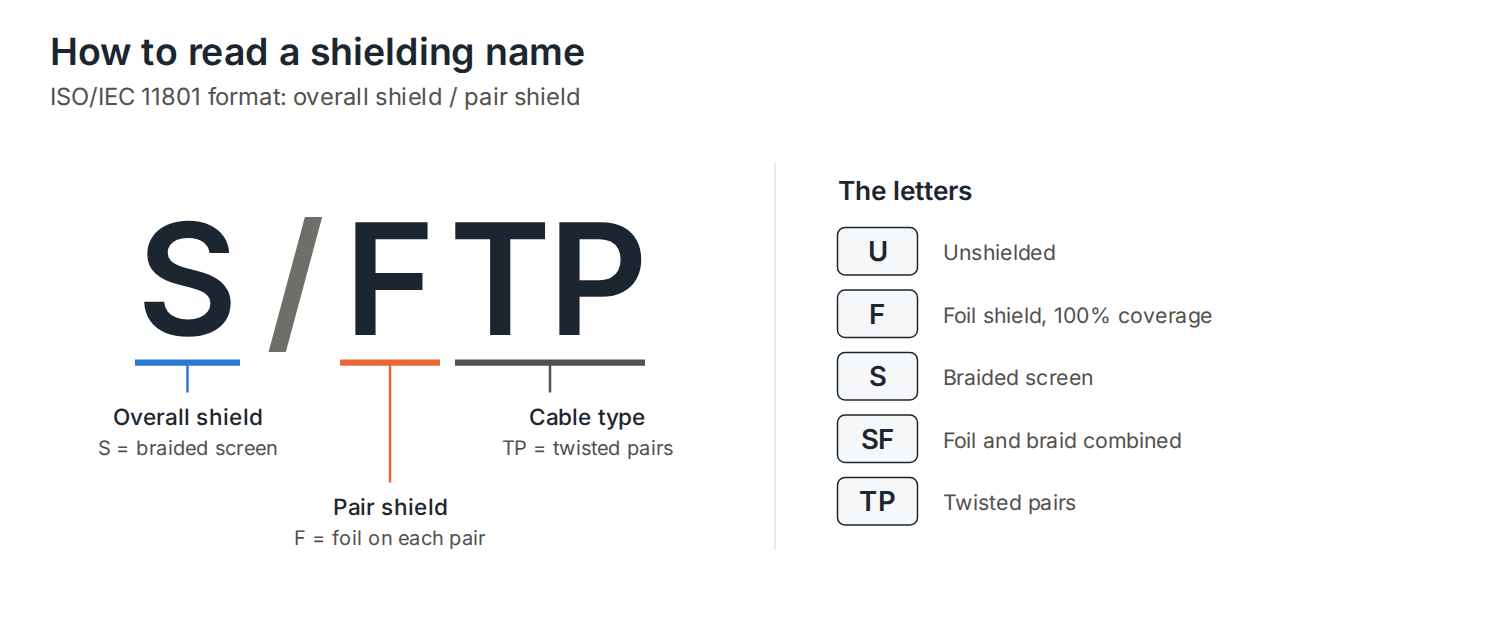
The international standard ISO/IEC 11801 defines a two-part naming convention that tells you exactly what shielding a cable has. The format is overall shield / pair shield. Reading the label this way removes the ambiguity entirely.
The letters used are:
- U — unshielded (no shield at that level)
- F — foil shield (aluminium foil, 100% coverage)
- S — braided screen (woven metal mesh, typically copper or tinned copper)
- SF — both foil and braid combined
- TP — twisted pairs
So F/UTP means: overall foil shield / unshielded twisted pairs. S/FTP means: overall braided screen / individually foil-shielded twisted pairs. U/UTP means no shielding at all — the standard unshielded cable most installations use.
The confusion arises because older shorthand terms — FTP, STP — are still widely used but imprecise. FTP is generally understood to mean F/UTP. STP is used loosely to mean almost any shielded cable. Whenever a cable specification matters, use the ISO/IEC 11801 two-part designation and check what it actually says on the cable jacket.
U/UTP — unshielded twisted pair
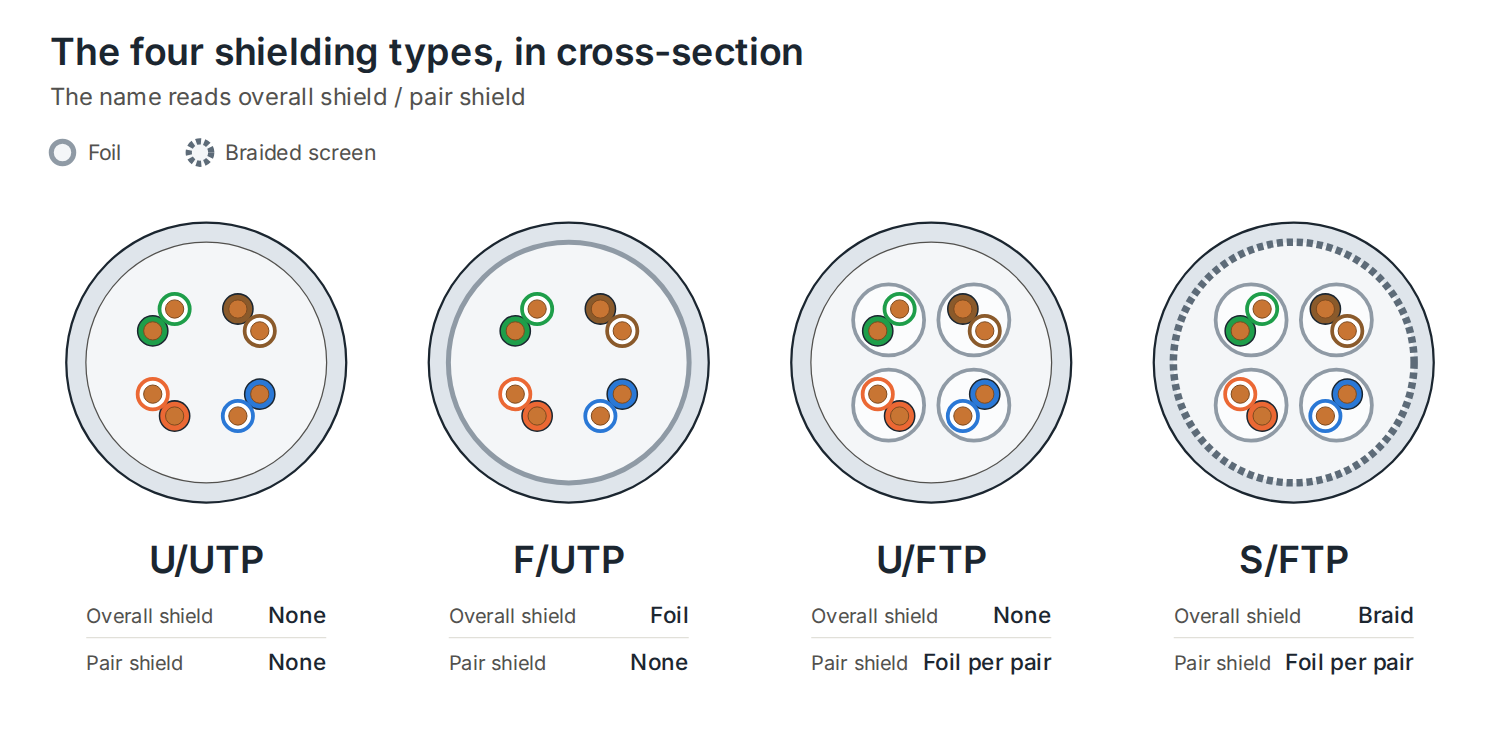
U/UTP — commonly referred to simply as UTP — is the most widely installed data cable in the world. It has no metallic shielding of any kind. The four twisted pairs sit directly beneath the outer jacket, with each pair twisted at a slightly different rate to reduce crosstalk between them.
It is thinner, lighter, more flexible, and easier to terminate than any shielded variant. It requires no grounding at the connector or patch panel. For the vast majority of commercial office installations — where cable routes are away from significant EMI sources and the environment is reasonably controlled — UTP is the correct and most practical specification.
Where UTP starts to struggle is in environments with significant electrical noise running near cable routes, in high-density bundles where alien crosstalk becomes a concern, and in applications such as AV distribution or broadcast where signal integrity tolerances are tighter than standard data applications.
F/UTP — overall foil shield
F/UTP adds a continuous aluminium foil shield around all four twisted pairs beneath the outer jacket, along with a drain wire that carries induced currents to ground when the shield is correctly terminated. The individual pairs themselves remain unshielded.
The foil provides 100% coverage — unlike a braided screen which has small gaps — and is highly effective against high-frequency EMI. It is the natural next step from UTP for installations where cable routes pass near power cables, lighting infrastructure, or moderate electrical equipment, and for AV and broadcast applications where external interference needs to be controlled without the complexity of individually shielded pairs.
If the shield is not connected to ground at the termination point, it cannot discharge those currents effectively — the protection is lost, and the floating shield may capacitively couple some noise onto the conductors rather than diverting it. An ungrounded shielded cable does not perform worse than unshielded cable in most environments, but it does not deliver the protection it was specified to provide — which means you are paying for shielding that is not working.
DTECH’s Cat XG F/UTP cable is rated to 500MHz with an LSZH jacket, suitable for both internal and external installations. The 500MHz bandwidth means it exceeds the standard Cat6A specification and supports 10GBase-T across practical commercial run lengths — making it a strong choice for AV-ready installations and any structured cabling project where a degree of EMI protection is required without the additional complexity of individually shielded pairs.
U/FTP — individually foil-shielded pairs
U/FTP takes a different approach to shielding. There is no overall shield around the cable, but each of the four twisted pairs is wrapped in its own individual foil screen. This targets crosstalk specifically — the interference that occurs between pairs within the same cable — rather than external EMI entering the cable from outside.
Because each pair is isolated from its neighbours, alien crosstalk and pair-to-pair interference is significantly reduced. This is particularly valuable in high-density installations where many cables are bundled tightly together, and in Cat6A applications where alien crosstalk is one of the key performance challenges that the augmented category standard was designed to address.
DTECH’s Cat6A U/FTP cable is rated to 650MHz — 150MHz above the Cat6A standard — with 23AWG conductors and an LSZH jacket. The higher bandwidth rating gives meaningful headroom above the minimum specification, which translates to better performance in dense bundles and longer runs. The individually shielded pairs make it the right choice for high-density patch environments, AV over IP installations, and any application where pair-to-pair crosstalk is the primary concern.
S/FTP — fully shielded
S/FTP combines both shielding approaches: an overall braided screen around the entire cable, plus individual foil shields around each twisted pair. This is the most comprehensively shielded construction available for twisted pair cabling, addressing both external EMI and internal crosstalk simultaneously.
The braided outer screen provides better grounding than foil alone — the woven metal construction has greater mechanical robustness and maintains contact with the connector housing more reliably — while the individual pair foils isolate each pair from its neighbours. The combination delivers maximum protection from external interference, alien crosstalk, and pair-to-pair crosstalk within the same cable.
S/FTP is the construction used for Cat7, Cat7A, and Cat8 cable, and is specified for the most demanding environments — industrial installations, data centres, broadcast facilities, and any application where neither external interference nor internal crosstalk can be tolerated. It is also the correct specification for very high frequency applications, since alien crosstalk becomes progressively more significant as frequency increases.
The trade-off is termination complexity. Removing three layers of shielding — outer braid, individual pair foils, and drain wire — to make a connection requires more care and time than terminating UTP or F/UTP. The shield must be correctly grounded at both ends of the link for the protection to function as intended.
DTECH’s Cat6A S/FTP patch leads are rated to 550MHz, factory-terminated and tested to 10GBase-T specification with an LSZH jacket. Pre-assembled S/FTP patch leads remove the termination complexity entirely — the shielding is correctly bonded at the factory, insertion loss is measured before despatch, and the lead arrives ready to install. For switch rooms, data centres, and any high-density environment where patch lead quality directly affects link performance, pre-terminated S/FTP is the lowest-risk option.
Shielding types: side-by-side
| U/UTP | F/UTP | U/FTP | S/FTP | |
|---|---|---|---|---|
| Overall shield | None | Foil | None | Braid |
| Pair shield | None | None | Foil per pair | Foil per pair |
| External EMI | Twist only | Good | Moderate | Excellent |
| Crosstalk protection | Twist only | Moderate | Excellent | Excellent |
| Grounding required | No | Yes | Yes | Yes |
| Termination | Straightforward | Moderate | Moderate | More involved |
| Typical use | Office, commercial | AV, light industrial | High density, Cat6A | Industrial, data centre, broadcast |
View our range of data cables: Bulk copper cable·Copper patch leads
Which shielding type should you specify?
The decision should be driven by the environment, not by a general preference for more shielding. Over-specifying shielding adds cost and installation complexity without improving performance in clean environments. Under-specifying it in noisy environments leads to unreliable links. Here is a practical guide:
- U/UTP — standard offices, commercial buildings, schools, and any environment where cable routes are clear of significant electrical equipment. The correct choice for the majority of structured cabling installations.
- F/UTP — installations where routes pass near power cables, fluorescent lighting, or moderate electrical equipment. AV distribution systems and broadcast environments where external interference control is required. The practical first step up from UTP where some EMI protection is needed without the complexity of individually shielded pairs.
- U/FTP — high-density Cat6A installations where alien crosstalk is the primary concern. Data centres and switch rooms with dense cable bundles. Applications where pair-to-pair isolation is more important than external EMI rejection.
- S/FTP — industrial environments, manufacturing floors, plant rooms, and anywhere with significant electrical noise from motors, drives, or heavy equipment. Broadcast and production facilities with stringent signal integrity requirements. Data centre environments specifying Cat7 or Cat8. Any installation where maximum protection from both external interference and internal crosstalk is required.
The grounding requirement
Any shielded cable — F/UTP, U/FTP, or S/FTP — must be correctly grounded to function as intended. The shield works by providing a conductive path that carries induced interference currents safely to earth. If the shield is not connected to ground at the termination point, it cannot discharge those currents and instead acts as an antenna, potentially making interference worse rather than better.
This means that specifying a shielded cable also commits the installation to shielded patch panels, shielded keystone jacks, shielded patch leads, and proper earthing of the cabinet or patch frame throughout. A shielded system that loses continuity at any point in the link — through an unshielded patch lead or an incorrectly terminated connector — loses its protection at that point.
This is not a reason to avoid shielded cabling where it is genuinely needed. It is a reason to plan a shielded installation as a complete system rather than specifying shielded cable in isolation.
Frequently asked questions
Does shielding make a cable faster?
No. Shielding does not increase the data rate or bandwidth of a cable beyond its category specification. What it does is protect the signal quality in environments where interference would otherwise degrade performance. A Cat6A U/UTP cable and a Cat6A S/FTP cable have the same rated bandwidth and speed — the shielded cable simply maintains that performance more reliably in noisy environments.
Can I use shielded cable with unshielded patch panels?
Technically the cable will carry data, but the shield will not be grounded at the patch panel end and will therefore not function correctly. The interference protection is lost at that point in the link. For a shielded system to work properly, every component in the channel — patch panel, keystone jack, patch lead, and connector — needs to be shielded and correctly earthed.
Is STP the same as S/FTP?
Not necessarily. STP is a legacy shorthand that gets used to describe almost any shielded cable, which is exactly the problem. On a product label or specification sheet, STP could refer to F/UTP, U/FTP, S/FTP, or something else entirely. Always look for the ISO/IEC 11801 two-part designation on the cable jacket — such as F/UTP or S/FTP — to know exactly what shielding construction you have.
Does PoE require shielded cable?
Not as a rule, but shielded cable does perform better in high-power PoE applications. At higher power levels — particularly PoE++ at 60W or 90W — the cable generates heat, which increases resistance and reduces the power available at the device. The metallic shielding in F/UTP and S/FTP cables helps dissipate that heat more effectively than unshielded cable, which can improve power delivery consistency over longer runs. For standard PoE and PoE+ deployments, good quality UTP Cat6A is generally adequate.
What is the difference between a foil shield and a braided screen?
A foil shield is a continuous layer of aluminium film that provides 100% coverage with no gaps. It is very effective against high-frequency interference but is relatively fragile — rough handling during installation can tear the foil and compromise the coverage. A braided screen is a woven mesh of copper or tinned copper strands. It has small gaps in coverage but is mechanically much more robust, provides better grounding due to its larger contact area with the connector, and is more resistant to repeated flexing. S/FTP combines both — the foil provides total coverage on individual pairs, the braid provides robust grounding and mechanical strength as the outer shield.
Summary
UTP is the right choice for the majority of commercial installations and should not be substituted with shielded cable simply as a precaution — shielding only delivers its benefit when the full system is correctly grounded. F/UTP is the practical upgrade for environments with moderate external interference or AV applications. U/FTP is the correct specification for high-density Cat6A installations where crosstalk is the concern. S/FTP is the maximum protection option for demanding industrial, broadcast, and data centre environments.
The naming system looks complicated but follows a simple logic: what is around the whole cable, and what is around each pair. Once that rule is understood, any shielding designation can be decoded immediately.
If you need help specifying the right cable shielding for your installation, get in touch with the DTECH team — we supply shielded and unshielded bulk cable and patch leads to installers and IT teams across the UK, Europe, and the Middle East.