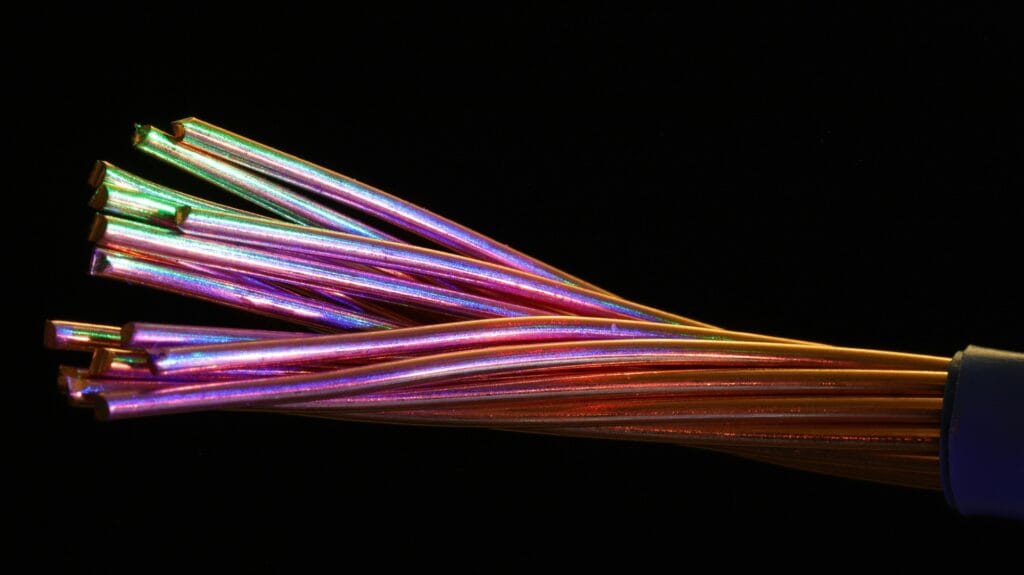
Copper data cable comes in two fundamentally different conductor constructions: solid and stranded. The names describe exactly what they are — a solid core uses a single continuous copper wire per conductor, while a stranded core uses multiple thinner wires twisted together to form each conductor. The difference has nothing to do with category rating or performance specification. A solid Cat6A cable and a stranded Cat6A cable are both Cat6A. What changes is where and how each should be used — and getting it wrong causes problems that are often difficult to diagnose after installation.
This guide explains the practical differences between solid and stranded copper cable, where each belongs in a structured cabling installation, and what to consider when choosing patch leads.
What solid core cable is and where it belongs
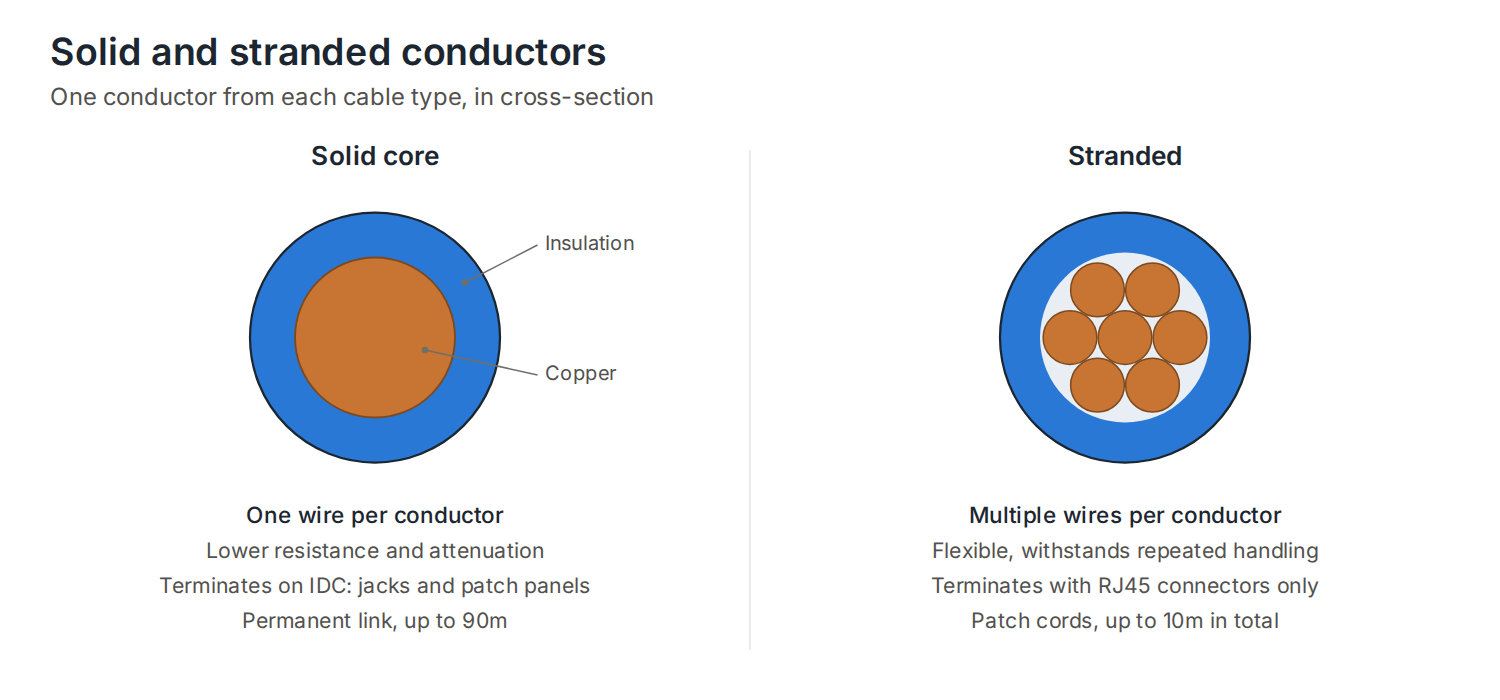
A solid core cable has one single copper wire per conductor — eight conductors in total for a standard four-pair Ethernet cable. That single continuous wire is a better electrical conductor than stranded: it has lower DC resistance, lower attenuation over distance, and a larger effective surface area that carries high-frequency signals more efficiently. This is why solid core cable is the correct and only appropriate specification for permanent structured cabling installations.
Both TIA and ISO/IEC standards are explicit on this point — the horizontal permanent link, which covers the cable routed from the patch panel or telecoms room to the wall outlet, must be solid core. That 90-metre maximum permanent link is where solid core cable’s lower attenuation matters most. Over that distance, the performance difference between solid and stranded is meaningful, and the standards reflect it.
Solid core is also the correct choice for PoE applications. When power is transmitted over the cable alongside data, the conductor generates heat proportional to its resistance. Solid core has lower resistance than stranded of the same nominal gauge, which means less heat generation and more consistent power delivery over the full run. For ceiling-mounted access points, IP cameras, and other remote PoE devices — particularly where the cable is routed through confined spaces that limit heat dissipation — solid core is the safer and more reliable specification.
The limitation of solid core is the one that gives it its name. A single continuous wire does not flex well. Repeatedly bending solid core cable — routing it around tight corners during installation is fine, but flexing it regularly in service is not — will eventually fatigue and fracture the conductor. This is why solid core bulk cable is designed to be installed and left in place. It terminates correctly and reliably into IDC-style connections: keystone jacks, patch panels, and field-termination plugs. It should not be used as a patch lead.
What stranded cable is and where it belongs
A stranded conductor is made of multiple smaller-gauge wires twisted together — the construction is similar in principle to a rope, where many threads combine to form a single strong, flexible element. The individual strands move independently when the cable is bent, distributing the mechanical stress across all of them rather than concentrating it in a single point. This gives stranded cable the ability to withstand repeated flexing without conductor failure — which is exactly what a patch lead experiences in daily use.
The trade-off is electrical performance over distance. The small air gaps between strands in a stranded conductor increase DC resistance and attenuation compared to solid core of the same nominal gauge. Over the short distances involved in patch leads — typically one to five metres, rarely more than ten — this is not a concern. The higher resistance has no meaningful impact on link performance at those lengths. Over longer permanent link distances, it would.
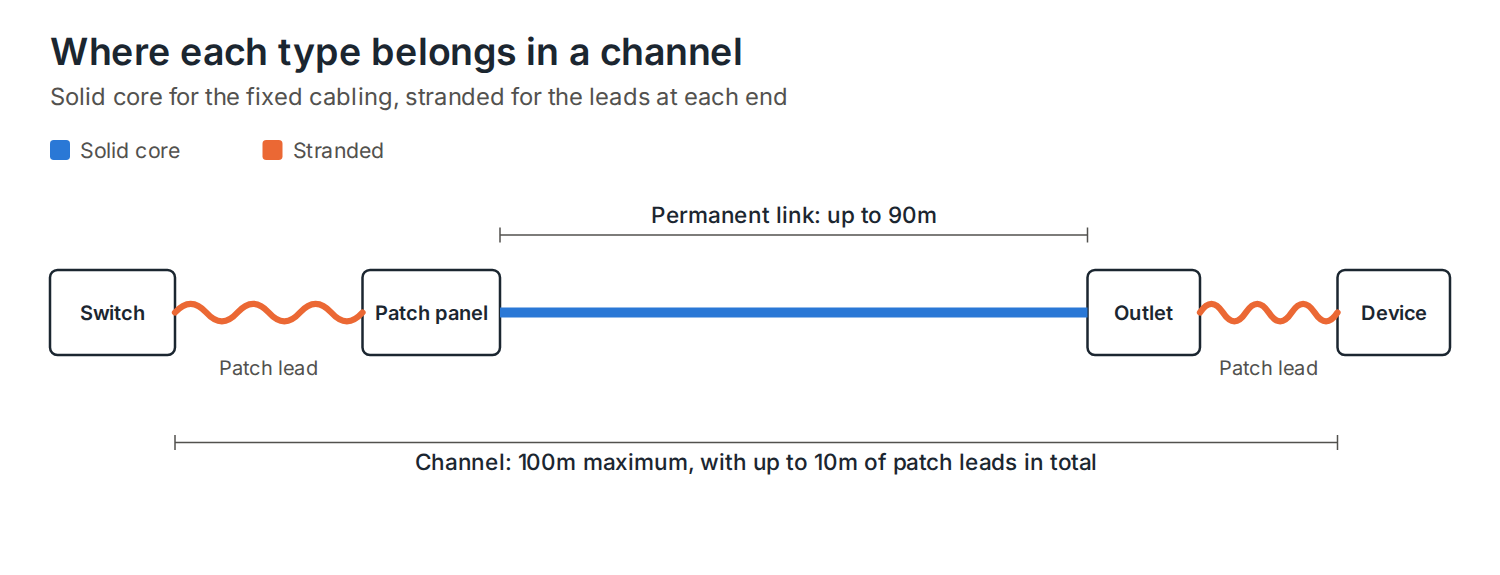
Standards reflect this clearly. Stranded cable is limited to patch cords and cross-connect jumpers, with a combined maximum of ten metres allocated to patch cord length within a 100-metre channel. The 90-metre permanent link is solid; the remaining ten metres across all patch connections is where stranded belongs.
Stranded cable also terminates differently from solid. IDC-style terminations — keystone jacks and patch panels — are designed for solid core. The individual strands of a stranded conductor do not seat cleanly or consistently in an IDC slot. Stranded cable should be terminated with RJ45 connectors designed for stranded wire, not punched down into jacks or patch panels. Attempting to punch stranded cable into an IDC termination produces unreliable connections that while it may pass initial testing, it can later fail in use and so is not recommended.
Solid and stranded in a complete installation
A properly structured installation uses both. Solid core bulk cable runs from the patch panel in the telecoms room through the building fabric — walls, ceilings, floor voids, risers — to the faceplate outlet at the desk or device location. This is the permanent link. It is never touched again after installation. Solid core is right for this.
Stranded patch leads then make the connections at each end of the permanent link: from the patch panel to the switch in the comms room, and from the faceplate outlet to the device at the desk or in the ceiling. These leads get plugged and unplugged, occasionally repositioned, and generally handled in a way that solid core cannot sustain. Stranded is right for this.
Using solid core as a patch lead is a common mistake, particularly when installers make their own patch leads from bulk installation cable. The leads work initially but are prone to conductor fracture at the connector or at points of regular bending, producing intermittent faults that are difficult to locate. Using stranded cable for the permanent link is less common but equally problematic — the higher attenuation may cause marginal channel performance, particularly on longer runs or in combination with PoE loads.
DTECH stranded bulk cable
For installations where custom-length patch leads are needed — AV installations, comms rooms with non-standard rack spacing, or any project where off-the-shelf lengths do not suit — DTECH’s stranded bulk data cable range provides the correct conductor construction for patch lead fabrication. Stranded bulk cable should always be terminated with RJ45 connectors rated for stranded conductors — not punched down into keystones or patch panels.
For installers who regularly make patch leads on site, DTECH’s patch kit packages stranded cable cuts — available in 10m or 20m lengths, three cuts per kit — with RJ45 connectors and strain relief boots included. Everything needed to make custom-length patch leads is in one box, without needing to stock bulk reels and separate components. The kit is designed for the installer who needs flexibility on length without the overhead of managing multiple separate product lines on a job.
Pre-made patch leads
For the majority of installations, factory-terminated patch leads are the more practical choice. They are manufactured under controlled conditions, tested before despatch, and arrive ready to use — removing termination risk and saving time on site. DTECH’s copper patch lead range covers Cat5e, Cat6, and Cat6A in a range of lengths and colours, with stranded conductors throughout.
The range includes 28AWG slim patch leads in Cat6 and Cat6A. Standard patch leads use 24AWG conductors — the same gauge as solid bulk cable. A 28AWG stranded patch lead uses thinner individual strands, producing a cable with a noticeably smaller overall diameter. In a high-density patch environment — a fully populated 48-port panel, a dense AV rack, or a comms room where multiple panels are in use — the reduction in cable bulk at the front of the panel makes a practical difference to airflow, finger access between leads, and general cable management. The 28AWG construction meets Cat6 and Cat6A performance standards at patch lead lengths, where the slightly higher attenuation of the thinner conductors is not a factor in overall channel performance.
Solid vs stranded: side-by-side
| Solid core | Stranded | |
|---|---|---|
| Construction | One wire per conductor | Multiple wires per conductor |
| Flexibility | Rigid — not for repeated bending | Flexible — withstands repeated handling |
| Attenuation | Lower — better over long runs | Higher — suitable for short runs only |
| PoE performance | Better — lower resistance, less heat | Higher resistance — keep runs short |
| Termination | IDC — keystone jacks, patch panels | RJ45 connectors only |
| Standards use | Permanent link — up to 90m | Patch cords — up to 10m total in channel |
| Correct application | In-wall, ceiling, riser, backbone runs | Patch leads, cross-connects, jumpers |
View our copper cable range: Stranded bulk cable·Copper patch leads·Patch kit
Frequently asked questions
Can I use solid core cable as a patch lead?
Technically it will work initially, but it is not the correct specification and creates a reliability risk. Solid core conductors are not designed for repeated bending and will fatigue at points of regular flexing — particularly at the connector, where a patch lead is most often stressed. The result is intermittent connectivity faults that are difficult to trace. Always use stranded patch leads for any connection that will be plugged, unplugged, or repositioned.
Can I punch stranded cable into a keystone jack?
IDC terminations in keystone jacks and patch panels are designed for solid core conductors. Stranded cable does not seat reliably in an IDC slot — the individual strands can spread unevenly during termination, producing a connection that may pass a basic continuity check but fails under load or loses contact over time. Stranded cable should be terminated with RJ45 connectors appropriate for stranded conductors. If you need to connect stranded cable at a patch panel, use a pre-terminated lead rather than attempting field termination into IDC hardware.
What is the maximum length for a stranded patch lead?
TIA and ISO/IEC standards allocate a combined maximum of ten metres to all patch cord lengths within a 100-metre channel — covering the patch lead at the patch panel end and the equipment lead at the outlet end together. In practice, keeping individual patch leads to five metres or less is good practice, both for performance and for cable management. Longer stranded patch leads are possible within the ten-metre allowance but introduce more attenuation and more bulk than is typically necessary.
What is the advantage of 28AWG slim patch leads?
Standard patch leads use 24AWG conductors, producing a cable outer diameter of around 6mm. A 28AWG patch lead uses thinner individual strands and produces an outer diameter closer to 3.8–4mm — roughly half the cross-section. In a fully populated patch panel, the difference in cable bulk at the front of the panel is visible and practical: better airflow between leads, easier finger access for plugging and unplugging, and less weight on the connector panel. Performance at patch lead lengths is unaffected — the higher attenuation of 28AWG conductors is not a factor over distances of a few metres.
What is in the DTECH patch kit and when is it useful?
The patch kit contains three cuts of stranded bulk cable — available in 10m or 20m cut lengths — along with RJ45 connectors and strain relief boots. It is aimed at installers who need to make custom-length patch leads on site without carrying a full bulk reel and separate component stock. A comms room with non-standard rack spacing, an AV installation where exact lengths reduce cable clutter, or a site where a handful of specific lengths are needed quickly — these are the typical applications. The kit keeps the right components together in one package and removes the need to source cable, connectors, and boots separately.
Summary
Solid core cable belongs in the permanent installation — routed through building fabric, terminated into keystones and patch panels, and left in place. Stranded cable belongs at both ends of that permanent link, as the flexible patch lead connecting the panel to the switch and the outlet to the device. Using the wrong type in either position creates problems: solid core patch leads fatigue and fail; stranded permanent links underperform over distance and under PoE load.
The distinction is straightforward once it is understood, and the right product for each application is clearly defined by both the standards and the physical properties of each construction type.
If you need help specifying the right cable for your installation, get in touch with the DTECH team — we supply solid and stranded copper cable, patch leads, and patch kits to installers and IT teams across the UK, Europe, and the Middle East.