Amendment 4 to BS 7671:2018 is the first edition of the IET Wiring Regulations to deal with Power over Ethernet. It was published on 15 April 2026, and the previous edition, BS 7671:2018+A2:2022+A3:2024, is withdrawn on 15 October 2026. From that date, new installations must comply with Amendment 4.
For anyone who installs or specifies data cabling, two additions matter most: Section 716, which sets requirements for PoE, and Section 545, which covers functional earthing and bonding for ICT equipment. This guide explains what each one says, what it means on site, and the other changes in the amendment worth knowing about.
What Amendment 4 is, and when it applies
Amendment 4 was signed off in January 2026 and published by the IET and BSI on 15 April 2026. It could be used straight away, and it folds the 2024 amendment into the main text.
Until 15 October 2026 either edition can be used. After that date the previous edition is withdrawn and new installations must comply with Amendment 4. An installation that was designed to the previous edition and is already under construction can continue to that edition, subject to what has been agreed in the contract.
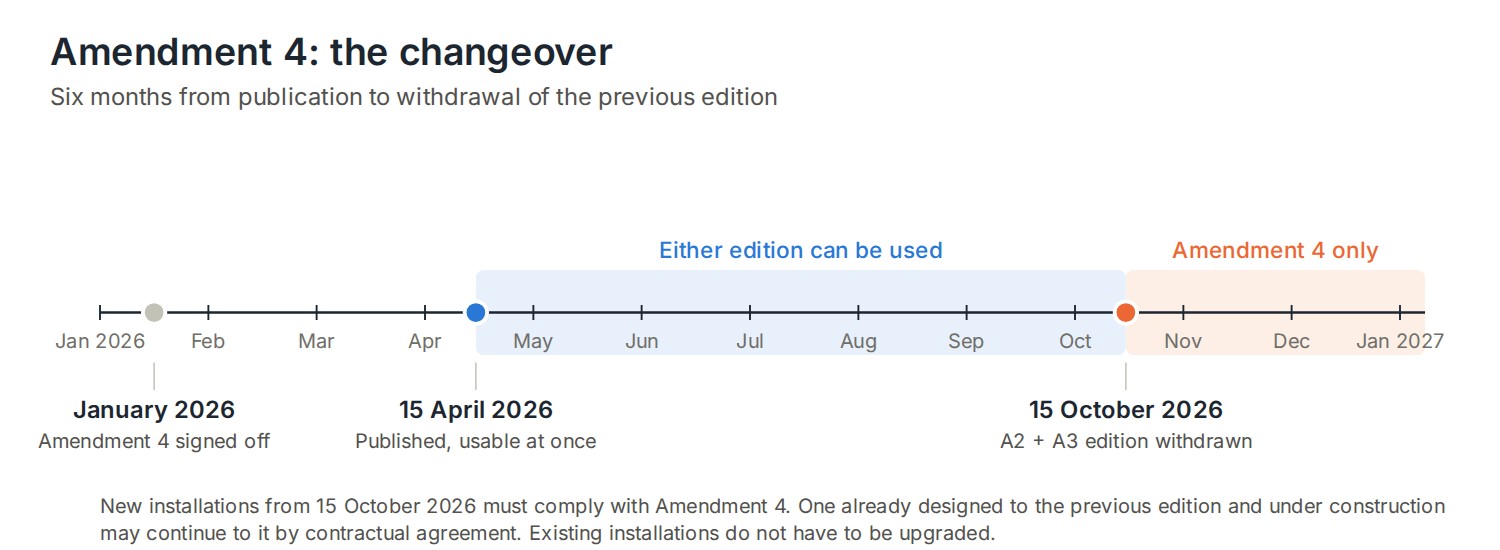
Like every edition of BS 7671, Amendment 4 is not retrospective. An existing installation built to an earlier edition will not comply with every new requirement, but that does not make it unsafe and it does not have to be upgraded.
Section 716: Power over Ethernet
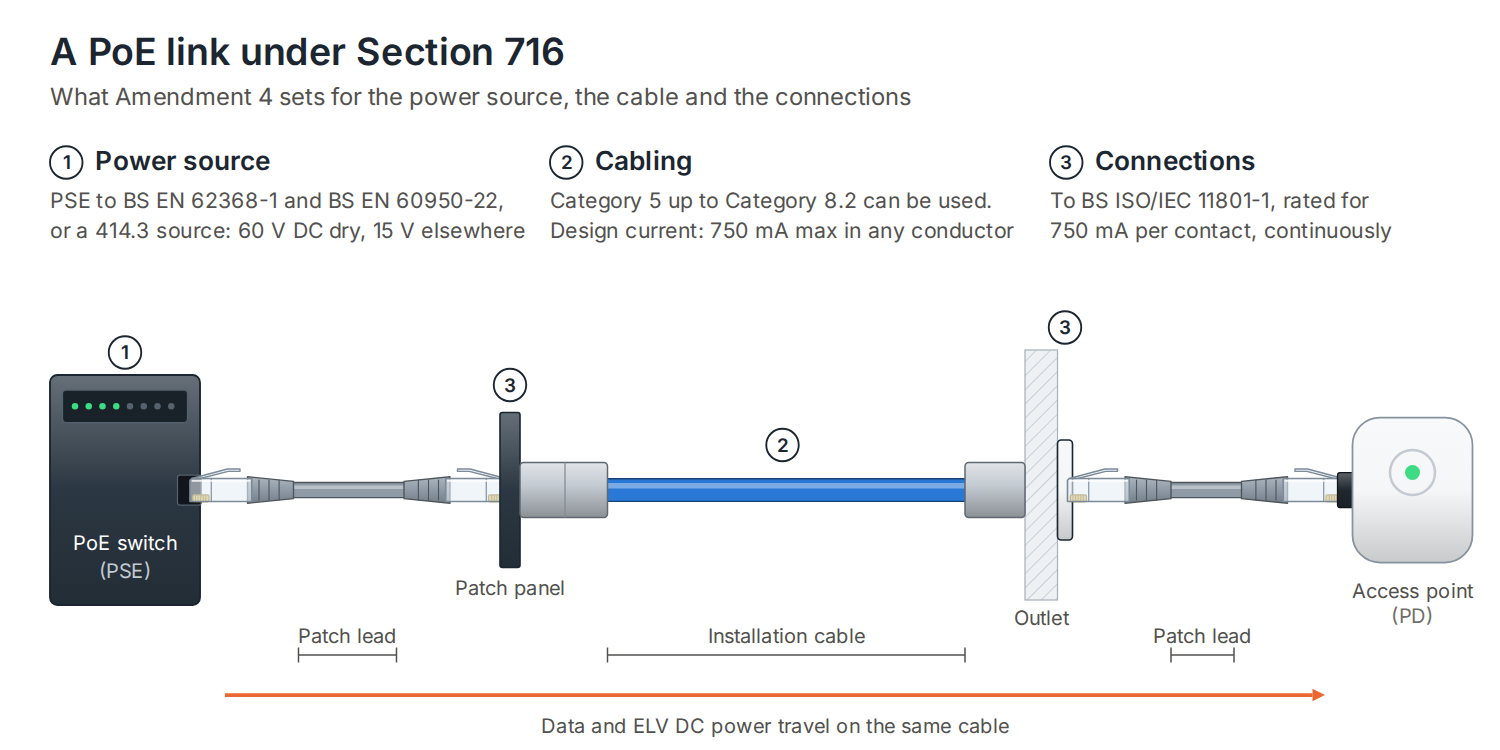
Section 716 is new, and it is the first time BS 7671 has covered PoE directly. Regulation 110.1, which sets out what the standard applies to, now lists Power over Ethernet. The section covers the distribution of extra-low voltage DC power over balanced ICT cables and connectors that were designed primarily for data, referring to standards including BS EN 50173-1 for the cabling and parts of BS EN 60512 for the connectors.
The section sits in Part 7, which supplements or modifies the general rules for special installations and locations. That matters for the voltage. SELV and PELV systems would normally be allowed up to 120 V ripple-free DC. For PoE, Section 716 reduces this to 60 V ripple-free DC in dry locations and 15 V ripple-free DC in all other locations.
What Section 716 requires
| Area | What Amendment 4 says | What it means in practice |
|---|---|---|
| Power source | Power sourcing equipment conforming to BS EN 62368-1 and BS EN 60950-22, plus the PoE interoperability requirements of ISO/IEC/IEEE 8802-3; or a source to Regulation 414.3 | Use PoE switches, midspans and injectors built to those standards. Any other DC source has to meet the 414.3 limits. |
| Voltage | 60 V ripple-free DC in dry locations, 15 V ripple-free DC in all other locations, for a Regulation 414.3 source | Check the location at design stage, particularly for outdoor and damp areas such as external CCTV. |
| Cabling | Category 5, 6, 6A, 7, 7A, 8.1, 8.2 or other | No category above Category 5 is mandated. The current per conductor and how the cable is installed matter more. |
| Current | Design current in any conductor must not exceed 750 mA | Every IEEE PoE type, including 90 W PoE++, stays below this (see below). |
| Connections | To BS ISO/IEC 11801-1, able to carry a continuous 750 mA per contact | Keystones, patch panels, plugs and couplers in a PoE link all need to be rated for that current. |
How PoE current compares with the 750 mA limit
IEEE 802.3 gives a maximum current per pair for each PoE type: 350 mA for Type 1 (802.3af), 600 mA for Types 2 and 3 (802.3at and 802.3bt), and 960 mA for Type 4 (802.3bt, 90 W). Each pair’s current is shared between its two conductors, so the current in any single conductor is half that figure.
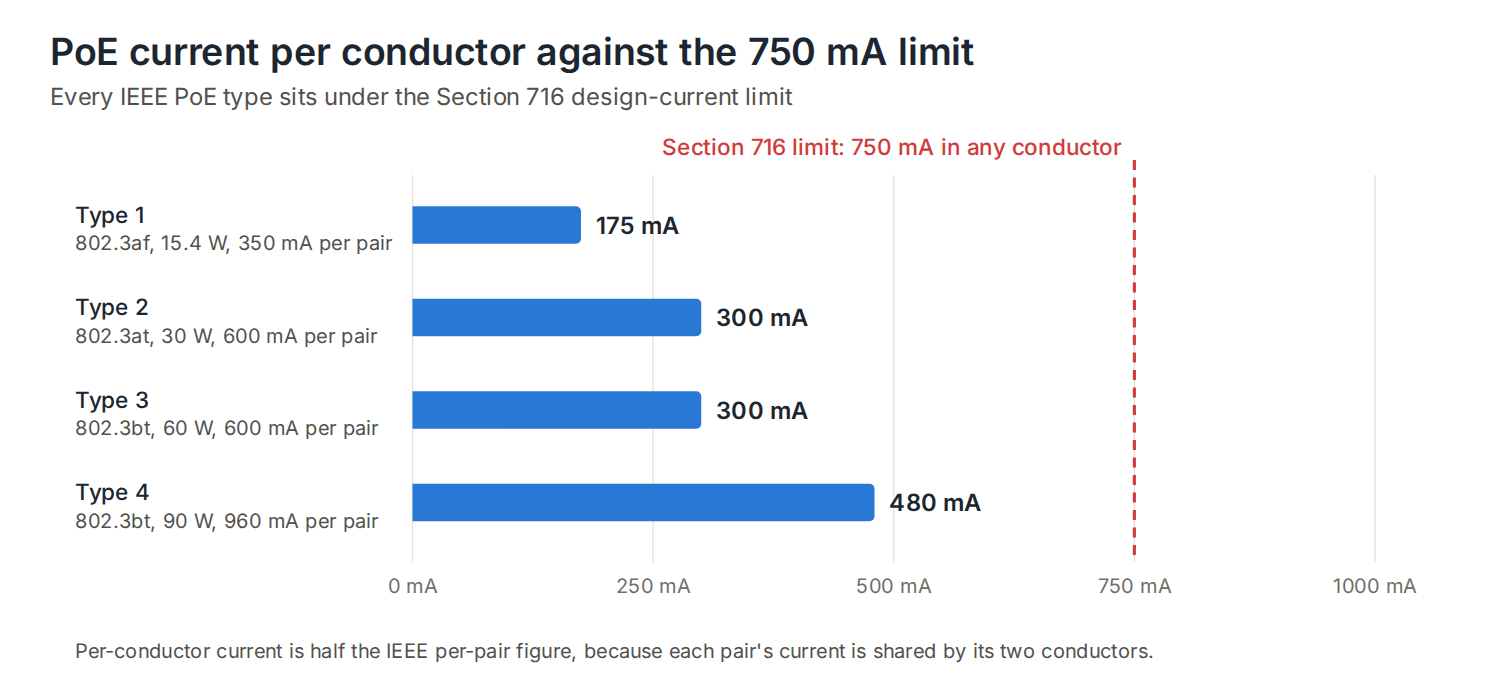
So the limit does not rule out any current PoE type, including Type 4. What it does mean is that the cable and every connection in the link must be fit to carry that current continuously, and that is a question of conductor quality as much as category.
Cable choice and heat
Because Section 716 accepts everything from Category 5 to Category 8.2, it does not force an upgrade to Cat6A for PoE. DTECH Cat6 is tested to 500MHz, carries 10GBase-T to 90m and supports PoE++, as does DTECH Cat6A. For a full comparison of the PoE standards, see PoE vs PoE+ vs PoE++.
The conductor matters more than the category. Current flowing through a conductor produces heat, and the conductor’s resistance decides how much. Pure copper keeps resistance and temperature rise down. Copper-clad aluminium has higher resistance and runs hotter under load, which is one reason CCA data cable fails in PoE installations.
Solid and stranded conductors both have a place. The installation cable should be solid, which has the lower resistance over a long run. Patch leads are stranded for flexibility. Stranded conductors have slightly higher resistance, but a patch lead is only a few metres long, so the extra heating is small and stranded leads are fine for PoE, including PoE++. Solid vs stranded data cable covers the difference in more detail.
Large bundles of PoE cables also run warmer than a single cable. Detailed guidance on remote powering, bundle sizes and temperature rise is published in PD CLC/TR 50174-99-1 and ISO/IEC TS 29125, and designs with large PoE bundles are worth checking against it.
Section 545: functional earthing and bonding for ICT
Section 545 is also new. It sits in Chapter 54, which covers earthing arrangements and protective conductors, and its full title is Functional Earthing and Functional-Equipotential-Bonding for Information and Communication Technology (ICT) Equipment and Systems.
Functional earthing is not there to protect people from electric shock; that is the job of protective earthing. It is there to help electronic equipment work properly and to reduce the effects of electromagnetic interference, which BS 7671 deals with in Section 444. Section 545 sets requirements for:
- the minimum cross-sectional area of functional bonding conductors
- how they are identified
- their electrical continuity
- combined protective and functional bonding conductors
- the main functional earthing terminal (MFET)
- equipotential bonding ring conductors
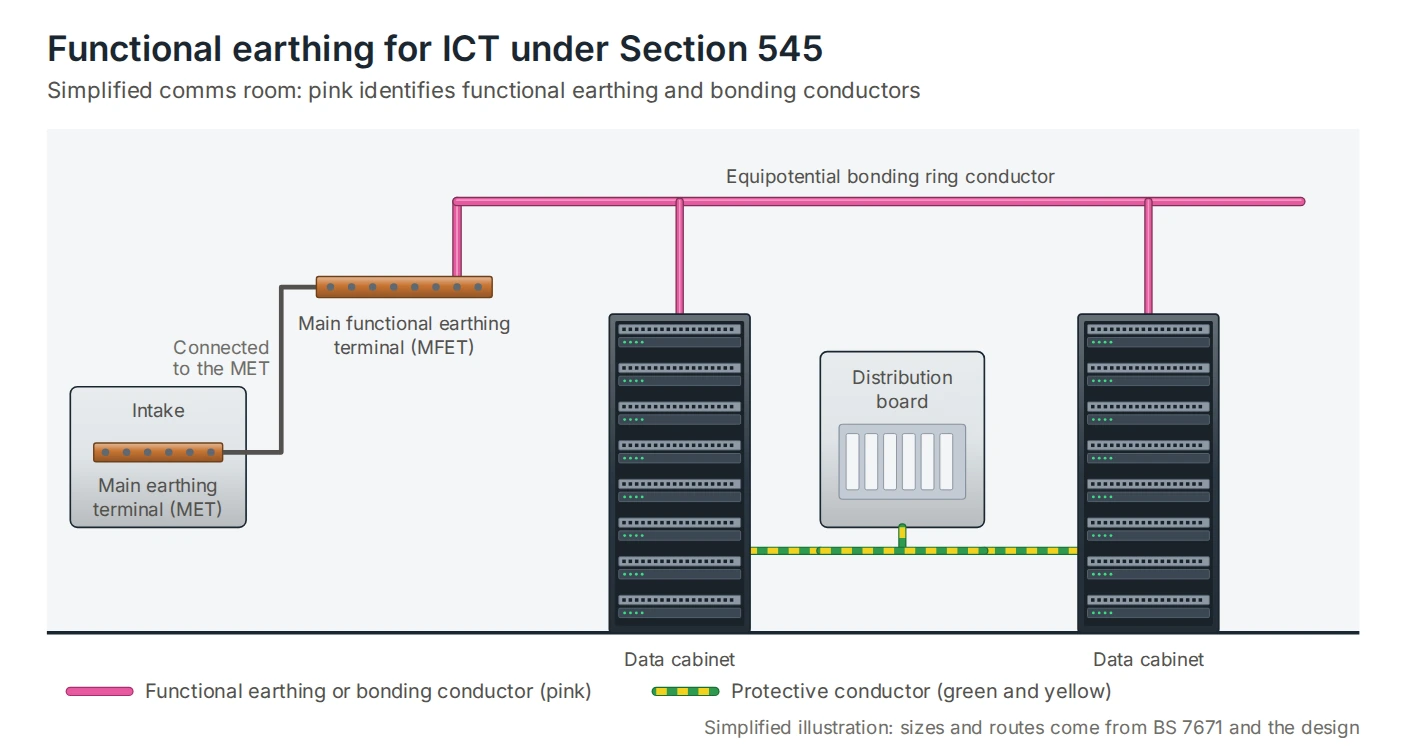
Where functional earthing or bonding conductors are identified by colour, the colour is pink. Pink replaced cream in Amendment 2 in 2022, and it carries through to the new section.
In practice, the bonding of racks, cabinets and ICT equipment back to a main functional earthing terminal is now covered within BS 7671 itself, alongside the cabling and bonding standards that already dealt with it.
Other changes in Amendment 4
Sections 716 and 545 are the changes that affect data cabling most directly. These are the other headline changes:
| Change | What it covers |
|---|---|
| New Chapter 57: stationary secondary batteries | More than 18 new regulations for battery energy storage. Batteries in fire alarm and emergency lighting systems are excluded. |
| AFDDs (Regulation 421.1.7) | The wording now refers to high-rise residential buildings. The other locations where AFDDs are required are unchanged. |
| EV charging (Section 722) | AFDDs are not required for EV charging equipment to BS EN 61851 with socket-outlets or connectors to BS EN IEC 62196-2. |
| RCDs in series (Regulation 531.3.3) | A new note: for example, a Type A RCD should not be fitted upstream of a Type F or Type B RCD. |
| Fire-fighting shafts and protected stairways (422.2.201 and 422.2.202) | Restrictions on what cables and equipment can be installed in them. |
| Wiring systems in a fire (Regulation 521.10.202) | A note explaining that the intent is to prevent general collapse of wiring systems, not to maintain circuit integrity. |
| Medical locations (Section 710) | Substantially revised. |
| Periodic inspection reports (Appendix 6) | The notes for the person producing the report have been rewritten. |
What to do before 15 October
- Get a copy of BS 7671:2018+A4:2026 and read Sections 716 and 545. NICEIC has said its registered contractors do not need an additional qualification, but must be able to show they understand Section 716.
- Design PoE to Section 716: check the power sourcing equipment, whether the location is dry, and the current per conductor.
- Specify pure copper throughout: solid-conductor data cable for the installation runs, stranded patch leads at each end, and keystones and other connecting hardware rated for PoE current.
- Identify functional earthing and bonding conductors in pink, and bring comms room bonding back to a main functional earthing terminal.
- Test and certify the cabling as before; a cable test certificate shows the link performs as specified.
Frequently asked questions
Do existing PoE installations have to be upgraded to Amendment 4?
No. BS 7671 is not retrospective. An installation built to an earlier edition is not unsafe because the standard has changed, and it does not need upgrading. Amendment 4 applies to new installations, and to additions and alterations, from 15 October 2026.
Does Section 716 require Cat6A for PoE?
No. Section 716 lists Category 5, 6, 6A, 7, 7A, 8.1 and 8.2 cabling. The requirement that applies to all of them is that the design current in any conductor must not exceed 750 mA, and that connections must carry 750 mA per contact continuously.
What voltage does Section 716 allow?
For a source to Regulation 414.3, Section 716 limits PoE to 60 V ripple-free DC in dry locations and 15 V ripple-free DC in all other locations. The alternative is power sourcing equipment conforming to BS EN 62368-1 and BS EN 60950-22 and the PoE interoperability standard.
Do data cabling installers need a new qualification?
NICEIC has said that no additional qualification is needed for its registered contractors, but they must be able to show they understand the requirements of Section 716.
What colour are functional earthing conductors?
Pink, where they are identified by colour. Pink replaced cream in Amendment 2 (2022) and is used for functional earthing and bonding conductors under Section 545.
Summary
Amendment 4 brings Power over Ethernet into BS 7671 for the first time. Section 716 sets the power source and voltage limits, accepts cabling from Category 5 to Category 8.2, and caps the design current at 750 mA in any conductor, which every IEEE PoE type meets. Section 545 adds requirements for functional earthing and bonding of ICT equipment, identified in pink. The previous edition is withdrawn on 15 October 2026, after which new installations must comply with Amendment 4.
If you need help specifying PoE-ready cabling and connectivity for an installation under Amendment 4, get in touch with the DTECH team.