Office-grade connectors and patch leads are not built for a factory floor, plant room or outdoor cabinet. Vibration, washdown, oil mist, temperature swings and constant flexing all find the weak point in a standard RJ45 link. DTECH’s industrial range covers the whole connection for these environments: M12 D-code and X-code connectors, made-to-order M12 and RJ45 assemblies, industrial and marine grade cable, and the panel hardware that takes a link through an enclosure wall.
This guide shows where each part goes, what it is rated for, and links to every product in the range.
How the range fits together
Almost every industrial Ethernet link starts at a switch inside a control cabinet and ends at a device on the machine. The range is built around the three usual ways of getting from one to the other.
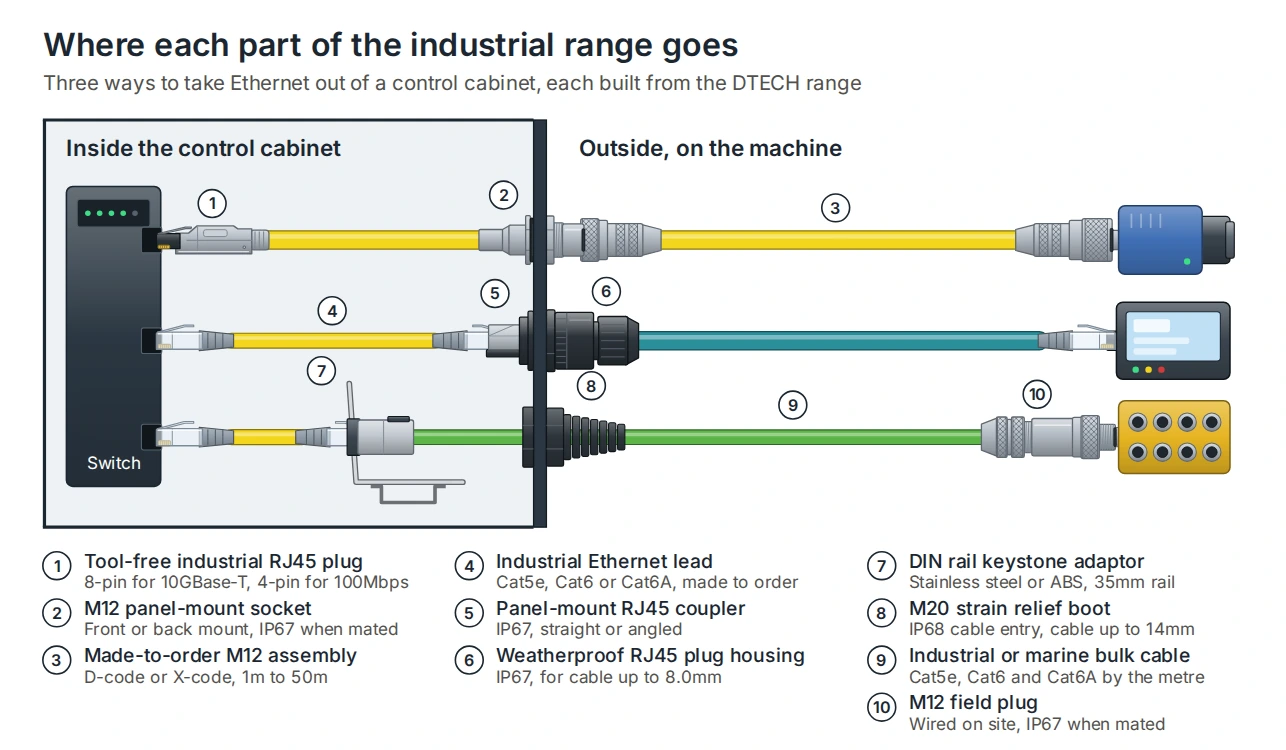
| Route | Inside the cabinet | Through the wall | Outside |
|---|---|---|---|
| M12 through the panel | Tool-free industrial RJ45 plug into the switch | M12 panel-mount socket | Made-to-order M12 assembly to the device |
| RJ45 through the panel | Industrial Ethernet lead | Panel-mount RJ45 coupler | Weatherproof RJ45 plug housing on the field cable |
| Cable through a gland | Lead to a keystone jack on a DIN rail adaptor | M20 strain relief boot | Bulk cable finished with an M12 field plug |
M12 connectors: D-code and X-code
M12 is the threaded, circular connector used on most industrial Ethernet field devices. The range covers the two codings used for Ethernet. D-code is the 4-pin version for 100Mbps links such as PROFINET and EtherCAT, built to IEC 61076-2-101. X-code is the 8-pin version that supports 10GBase-T for machine vision, IIoT and other high-speed industrial Ethernet, built to IEC 61076-2-109. Every M12 connector in the range is rated IP67 when mated and for at least 500 mating cycles. For a full comparison of the two codings, see M12 X-code vs D-code.
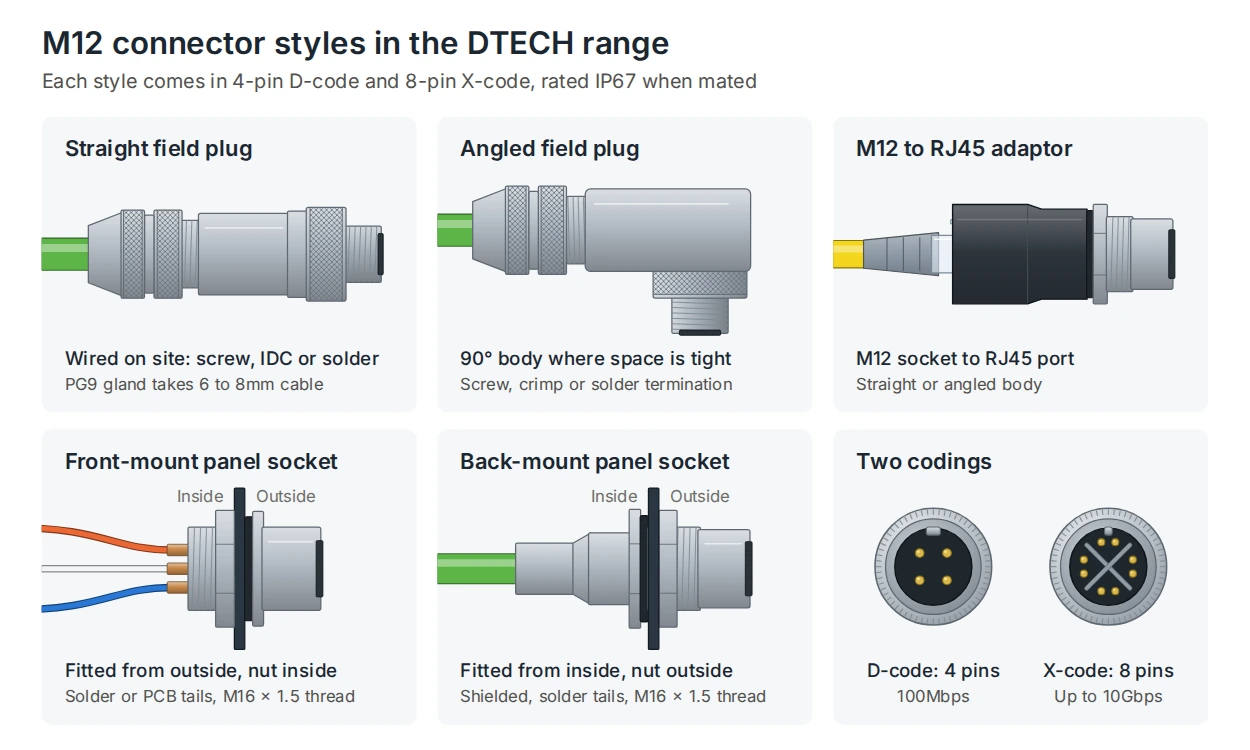
Both codings come in the same five styles. Field plugs are wired on site and clamp onto 6 to 8mm cable with a PG9 gland. Panel sockets fix through an M16 × 1.5 hole: a front-mount socket fits from the outside and is held by a nut on the inside, while a back-mount socket fits from the inside and is held by a nut on the outside. Adaptors convert an M12 socket to an RJ45 port. The links below go to each connector, named by how it terminates.
| Style | D-code, 4-pin | X-code, 8-pin |
|---|---|---|
| Straight plug, male | Screw, metal body Screw, plastic body | Tool-free IDC |
| Straight plug, female | Screw | Solder |
| Angled plug, male | Screw | Crimp, contacts supplied |
| Angled plug, female | Screw | Solder |
| Front-mount panel socket | Solder PCB | Solder PCB |
| Back-mount panel socket, shielded | Solder | Solder |
| M12 to RJ45 adaptor, straight | D-code adaptor | X-code adaptor |
| M12 to RJ45 adaptor, angled | D-code angled adaptor | X-code angled adaptor |
Made-to-order M12 assemblies
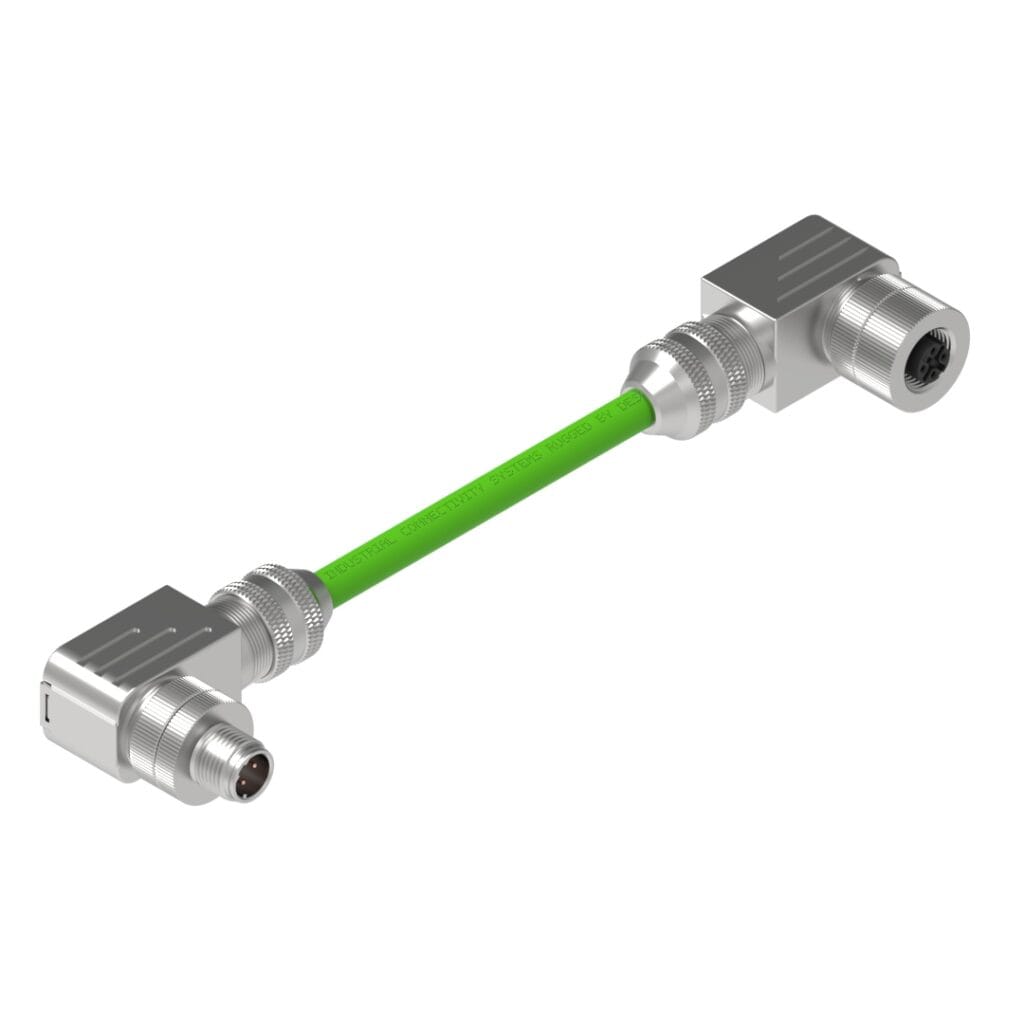
A field plug solves the termination. An assembly solves the whole link: both ends fitted and the cable cut to the length the machine needs, so there is no slack to manage and no joint in the run. DTECH M12 assemblies are made to order in 1m steps from 1m to 50m, in 14 end combinations per coding.
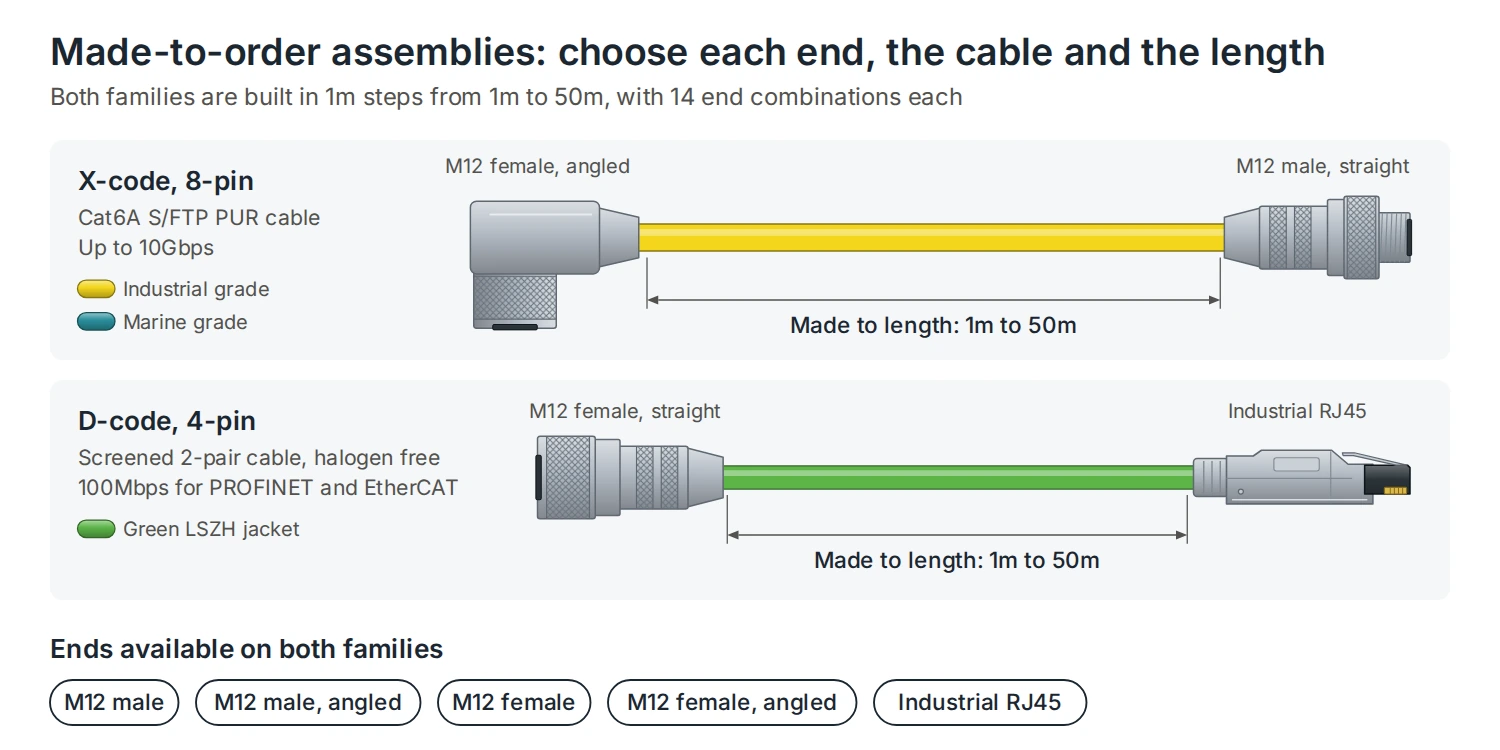
X-code assemblies use 8.0mm Cat6A S/FTP cable with a PUR jacket, so the lead supports the full 10Gbps the connector is built for. Each one can be ordered on industrial grade cable (yellow) or marine grade cable (teal).
D-code assemblies use a 2-pair, foil-screened cable with a green halogen-free jacket, for 100Mbps PROFINET, EtherCAT, EtherNet/IP and Modbus TCP. The connectors are rated 250V and 4A.
Tool-free industrial RJ45 plugs
Not every run can be measured in advance. DTECH’s industrial RJ45 plugs terminate on site without a crimp tool, using an IDC block inside a zinc alloy body that puts a full metal shield around the termination. The IDC block can be re-terminated up to 10 times.
| Plug | Speed | PoE | Cable |
|---|---|---|---|
| Industrial RJ45 plug, 8-pin | 10GBase-T | PoE++ | 22 to 24AWG, up to 8.0mm |
| Industrial RJ45 plug, 4-pin | 100Mbps | PoE+ | 22AWG, up to 6.5mm |
The 4-pin plug suits 2-pair PROFINET-style cable. The 8-pin plug suits 4-pair Cat6A. If you are choosing between an RJ45 and an M12 at the device end, Industrial RJ45 vs M12 covers the decision.
Industrial Ethernet leads and bulk cable
The same cable runs through the leads, the X-code assemblies and the bulk reels, so a link can be specified once and matched end to end.
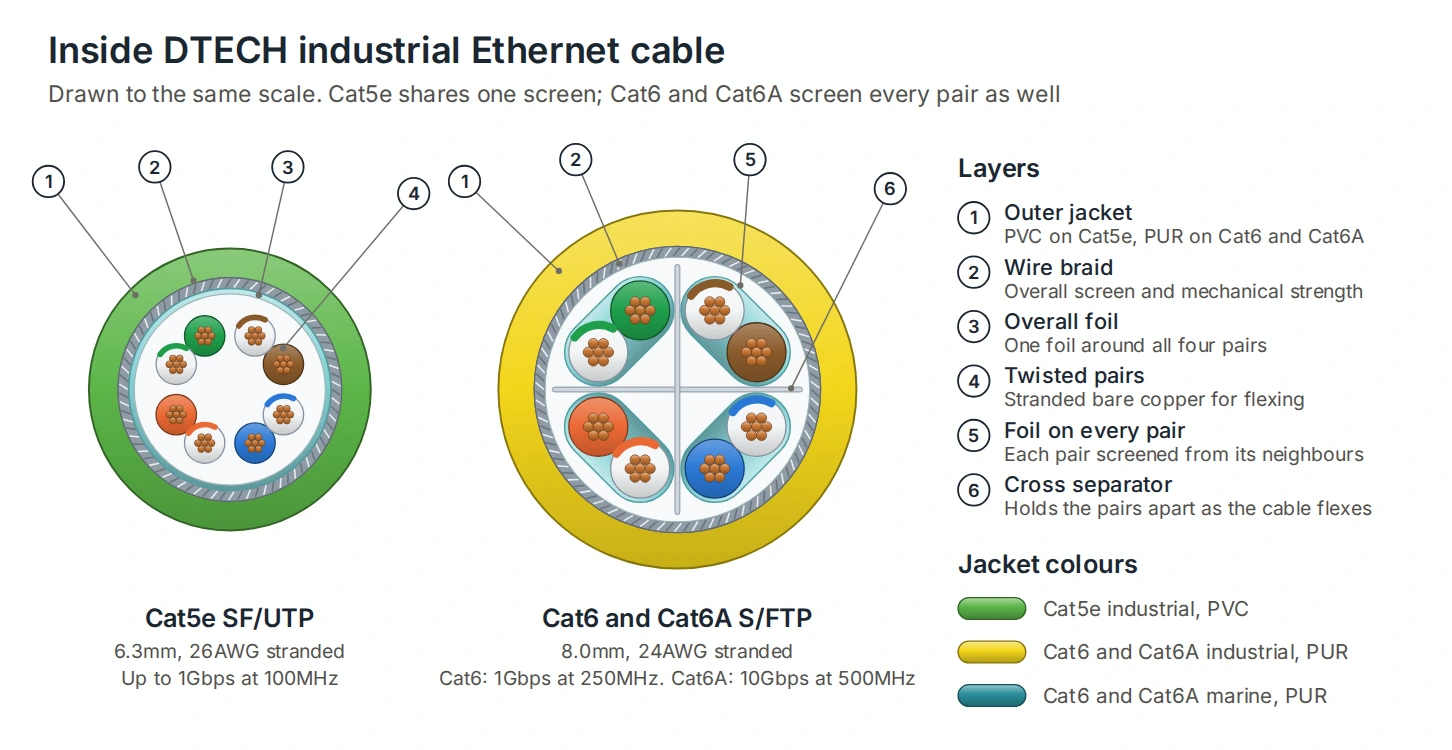
Cat5e is an SF/UTP construction: a wire braid and one overall foil around four unscreened pairs, in a flexible, oil-resistant PVC jacket. Cat6 and Cat6A are S/FTP: a wire braid, a foil around every pair and a cross separator, in an oil, notch and abrasion resistant PUR jacket. All use stranded copper conductors for flexing.
Cat6 and Cat6A are offered in two grades. Industrial grade (yellow) is for factory floor and machine building. Marine grade (teal) adds crush resistance and resistance to salt spray and moisture ingress, for exposed positions where splash and spray are present but the cable is not submerged.
| Bulk cable | Construction | Jacket | Performance |
|---|---|---|---|
| Cat5e industrial cable | SF/UTP, 26AWG stranded | Green PVC, 6.3mm | 1Gbps, 100MHz |
| Cat6 industrial cable | S/FTP, 24AWG stranded | Yellow PUR, 8.0mm | 1Gbps, 250MHz |
| Cat6 marine grade cable | S/FTP, 24AWG stranded | Teal PUR, 8.0mm | 1Gbps, 250MHz |
| Cat6A industrial cable | S/FTP, 24AWG stranded | Yellow PUR, 8.0mm | 10GBase-T to 90m, 500MHz |
| Cat6A marine grade cable | S/FTP, 24AWG stranded | Teal PUR, 8.0mm | 10GBase-T to 90m, 500MHz |
Bulk cable is cut to length by the metre, from 1m to 500m. Industrial leads are made to order from 1m to 50m, and the Cat6 and Cat6A leads can be ordered on either cable grade. The XG leads use the heavy-duty metal industrial RJ45 plug. The keystone versions finish in a shielded keystone jack for a DIN rail adaptor.
| Lead | Cat5e | Cat6 | Cat6A |
|---|---|---|---|
| RJ45 to RJ45 | Cat5e RJ45 lead | Cat6 RJ45 lead | Cat6A RJ45 lead |
| XG RJ45 to XG RJ45 | Cat5e XG lead | Cat6 XG lead | Cat6A XG lead |
| XG RJ45 to keystone jack | Cat5e RJ45 to keystone | Cat6 RJ45 to keystone | Cat6A RJ45 to keystone |
| Keystone to keystone | Cat5e keystone to keystone | Cat6 keystone to keystone | Cat6A keystone to keystone |
Panel and cabinet hardware
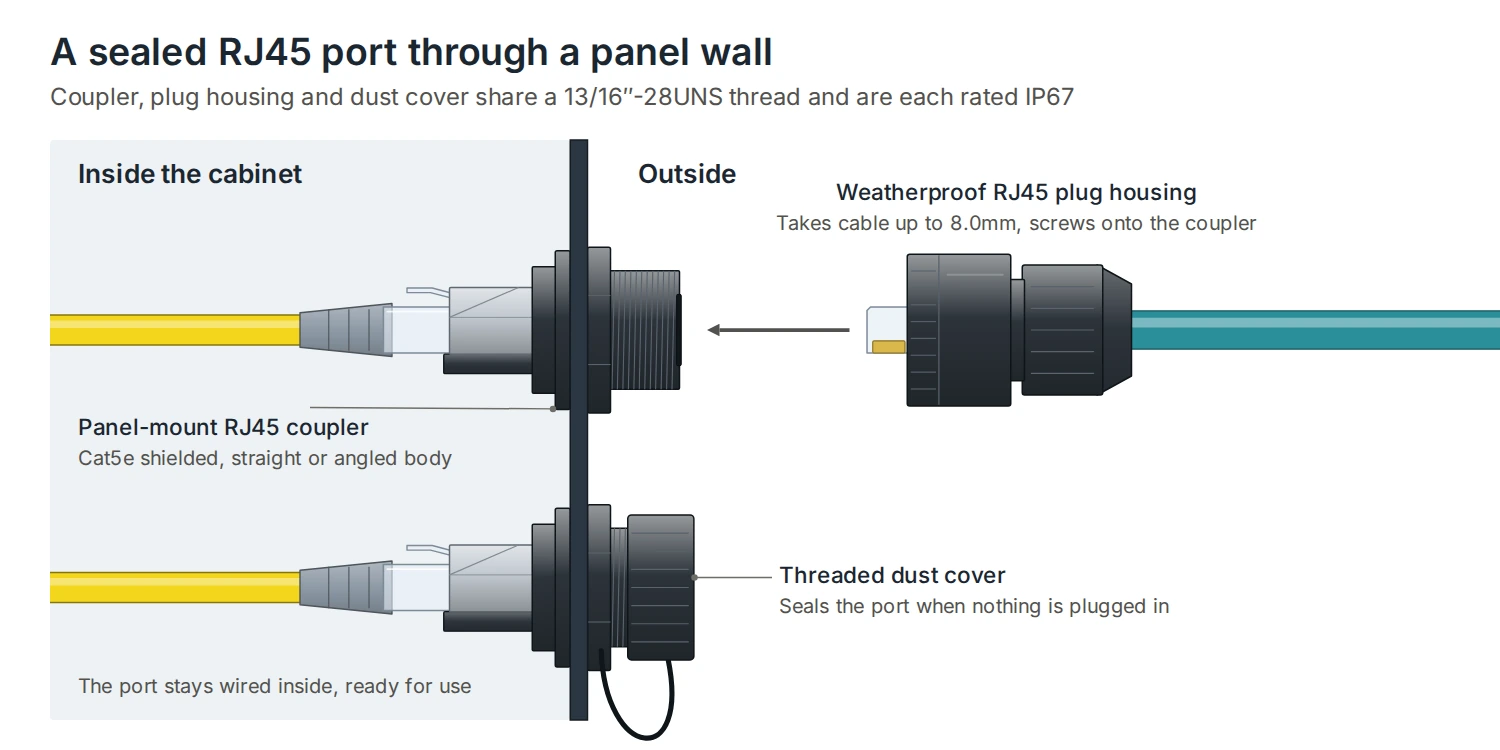
The small parts decide whether an enclosure stays sealed and serviceable. The panel-mount RJ45 coupler gives a cabinet an Ethernet port on the outside wall without opening the door: an ordinary lead plugs into the back, and the threaded nose on the front takes either a weatherproof plug housing or a dust cover.
| Part | What it does | Rating |
|---|---|---|
| RJ45 panel-mount coupler, straight | Cat5e shielded female to female, 13/16″-28UNS thread | IP67 |
| RJ45 panel-mount coupler, angled | As above with a 90° body behind the panel | IP67 |
| Weatherproof RJ45 plug housing | Seals an RJ45 plug on cable up to 8.0mm | IP67 |
| Weatherproof loose housing, 8.0mm | Sealed housing for cable up to 8.0mm | IP67 |
| Weatherproof loose housing, 3.0mm | Sealed housing for fibre leads up to 3.0mm | IP67 |
| E13 threaded dust cover | Seals an unused panel-mount RJ45 port | IP67 |
| USB Type-C panel mount | Female to female, 5/8″-27UNS thread | IP67 |
| M20 strain relief boot | Nylon cable entry for cable up to 14mm, locknut included | IP68 |
| RJ45 port dust cap | Push-in cap for unused keystone ports | – |
Inside the cabinet, DIN rail keystone adaptors clip onto a standard 35mm rail without tools and hold standard keystone jacks, so field cable can be terminated at the rail and patched to the switch with a short lead.
| DIN rail and screening | Detail |
|---|---|
| Stainless steel DIN rail adaptor, 1 port | Shielded mount for one keystone jack |
| Stainless steel DIN rail adaptor, 2 port | Shielded mount for two keystone jacks |
| Stainless steel DIN rail adaptor, 3 port | Shielded mount for three keystone jacks |
| ABS DIN rail adaptor, 1 port | Non-conductive mount for one keystone jack |
| Copper shielding strips, pack of 8 | Self-adhesive 35mm × 10mm strips for screening and earthing cable terminations |
Industrial fibre panel mounts
Where a run needs fibre rather than copper, for distance or for immunity to electrical noise, the same panel-mount approach carries across to LC and SC. Each adaptor works with single-mode and multimode fibre, with a maximum insertion loss of 0.3dB.
| Fibre panel mount | Connector | Fixing |
|---|---|---|
| LC duplex, front mount | LC duplex | Threaded, 13/16″-28UNS |
| LC duplex, back mount | LC duplex | Bayonet |
| SC simplex, front mount | SC simplex | Threaded, 13/16″-28UNS |
| SC simplex, back mount | SC simplex | Bayonet |
IP ratings across the range
An IP rating only applies to a connection that is fully mated and tightened. IP67 means dust-tight and protected against temporary immersion in water. IP68 covers continuous immersion under conditions set by the manufacturer.
| Product group | Rating |
|---|---|
| M12 plugs, panel sockets and M12 to RJ45 adaptors | IP67 when mated |
| M12 D-code and X-code assemblies | IP67 when mated |
| Panel-mount RJ45 couplers, plug housings and dust cover | IP67 |
| USB Type-C panel mount | IP67 |
| M20 strain relief boot | IP68 |
Nothing in the range is listed as IP69K, the rating for high-pressure, high-temperature washdown. If a specification calls for it, talk to the DTECH team before ordering. IP ratings explained sets out what each rating is tested against.
Frequently asked questions
What is the difference between M12 D-code and X-code?
D-code is the 4-pin M12 used for 100Mbps industrial Ethernet such as PROFINET and EtherCAT. X-code is the 8-pin M12 that supports 10GBase-T, used for machine vision cameras and other high-bandwidth links. The two are keyed differently and will not mate with each other.
What lengths can M12 assemblies and industrial leads be made in?
Every M12 assembly and industrial Ethernet lead is made to order in 1m steps from 1m to 50m. Bulk industrial cable is cut by the metre from 1m to 500m.
What is the difference between industrial grade and marine grade cable?
Both are S/FTP cables with an oil, notch and abrasion resistant PUR jacket. Marine grade, in a teal jacket, adds crush resistance and resistance to salt spray and moisture ingress for exposed positions where splash and spray are present. It is not intended for full submersion. Industrial grade, in a yellow jacket, covers factory floor and machine building use.
What is the difference between a front-mount and a back-mount panel socket?
A front-mount socket is fitted from the outside of the panel and held by a nut on the inside. A back-mount socket is fitted from the inside and held by a nut on the outside. Both use an M16 × 1.5 thread.
Do the industrial RJ45 plugs need a crimp tool?
No. The 8-pin and 4-pin industrial RJ45 plugs use a tool-free IDC termination and can be re-terminated up to 10 times.
Summary
DTECH’s industrial range covers the full link for harsh environments: M12 D-code and X-code connectors in five styles, made-to-order M12 assemblies and industrial leads from 1m to 50m, industrial and marine grade cable in Cat5e, Cat6 and Cat6A, tool-free industrial RJ45 plugs, and the panel, DIN rail and fibre hardware that takes a connection through an enclosure wall. The M12 connectors and assemblies are rated IP67 when mated.
If you need help choosing the right connector, assembly or cable for an application, get in touch with the DTECH team.