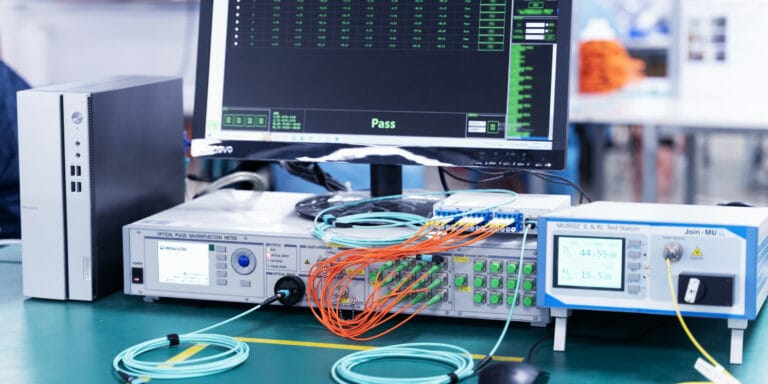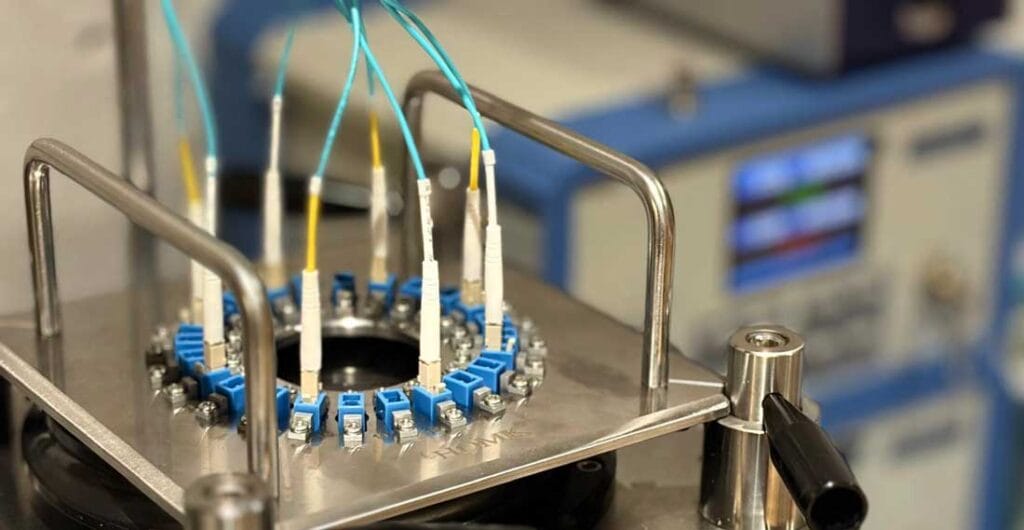
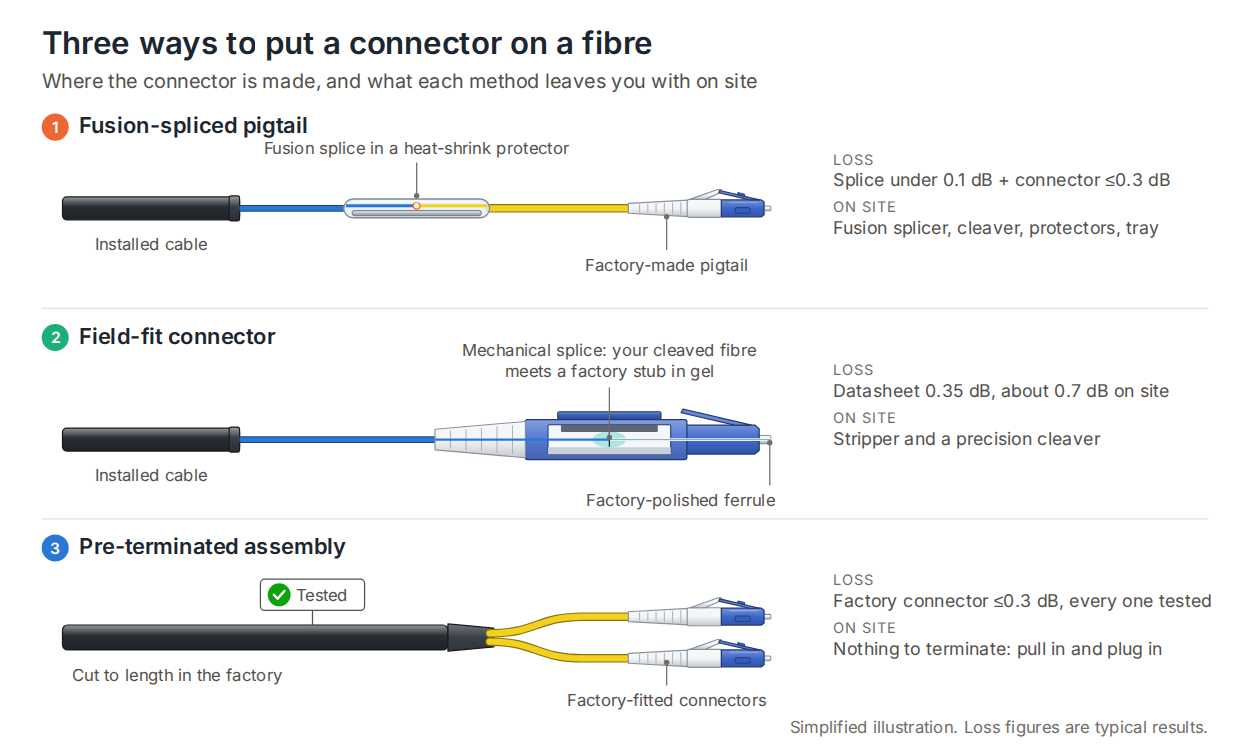
Every fibre link ends in a connector, and there are three ways to get one there. You can fusion splice a factory-made pigtail onto the installed fibre, fit a field-fit connector by hand, or order pre-terminated cable with the connectors already on. All three work. They differ in loss, in the tools and skills needed on site, and in how much of the risk is taken off the job before the cable arrives.
This guide explains how each method works, what loss to expect, what each one costs you in time and equipment, and when to use which.
The three methods at a glance
| Fusion-spliced pigtail | Field-fit connector | Pre-terminated | |
|---|---|---|---|
| Where the connector is made | Factory (on the pigtail) | Factory ferrule, joined on site | Factory |
| Joint made on site | Fusion splice | Mechanical splice inside the connector | None |
| Typical loss | Splice under 0.1 dB, plus connector up to 0.3 dB | About 0.7 dB on site (0.35 dB on datasheets) | Connector up to 0.3 dB, tested |
| Tools on site | Fusion splicer, cleaver, stripper, protectors, tray | Stripper and a precision cleaver | None for termination |
| Best for | High fibre counts, backbones, loose tube and external cable | A few ends and repairs, where loss matters less | Known route lengths, fast installs |
Fusion splicing
A fusion splice joins two fibres into one continuous piece of glass. The splicer lines up the two cores and an electric arc melts the ends together. Because nothing is left between the fibres, a fusion splice has the lowest loss and the lowest reflectance of any joint. Typical loss is under 0.1 dB, and below 0.05 dB is readily achievable when splicing singlemode fibres of the same type.
In a building, fusion splicing is almost always used to fit pigtails. A pigtail, such as an OS2 or OM4 LC UPC pigtail, is a short length of fibre with a factory-fitted connector on one end and bare fibre on the other. You splice the bare end to the installed fibre, protect the splice, and store it in a splice cassette or tray inside the patch panel or enclosure. The connector is factory-made and polished, so its quality doesn’t depend on the conditions on site.
How a fusion splice is made
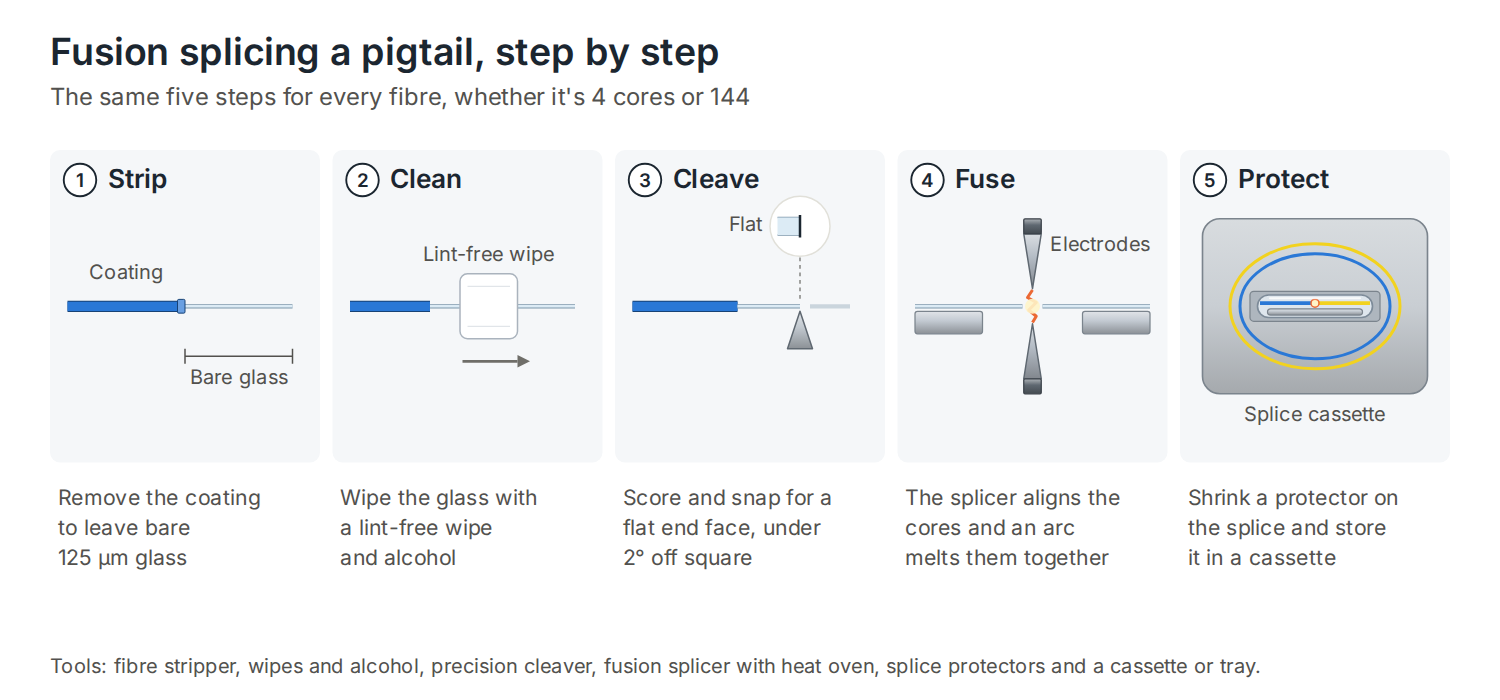
- Strip the coating to leave bare 125 µm glass.
- Clean the glass with a lint-free wipe and alcohol, and handle it as little as possible.
- Cleave the fibre to give a flat end face. End angles under 2° give acceptable fusion splices, and a good cleaver does much better.
- Fuse the fibres. The splicer aligns the cores, fires the arc and estimates the splice loss.
- Protect the splice with a heat-shrink splice protector and store it in the cassette, keeping the bend radius.
The cleave is the step that most affects the result. A poor cleave gives a high-loss splice however good the splicer is.
What fusion splicing needs
A fusion splicer is a significant purchase, and splicing is a skill that takes training and practice. Against that, the consumables for each splice cost very little, so on jobs with many fibres the cost per joint is the lowest of any method. Fusion splicing uses a high-voltage arc, so it can’t be done in an explosive atmosphere.
It is the standard way to terminate loose tube cable, where the 250 µm fibres are too fine to take a connector directly, and it suits long backbones where the exact length isn’t known until the cable has been pulled in.
Mechanical splicing
A mechanical splice doesn’t fuse the glass. It holds two cleaved fibres end to end in an alignment sleeve or V-groove, with index-matching gel between them to cut reflection. It needs no splicer, but typical loss is higher, from 0.2 dB to 0.75 dB, and the top of that range is well above the 0.3 dB TIA-568 maximum for a splice. Mechanical splices are mostly used for temporary restoration, such as getting a damaged cable working again until it can be fusion spliced.
Field-fit connectors
A field-fit connector, also called a fast connector or a pre-polished splice connector, puts the mechanical splice inside the connector. The ferrule is polished in the factory and holds a short stub of fibre. On site you strip and cleave the installed fibre, push it into the back of the connector until it meets the stub in index-matching gel, and clamp it. There’s no splicer, no epoxy and no polishing.
The trade-off is loss, and it is bigger than the datasheets suggest. Every field-fit connector has two loss points, the ferrule and the mechanical splice behind it, and the result depends on the cleave, how clean the fibre is and the person doing it. Datasheet figures of around 0.35 dB are measured with the maker’s recommended tools in ideal conditions. You won’t see that on site. Around 0.7 dB is a realistic result, and that’s on a good day. The Fiber Optic Association reports the same pattern: about 0.5 dB at best with a precision cleaver, and more often about 0.75 dB with a basic one.
That means one field-fit connector can use almost all of the 0.75 dB TIA-568 allows for a whole mated connector pair. You also can’t check the result until the connector is fitted, and most can’t be re-terminated, so a bad one is cut off and replaced. You don’t need a splicer, but you do need a stripper and a good cleaver.
DTECH field-fit connectors are made for OS2 singlemode, in LC and SC with UPC or APC polish. They suit G.652.D and G.657.A1/A2 fibre with a 0.9 to 3.0 mm buffer or jacket. Use them where a splicer isn’t available and the link can stand the extra loss: a handful of terminations, a repair, or a drop. For anything else, a spliced pigtail or a pre-terminated assembly will give a lower, more predictable result.
Pre-terminated fibre
Pre-terminated cable arrives with the connectors already fitted and tested. The termination is done in the factory, with the polishing, inspection and testing that a site can’t match, so there’s nothing to splice or fit on site. The cable is pulled in and plugged in.
The trade-off is that the length has to be known before you order. Measure the route, allow some slack for routing and service loops, and the cable is made to suit.
DTECH pre-terminated fibre is UK manufactured and made to order in OS2, OM3 and OM4, from 4 to 24 fibres, in tight buffered, loose tube and armoured constructions, including OS2 and OM4 tight buffered assemblies, with LC or SC connectors in UPC or APC. Every assembly is 100% factory tested before despatch, and every order is delivered in 2 to 4 days. Pre-terminated fibre: when to use it and how DTECH’s service works covers the service in detail.
How the loss compares
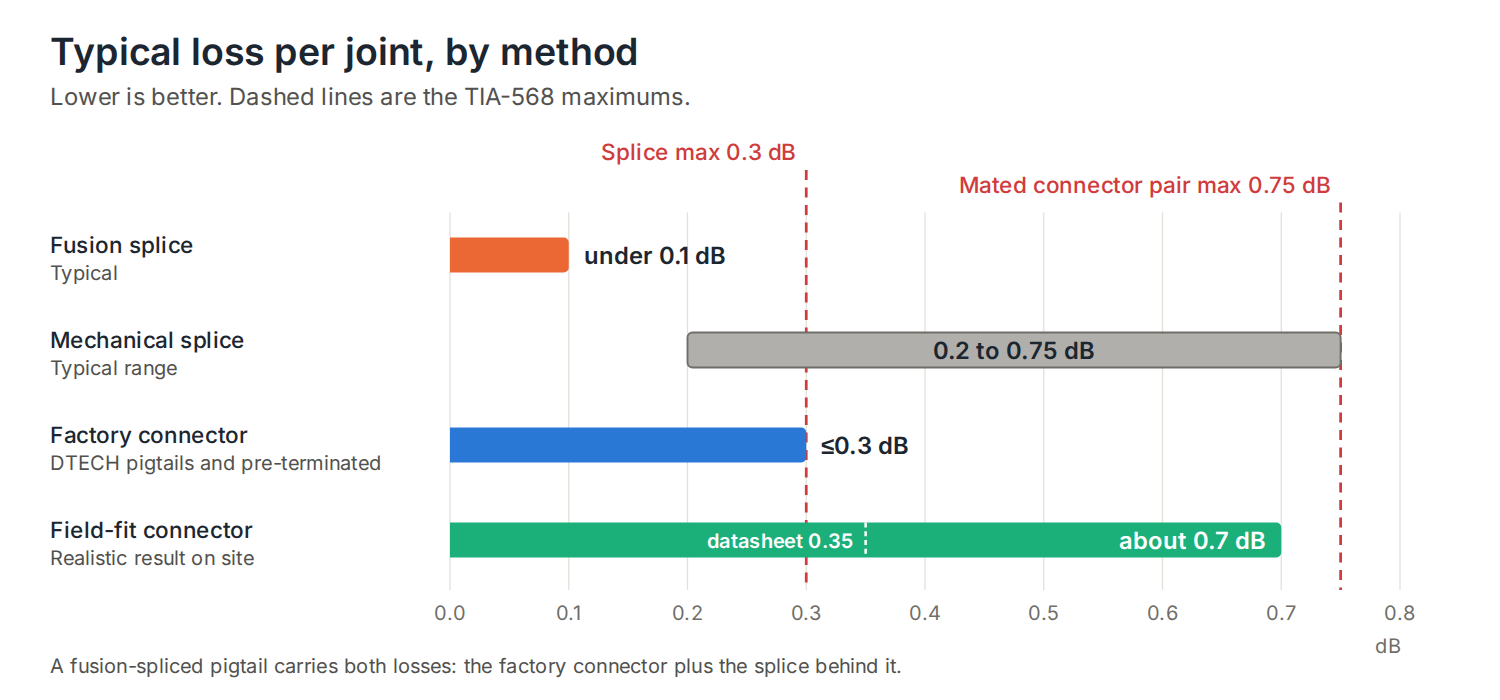
TIA-568 allows up to 0.3 dB per splice and 0.75 dB per mated connector pair. Pigtails and pre-terminated connectors sit comfortably inside those limits. A field-fit connector at around 0.7 dB is right at the edge on its own. The difference shows when you add up a whole link in a loss budget, especially on links with several connections or tight power budgets at higher speeds.
| Method | In the path at each end | Loss at each end |
|---|---|---|
| Fusion-spliced pigtail | Factory connector + fusion splice | Up to 0.3 dB + under 0.1 dB |
| Field-fit connector | Factory ferrule + mechanical splice, in one connector | About 0.7 dB on site (0.35 dB on datasheets) |
| Pre-terminated | Factory connector | Up to 0.3 dB, measured before despatch |
Across both ends of a link, that is about 1.4 dB for two field-fit connectors, against up to about 0.8 dB for two spliced pigtails and up to 0.6 dB for a pre-terminated assembly, before the cable itself is counted. A spliced pigtail carries two losses, the connector and the splice behind it. A pre-terminated assembly has only the connector, and it has already been measured. Whichever method you use, clean and inspect every connector before mating it, because a dirty end face adds more loss than any of the differences above. Insertion loss and return loss explained covers what the figures mean.
Which method should you use?
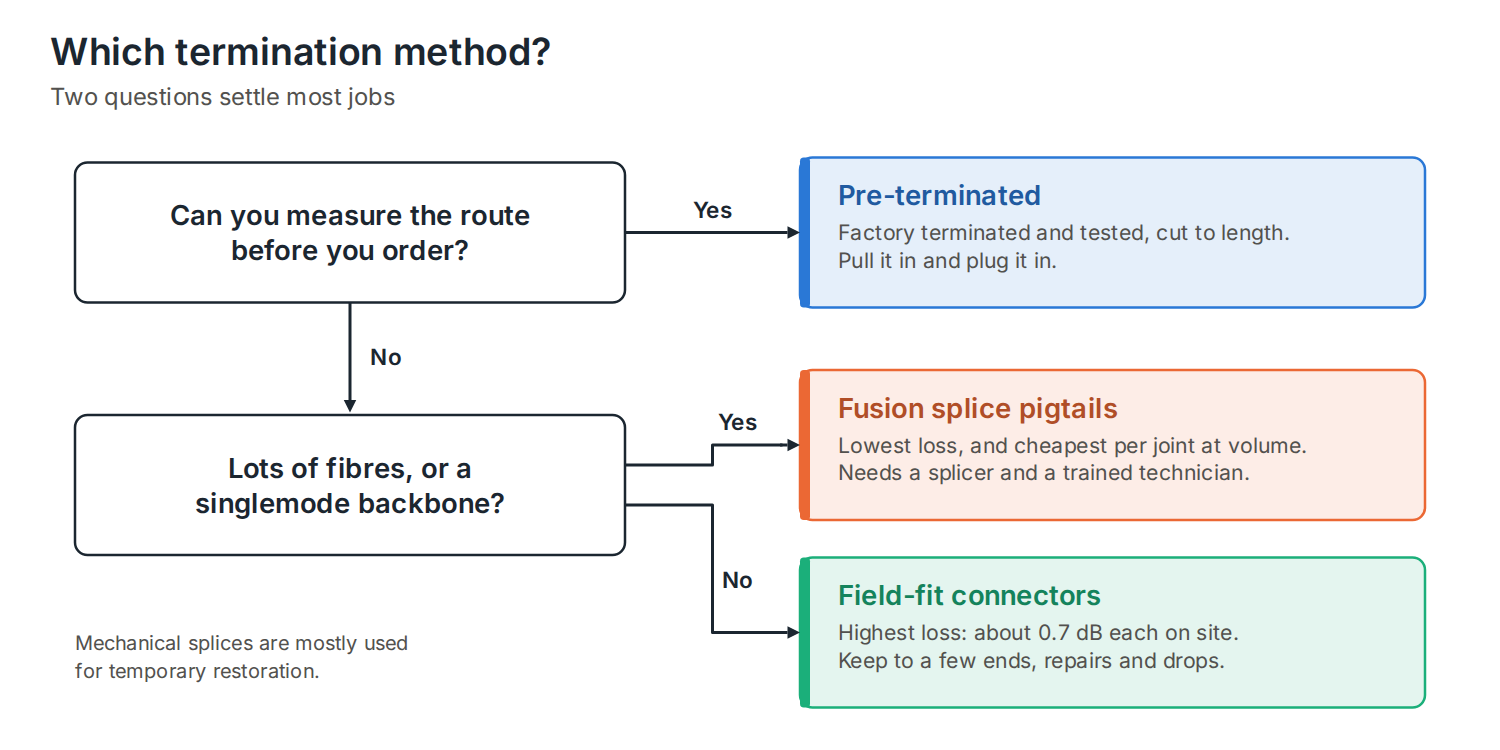
| Job | Best method | Why |
|---|---|---|
| Data centre and inter-cabinet links | Pre-terminated | Lengths are known, and factory-tested connectors cut installation time |
| Equipment room to floor distributor, defined route | Pre-terminated | Measure once, order to length, no work at the panel |
| Long backbone, length unknown until pulled | Fusion-spliced pigtails | Terminate after the cable is in, at the lowest loss |
| Loose tube or external cable | Fusion-spliced pigtails | 250 µm fibres need splicing to a pigtail |
| High fibre counts, many terminations | Fusion-spliced pigtails | Lowest cost per joint once you have a splicer |
| A few singlemode ends or a repair, no splicer available | Field-fit connectors | Quick to fit, but expect about 0.7 dB per connector |
| Temporary repair to a damaged cable | Mechanical splice | Quick restoration until it can be fusion spliced |
Frequently asked questions
Is fusion splicing better than mechanical splicing?
For permanent joints, yes. A fusion splice is typically under 0.1 dB with very low reflectance, against 0.2 to 0.75 dB for a mechanical splice. Mechanical splices need no splicer, so they’re useful for temporary restoration, but fusion splicing is the standard for permanent installations.
What is the difference between a pigtail and a patch lead?
A pigtail has a connector on one end only, and the other end is spliced to the installed cable. A patch lead has connectors on both ends and links equipment to the patch panel.
Can I terminate fibre without a fusion splicer?
Yes. Pre-terminated cable needs no termination at all. Field-fit connectors need only a stripper and a precision cleaver, but expect about 0.7 dB per connector on site. Loose tube cable is the exception, as its 250 µm fibres are normally spliced to pigtails.
How much loss is acceptable for a splice or a connector?
TIA-568 allows up to 0.3 dB per splice and 0.75 dB per mated connector pair. A good fusion splice is well under 0.1 dB, and DTECH factory connectors are 0.3 dB or less. A field-fit connector at around 0.7 dB is close to the connector pair limit on its own.
Do field-fit connectors work on multimode fibre?
Multimode field-fit connectors exist, but the DTECH range is for OS2 singlemode. For OM3 and OM4, use OM3 or OM4 pigtails, or a pre-terminated assembly.
Summary
Fusion-spliced pigtails give the lowest loss and suit long backbones, high fibre counts and loose tube cable, but need a splicer and a trained technician. Field-fit connectors need no splicer, but at around 0.7 dB a connector on site they have the highest loss of the three, so keep them to a few ends and repairs. Pre-terminated cable takes termination off site completely, with every connector tested before it arrives, and is the quickest choice wherever the route can be measured. DTECH supplies all three: pigtails and splicing accessories, field-fit connectors, pre-terminated fibre, bulk fibre cable and patch panels.
If you need help choosing a termination method or specifying a pre-terminated assembly, get in touch with the DTECH team.