A 48-port switch patched with standard leads fills its cable managers quickly. Slim patch leads use thinner 28AWG conductors to cut the cable diameter by up to a third, which frees up space in the cabinet, keeps airflow moving across the equipment and makes individual ports easier to reach.
28AWG patch cords have been recognised by the TIA cabling standards since 2018, and good-quality slim leads carry 10GBASE-T and PoE++ when they’re used as the standards intend. This guide covers how slim leads are made, how they fit into a standard channel, what to know about PoE, and where they work best.
What makes a patch lead slim
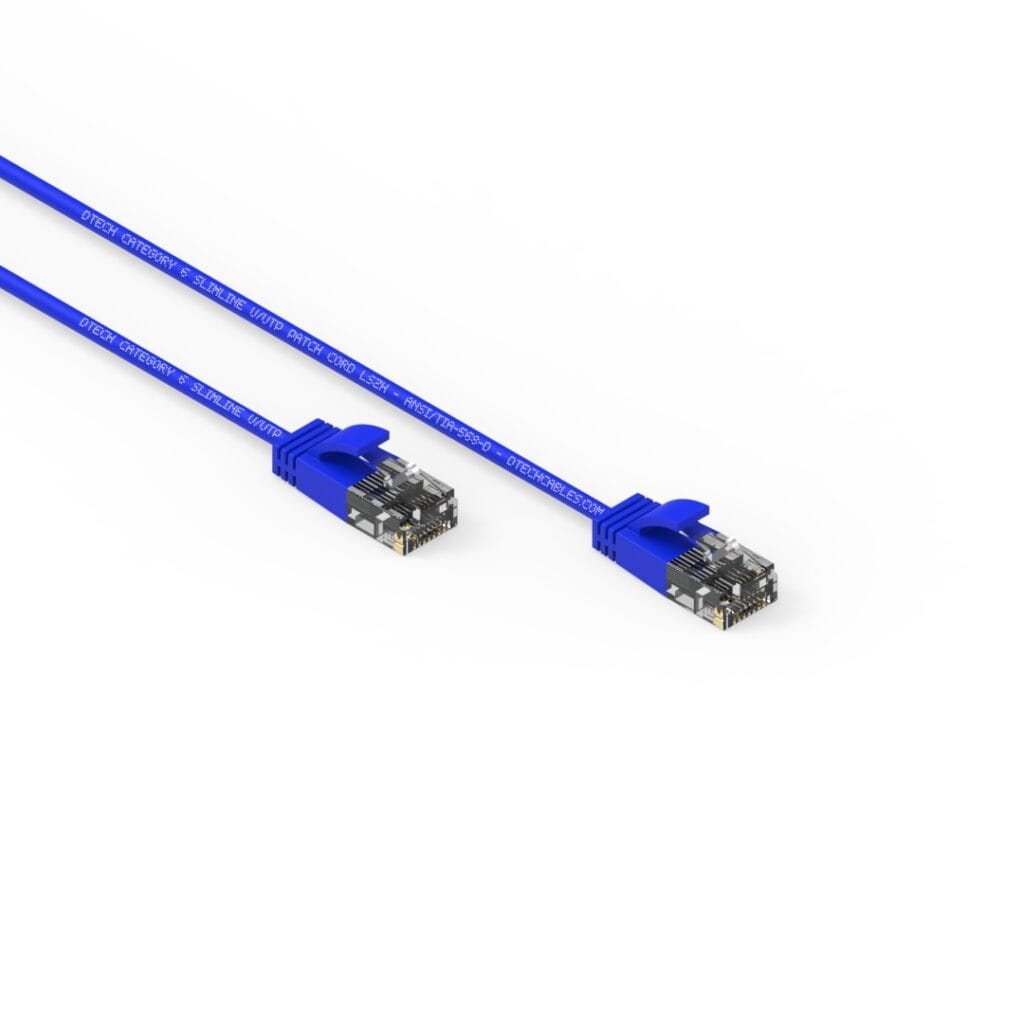
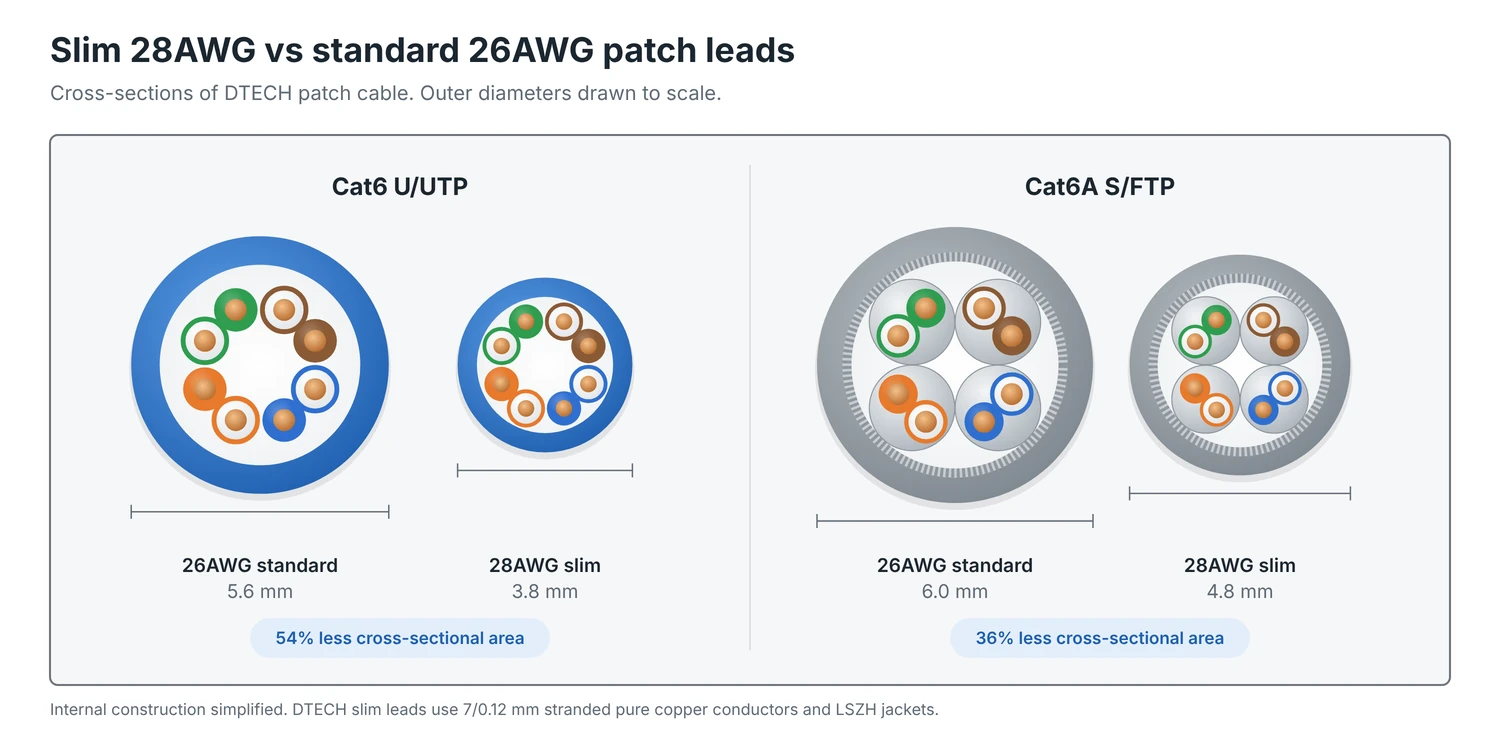
The difference is the conductor size. Standard patch leads use 24AWG or 26AWG stranded conductors. Slim leads use 28AWG, with smaller insulation around each conductor, so the four pairs pack into a much smaller jacket.
The cross-section is where the space saving comes from. A DTECH 28AWG Cat6 patch lead measures 3.8 mm across, against 5.6 mm for DTECH’s 26AWG Cat6 patch cable. That’s about 54% less cross-sectional area per lead. A DTECH 28AWG Cat6A S/FTP patch lead is 4.8 mm against 6.0 mm for the 26AWG version, about 36% less, while keeping individually foiled pairs and an overall braid.
| DTECH patch cable | Conductors | Diameter | Rated bandwidth |
|---|---|---|---|
| Cat6 U/UTP slim | 28AWG stranded (7/0.12 mm) | 3.8 mm | 550 MHz |
| Cat6 U/UTP standard | 26AWG stranded | 5.6 mm | 550 MHz |
| Cat6A S/FTP slim | 28AWG stranded (7/0.12 mm) | 4.8 mm | 650 MHz |
| Cat6A S/FTP standard | 26AWG stranded | 6.0 mm | 650 MHz |
Both DTECH slim leads use pure copper conductors and LSZH jackets, and are guaranteed to pass Fluke patch lead testing to ISO/IEC 11801, Class E for Cat6 and Class EA for Cat6A.
Why installers choose slim leads
- More room in the cabinet. Smaller bundles fit horizontal and vertical cable managers with space to spare, which matters most on high-density switches and patch panels.
- Better airflow. Thick bundles across the front of switches and panels restrict airflow. Slimmer leads leave more open space for air to move through the cabinet.
- Easier moves and changes. Individual leads are easier to trace, label and unplug when they aren’t packed tightly together.
- Tighter routing. DTECH slim leads have a minimum bend radius of 4 times the cable diameter, about 15 mm for the Cat6 lead, so they route neatly around tight corners in shallow cabinets and wall boxes.
How slim leads fit into a standard channel
A standard Ethernet channel is up to 100 m: a permanent link of up to 90 m of installation cable, plus patch cords at both ends. The 90 m and 100 m rules explain how that works.
ANSI/TIA-568.2-D added 28AWG patch cords in 2018, for Category 6A as well as Category 6. Because thinner conductors have higher insertion loss, the standard gives them a de-rating factor of 1.95: each metre of 28AWG cord counts as 1.95 m of installation cable. In practice, up to about 6 m of 28AWG cords in a channel still leaves the full 90 m permanent link. That covers a typical layout of a short lead at the patch panel and another at the outlet.
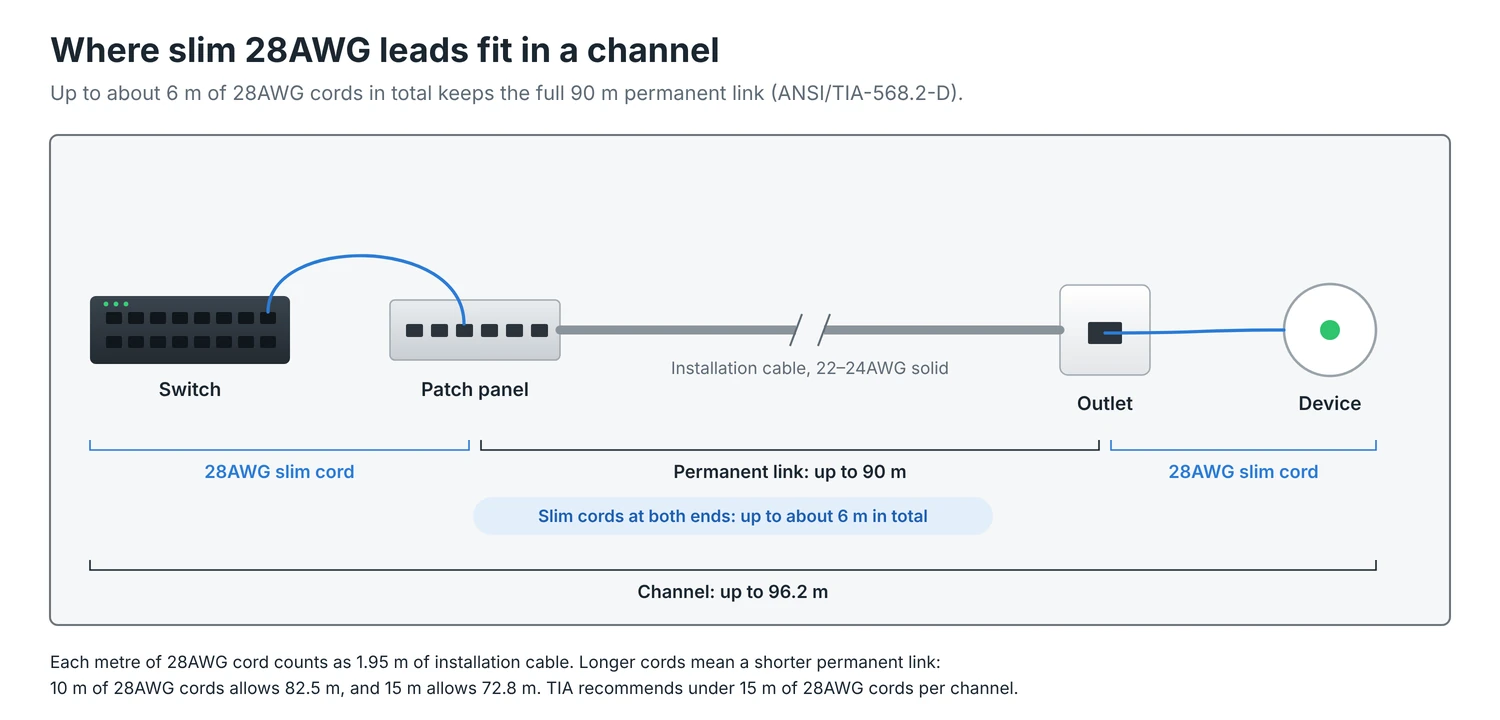
| Total 28AWG cord length | Maximum permanent link | Channel length |
|---|---|---|
| Up to 6.2 m | 90 m | 96.2 m |
| 10 m | 82.5 m | 92.5 m |
| 15 m | 72.8 m | 87.8 m |
TIA also recommends keeping the total 28AWG cord length in a channel under 15 m, so the channel stays within its DC resistance limit. Slim cords are for patching only: the permanent link itself should always be installation cable with 22AWG to 24AWG solid conductors.
Slim leads and PoE
Slim leads carry Power over Ethernet. DTECH 28AWG Cat6 and Cat6A patch leads support PoE++ (IEEE 802.3bt) at lengths up to 6 m, so they suit the short patching runs where they’re normally used, including access points, IP cameras and phones.
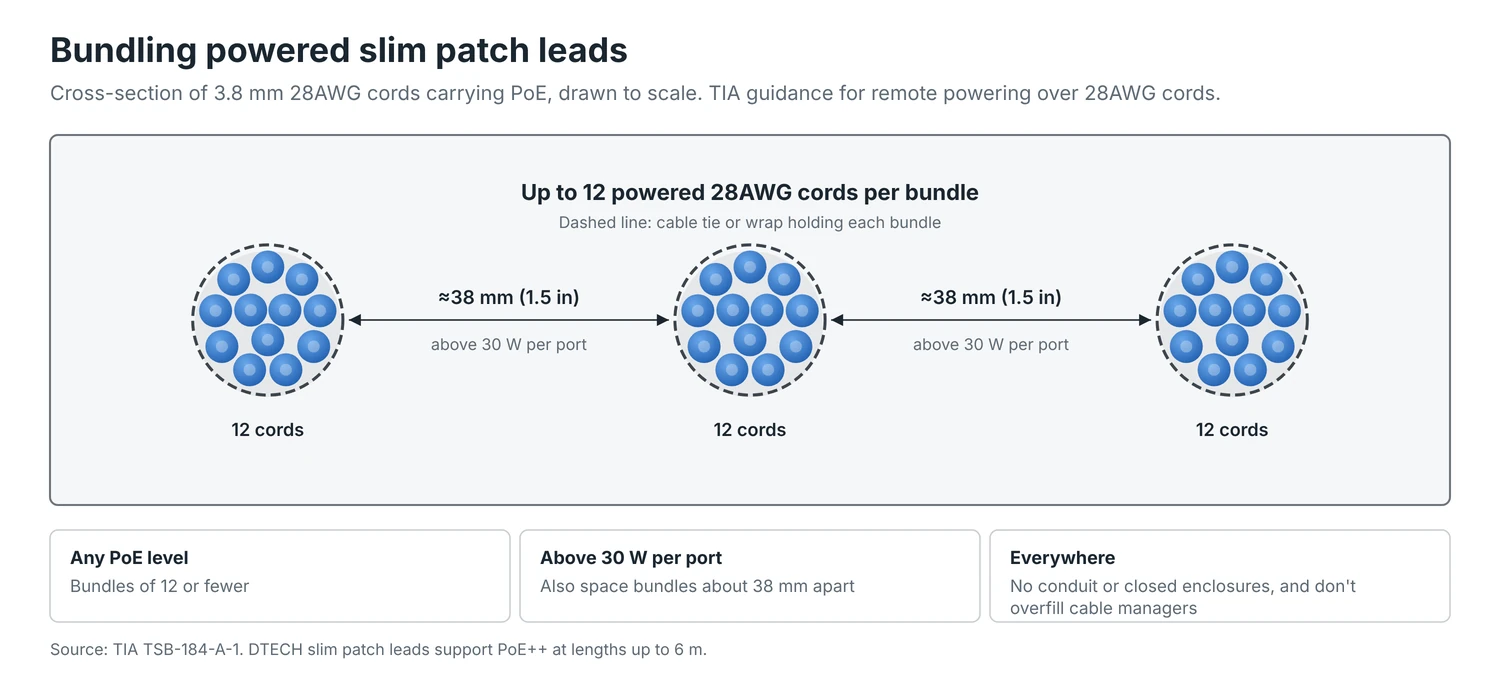
Thinner conductors have more resistance, roughly two and a half times that of 24AWG installation cable per metre, so a slim lead carrying power runs a little warmer than a standard one. A single lead is no concern. In large, tightly packed bundles the heat adds up, so TIA has published guidance for powering over 28AWG cords, in TSB-184-A-1:
- Keep powered 28AWG cords in bundles of 12 or fewer.
- Above 30 W per port, space those bundles about 38 mm (1.5 inches) apart so heat can escape.
- Don’t run powered slim cords through conduit or closed enclosures, and don’t overfill cable managers.
Every IEEE PoE type stays within the 750 mA per conductor that BS 7671 Amendment 4 sets for PoE, and that applies to slim leads too. PoE vs PoE+ vs PoE++ covers the power levels.
Choosing the right slim lead
| Use | DTECH option |
|---|---|
| Unscreened Cat6 systems | 28AWG Cat6 U/UTP patch leads, 3.8 mm, 550 MHz, 10GBASE-T |
| Screened Cat6A systems | 28AWG Cat6A S/FTP patch leads, 4.8 mm, 650 MHz, keeps the screen continuous to the switch |
| Custom lengths in the cabinet | Cat6 SuperSlim 28AWG stranded cable, 3.6 mm, terminated with SuperSlim RJ45 plugs |
| Engineers’ van stock | Cat6 SuperSlim PatchKit, three 10 m lengths of SuperSlim cable with 50 RJ45 plugs and boots |
Match the lead to the system: use U/UTP leads with unscreened cabling and S/FTP leads with screened cabling, so the screen runs unbroken from panel to switch. Cable shielding explained covers the differences. For the cabinet side, patch panels explained goes through panel types and density.
Slim patch lead checklist
- Use slim leads for patching only, never for the permanent link.
- Keep the total 28AWG cord length in each channel to about 6 m to keep the full 90 m permanent link.
- Match U/UTP or S/FTP leads to the cabling system.
- For PoE, keep powered slim cords in bundles of 12 or fewer, and space bundles apart above 30 W.
- Certify the channel once it’s patched; how to read a cable test certificate explains the results.
Frequently asked questions
Are 28AWG patch leads standards compliant?
Yes. ANSI/TIA-568.2-D recognised 28AWG patch cords in 2018, including Category 6A, with a de-rating factor of 1.95 for channel length. DTECH slim leads are guaranteed to pass Fluke patch lead testing to ISO/IEC 11801 Class E (Cat6) and Class EA (Cat6A).
Do slim patch leads support 10 Gb/s?
Yes. DTECH 28AWG Cat6 and Cat6A patch leads both support 10GBASE-T.
Can slim patch leads carry PoE++?
Yes. DTECH 28AWG patch leads support PoE++ at lengths up to 6 m. Keep powered slim cords in bundles of 12 or fewer, with space between bundles above 30 W per port.
How long can a slim patch lead be?
Up to about 6 m of 28AWG cords in total keeps the full 90 m permanent link. Longer cords are allowed if the permanent link is shortened, and TIA recommends keeping the total under 15 m.
Can I use 28AWG cable for horizontal runs?
No. 28AWG is recognised for patch cords only. The permanent link needs installation cable with 22AWG to 24AWG solid conductors.
Summary
Slim 28AWG patch leads save space and improve airflow in busy cabinets, and they’re recognised by ANSI/TIA-568.2-D. Keep about 6 m of slim cords or less in each channel and the permanent link keeps its full 90 m. DTECH slim leads carry 10GBASE-T and PoE++ up to 6 m, in Cat6 U/UTP and Cat6A S/FTP, with SuperSlim cable and plugs for custom lengths.
If you need help choosing patch leads for a high-density cabinet, get in touch with the DTECH team.