Fibre optic cabling uses colour in three ways. The jacket colour tells you the fibre type, the connector colour tells you the grade or, on single mode, the polish, and inside a multi-fibre cable a sequence of 12 colours identifies each fibre and each tube.
Get these right and anyone can trace, patch or splice a fibre system without guessing. Get them wrong, or trust the wrong one, and you can end up mating single mode to multimode or an APC connector to a UPC one, both of which cost a lot of signal.
Jacket and connector colours
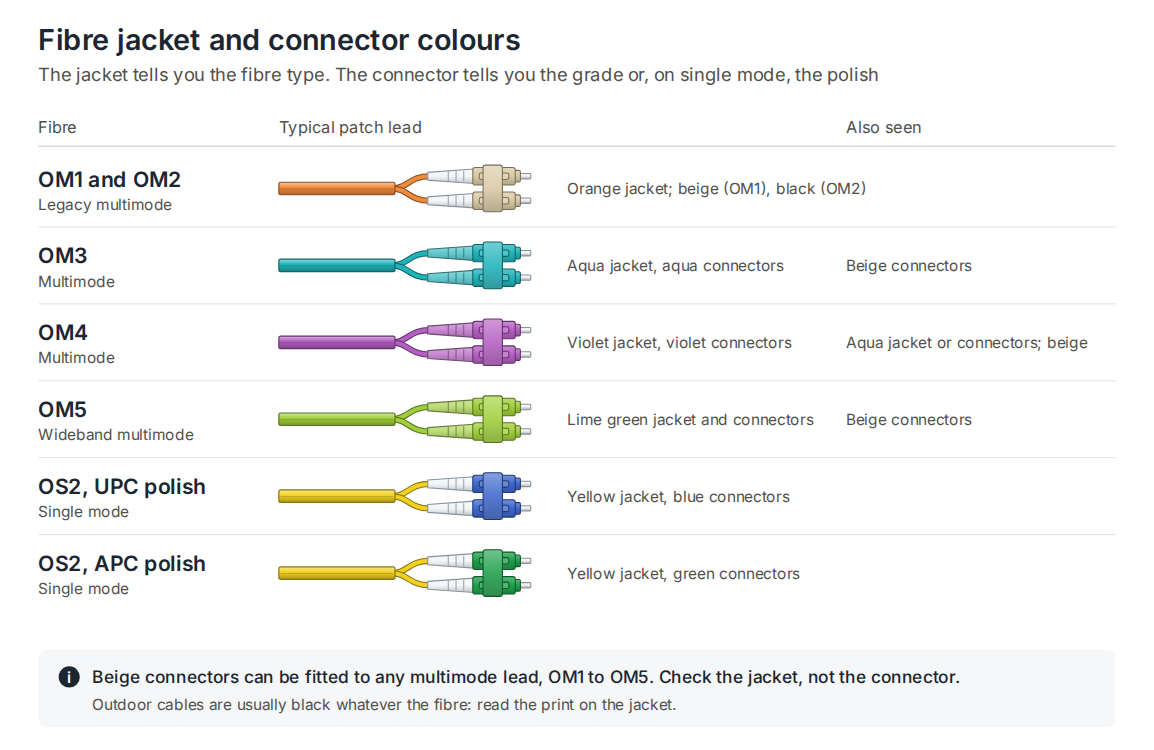
| Fibre | Jacket | Connector | Also seen |
|---|---|---|---|
| OM1 (62.5 µm) | Orange | Beige | |
| OM2 (50 µm) | Orange | Black | Beige connectors |
| OM3 (50 µm) | Aqua | Aqua | Beige connectors |
| OM4 (50 µm) | Violet or aqua | Violet | Aqua or beige connectors |
| OM5 (50 µm, wideband) | Lime green | Lime green | Beige connectors |
| OS2 single mode, UPC | Yellow | Blue | |
| OS2 single mode, APC | Yellow | Green |
The jacket is the colour to trust. Beige connectors can be used on any multimode fibre, OM1 to OM5, even though OM3, OM4 and OM5 have colours of their own, so a beige connector on its own doesn’t tell you the grade. Look at the jacket colour and the printed legend on the jacket to confirm it.
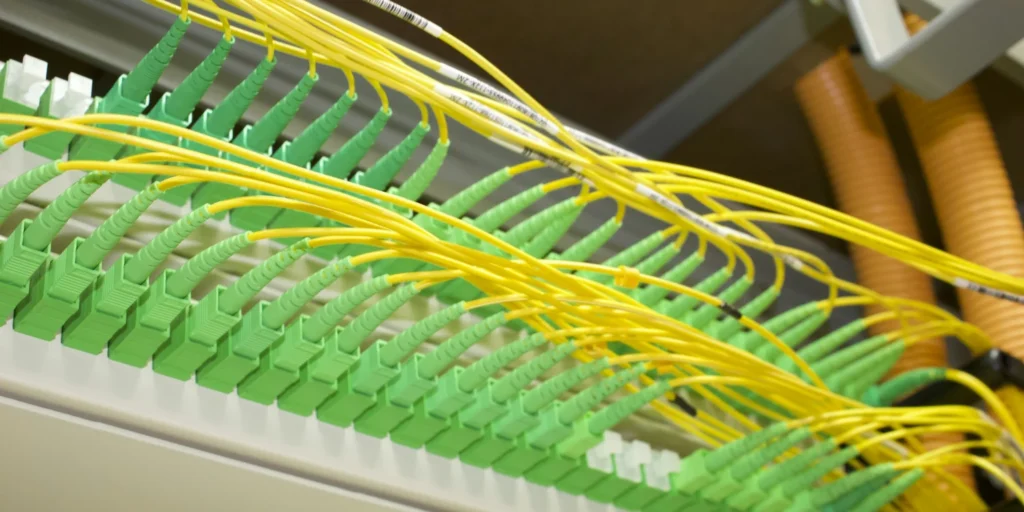
OM4 is violet in much of Europe, including the UK, and aqua in some other markets, so an aqua jacket can be OM3 or OM4. DTECH OM4 patch leads are violet, which keeps them clearly apart from OM3. On single mode the jacket is yellow either way, and the connector colour shows the polish: blue for UPC and green for APC. Never mate a green APC connector with a blue UPC one: the angled and flat end faces don’t meet, and the loss is high. LC vs SC and UPC vs APC explains why.
The 12-fibre colour sequence
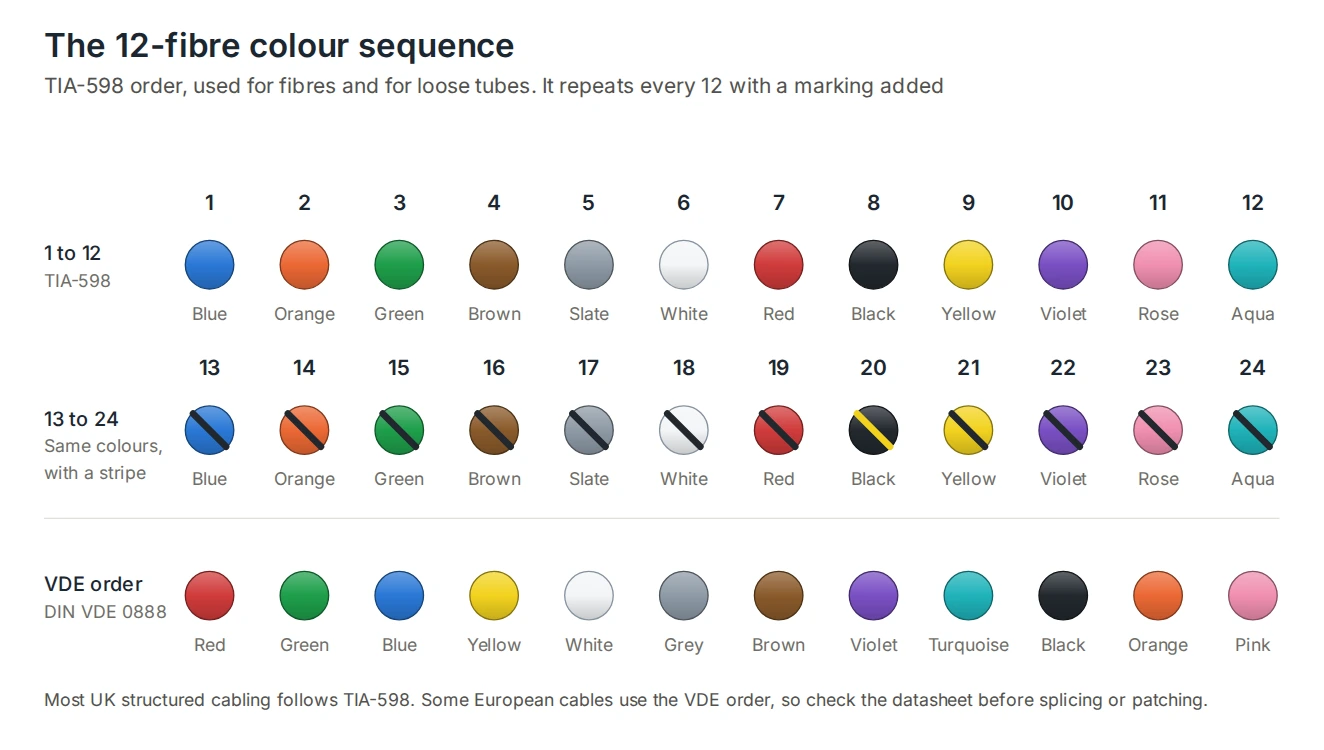
Inside a multi-fibre cable, each fibre has its own coloured coating. The order most used in UK structured cabling comes from TIA-598:
| Fibre | Colour | Fibre | Colour |
|---|---|---|---|
| 1 | Blue | 7 | Red |
| 2 | Orange | 8 | Black |
| 3 | Green | 9 | Yellow |
| 4 | Brown | 10 | Violet |
| 5 | Slate (grey) | 11 | Rose (pink) |
| 6 | White | 12 | Aqua (turquoise) |
Above 12 fibres in one tube or ribbon, the sequence repeats with a marking added, usually a stripe or dash, so fibre 13 is blue with a stripe, 14 orange with a stripe, and so on to 24.
Not every cable follows TIA-598. Some European manufacturers use the DIN VDE 0888 order, which starts red, green, blue, yellow. Check the cable datasheet before splicing, especially when joining cables from different makers, and record the scheme in the test results.
Tubes and fibres in larger cables
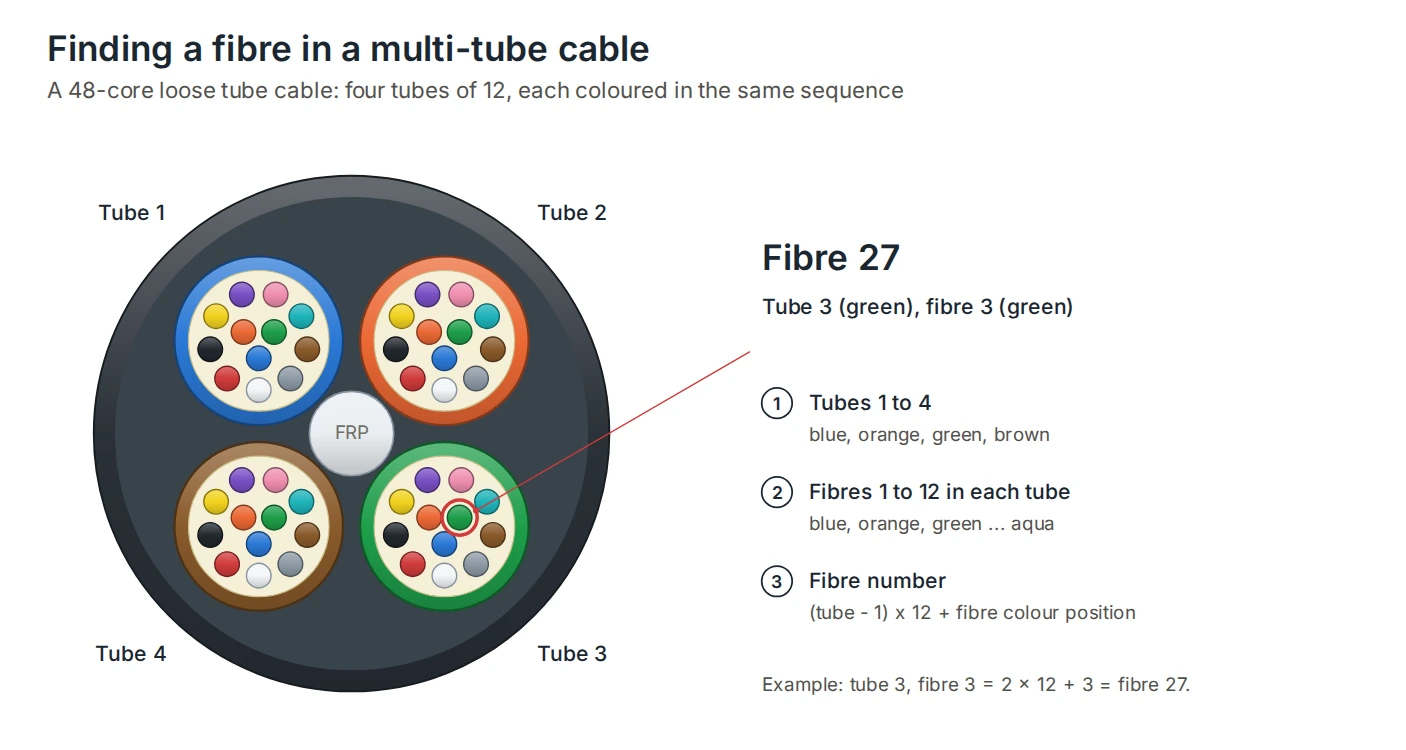
In loose tube cable, the tubes follow the same sequence as the fibres: tube 1 blue, tube 2 orange, tube 3 green and so on. To find a fibre, take the tube first, then the fibre colour inside it. In a cable of 12-fibre tubes, fibre 27 is tube 3 (green), fibre 3 (green), because 2 x 12 + 3 = 27.
Tight buffered cable works the same way at a smaller scale: each buffered fibre is coloured in order, so an 8-core cable runs from blue to black. Tight buffered vs loose tube explains the two constructions.
Outer jackets on armoured and outdoor cable
The jacket colour rule applies to indoor patch leads, pigtails and indoor cable. Armoured and outdoor cables don’t follow it. In the UK, most internal/external armoured fibre has a blue LSZH sheath whatever fibre it carries, and fully external cable for ducts and direct burial is usually black for UV resistance. DTECH CST armoured cable is blue in both OM4 and OS2, so the sheath tells you nothing about the grade. On armoured and outdoor cable, read the jacket print, which gives the fibre type, core count and manufacturer, and use the tube and fibre colours inside. Armoured vs unarmoured fibre covers the outdoor constructions.
Adaptors and patch panels
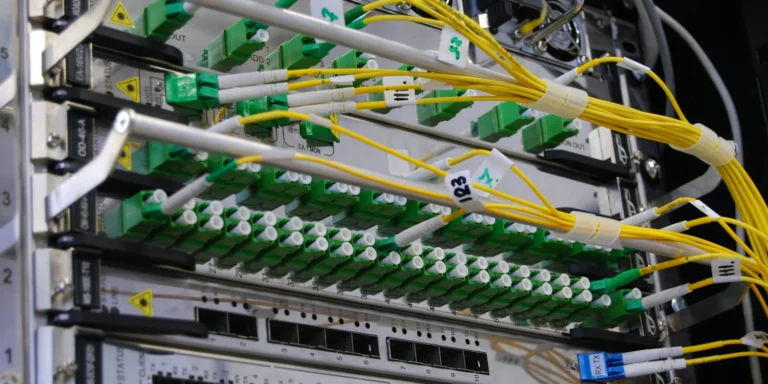
Adaptors follow the connector colours: beige or aqua for multimode, blue for single mode UPC and green for APC. A loaded patch panel’s adaptor colours should match the fibre behind them, which makes it easy to spot a wrong lead at a glance. If a panel mixes grades, label it clearly.
For field termination and repairs, DTECH beige multimode LC duplex connectors suit 50/125 µm OM3 and OM4 cable, so one connector covers both grades. The jacket then carries the grade.
Frequently asked questions
What colour is single mode fibre?
Yellow, for OS1 and OS2. The connectors are blue for UPC polish and green for APC.
What colour is OM4 fibre?
Violet in much of Europe, including the UK, and aqua in some other markets. Check the jacket print to be sure.
Can OM4 leads have beige connectors?
Yes. Beige connectors can be used on any multimode grade. The jacket colour tells you which fibre it is.
What is the fibre colour code order?
Under TIA-598: blue, orange, green, brown, slate, white, red, black, yellow, violet, rose, aqua. Fibres 13 to 24 repeat with a stripe.
Is there a UK fibre colour code?
UK structured cabling mostly follows TIA-598, but some cables use other orders, such as DIN VDE 0888. Always check the datasheet.
Summary
Jacket colour identifies the fibre type, connector colour shows the grade or polish, and the 12-colour sequence numbers each fibre and tube. Trust the jacket over the connector, never mate APC with UPC, and check the datasheet for the fibre order before splicing. DTECH fibre patch leads, connectors and fibre cable follow these colour conventions.
If you need help identifying or matching fibre on a project, get in touch with the DTECH team.