The jacket is the part of an industrial Ethernet cable that takes the punishment. On a factory floor it meets oil, coolant, sharp edges, cold and constant movement, and the jacket decides how long the cable lasts. The two jackets you’ll meet most are PVC and PUR.
This guide explains what each one is, where each belongs, and how to choose between them.
What is PUR cable?
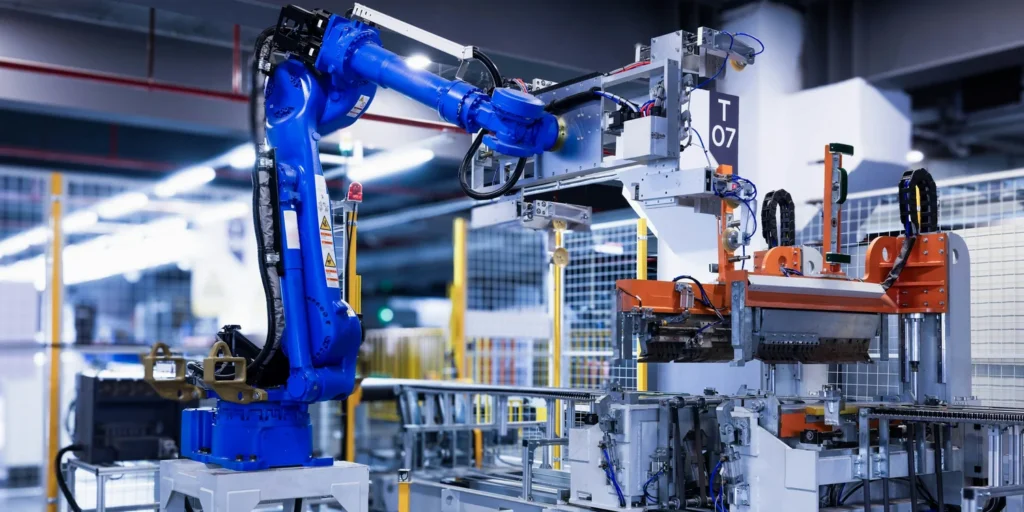
PUR is polyurethane. It’s a tough, flexible jacket material with high resistance to abrasion, cuts, tearing, oil and coolant, and it stays flexible in the cold. That makes it the standard jacket for cable that moves all the time: in drag chains, on robot arms, and on moving machine parts.
DTECH Cat6 S/FTP PUR industrial cable uses a PUR jacket conforming to EN 50363-10-2, with oil resistance to IEC 60811-2-1. Inside, highly flexible stranded copper and a cross separator protect the pairs under continuous movement, and individually foiled pairs under an overall braid screen keep out electrical noise. It’s built for cable chains, robotic arms and continuously moving applications.
What is PVC cable?
PVC is polyvinyl chloride. It’s the most widely used cable jacket: economical, flexible enough for normal installation, easy to strip and terminate, and available in grades with good oil resistance. It handles fixed runs and occasional movement well, but it wears faster under constant flexing and abrasion, and it stiffens in the cold.
DTECH Cat5e SF/UTP PVC industrial cable has an oil, notch and abrasion resistant flexible PVC jacket over stranded copper, with a foil and braid screen. It suits dry, damp and harsh environments and semi-moving applications, and it’s the economical choice wherever the cable is fixed.
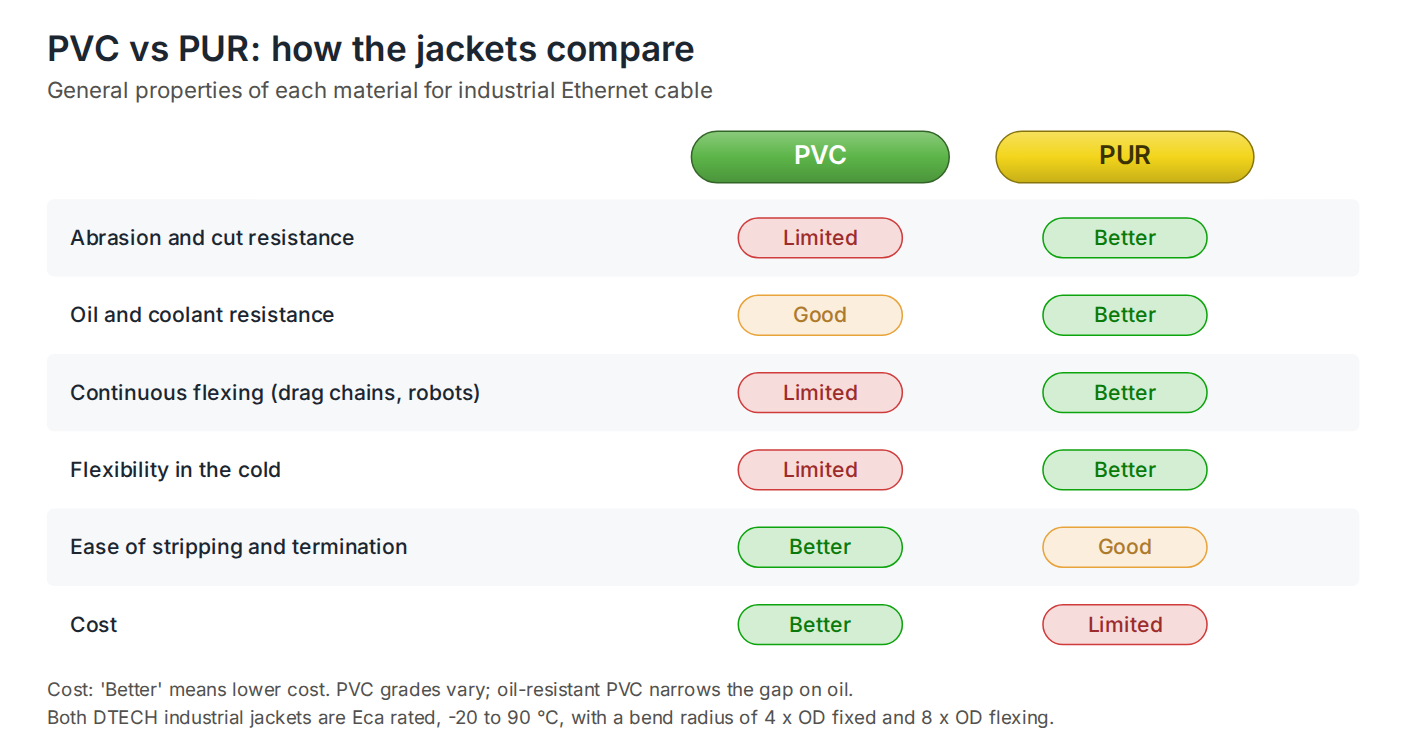
PVC vs PUR compared
| PVC | PUR | |
|---|---|---|
| Abrasion, cut and tear resistance | Moderate | High |
| Oil and coolant | Good in oil-resistant grades | High |
| Continuous flexing | Fixed or occasional movement | Drag chains, robots, moving machinery |
| Cold flexibility | Stiffens in the cold | Stays flexible |
| Stripping and termination | Easy | Tougher to strip |
| Cost | Lower | Higher |
| DTECH range | Cat5e SF/UTP, green | Cat6 and Cat6A S/FTP, yellow |
Both DTECH industrial jackets are rated Eca under the Construction Products Regulation, work from -20 to 90 °C, and have a minimum bend radius of 4 times the cable diameter when fixed and 8 times when flexing.
Where each jacket belongs
Use PUR for
- Drag chains and cable carriers, where the cable flexes thousands of times a day.
- Robot arms and moving machine parts.
- Machine tools and areas with oil, coolant or cutting fluid.
- Cable on the floor or anywhere it can be walked on, dragged or scraped.
- Cold stores and outdoor machinery, where PVC would stiffen.
Use PVC for
- Fixed runs in control cabinets, cable trays and conduit.
- Machine wiring that moves occasionally, such as a door or a maintenance panel.
- Dry and damp areas without heavy oil or abrasion.
- Projects where cost matters and the cable won’t be flexed continuously.
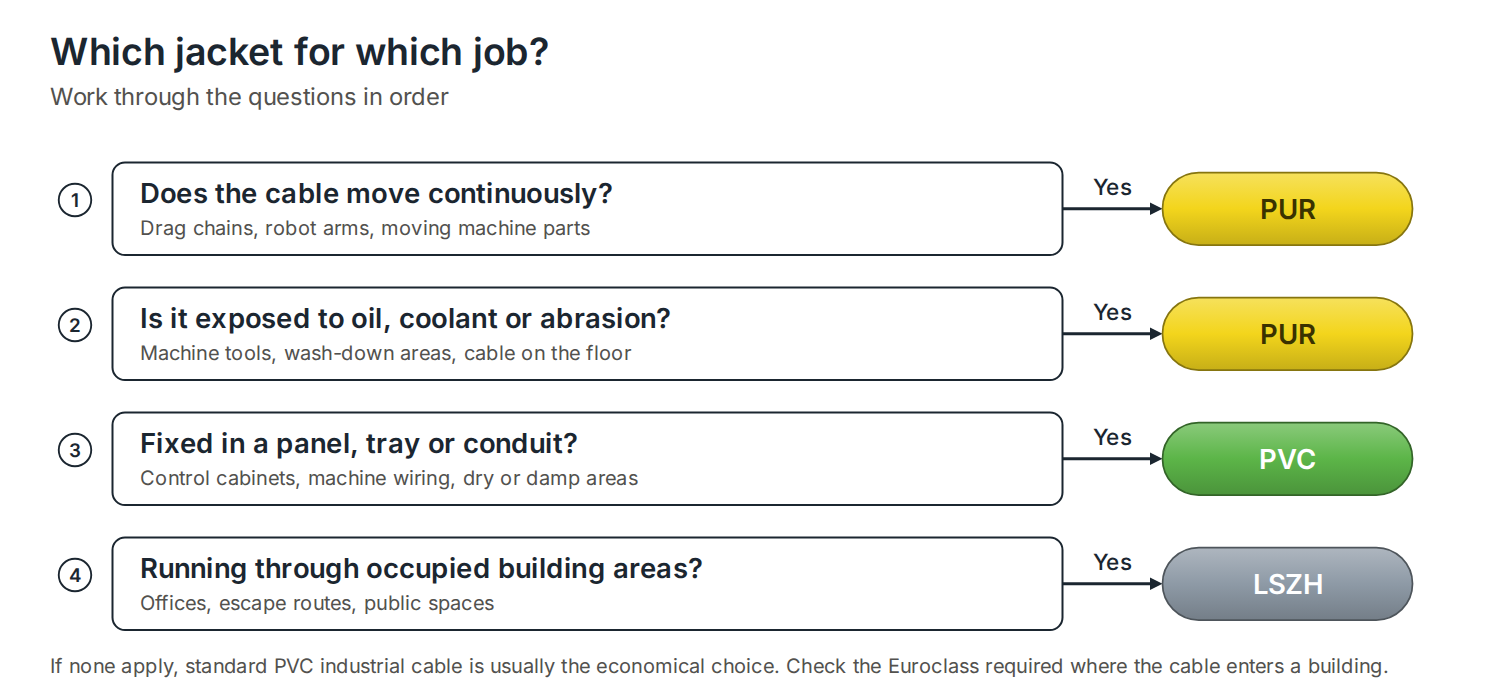
Neither is the right jacket for the occupied parts of a building. PVC contains chlorine and gives off dense smoke and hydrogen chloride gas when it burns, which is why offices, escape routes and public areas usually call for LSZH cable. What is LSZH cable explains where it’s required.
Cable in drag chains
Drag chains are where the jacket choice matters most. A cable that’s fine in a tray can fail within weeks in a chain if the jacket or the construction isn’t built for it. Use PUR cable designed for continuous flexing, and keep to its flexing bend radius.
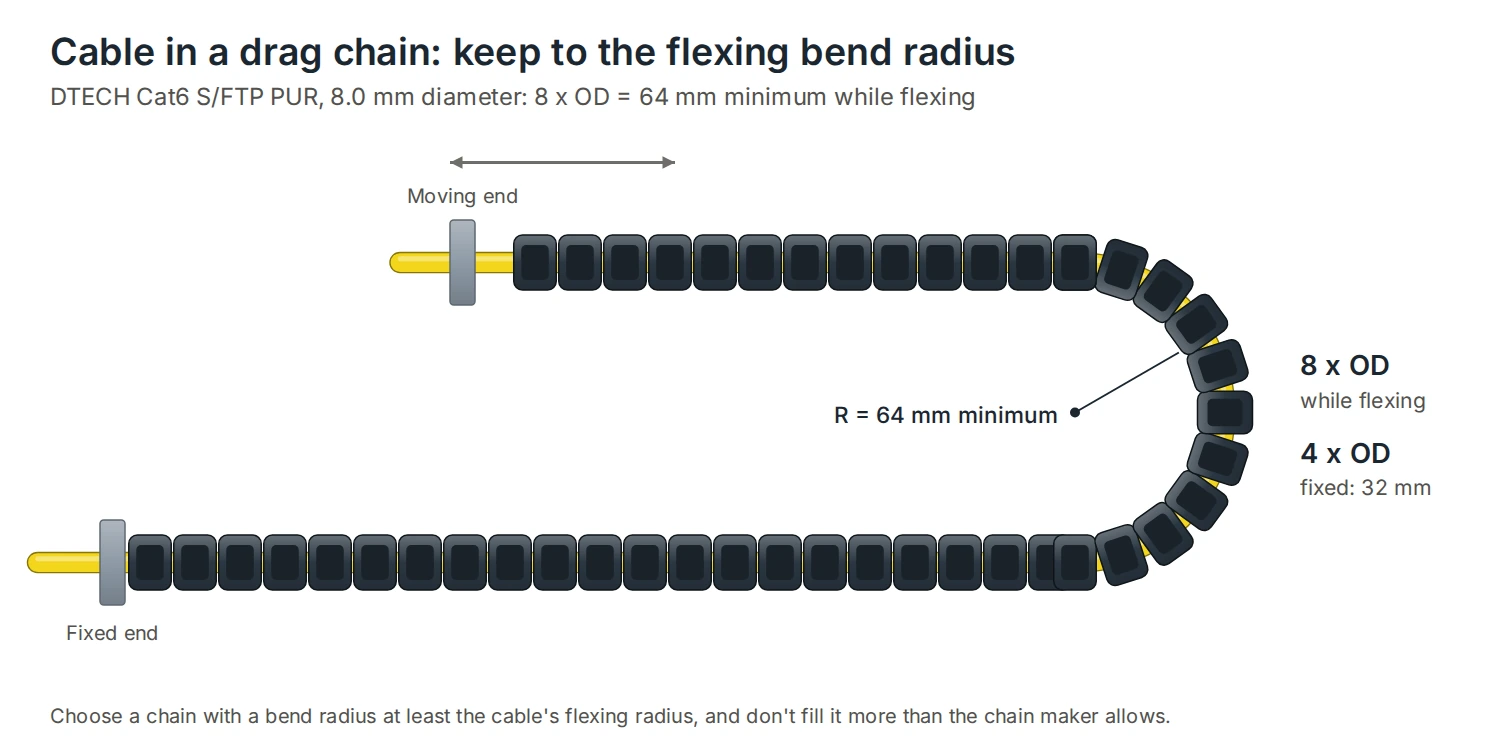
- Check the chain radius. For DTECH Cat6 PUR, 8.0 mm in diameter, the flexing bend radius is 8 x OD: 64 mm. The chain’s bend radius should be at least that.
- Don’t overfill the chain. Cables need room to move without rubbing against each other. Follow the chain maker’s fill limits.
- Lay the cable straight. Unwind it from the reel without twisting, and don’t tie it tightly inside the chain.
- Fix it at both ends. Clamp the cable at the fixed and moving ends, not inside the moving section.
Other things to check
- Screening. Factory floors are electrically noisy. Screened constructions such as S/FTP and SF/UTP protect the signal near motors, drives and welding equipment. Cable shielding explained covers the types.
- Connectors. The jacket only protects the cable. Where the connection is exposed, use sealed connectors such as M12 or industrial RJ45. Industrial RJ45 vs M12 and IP ratings explained cover the options.
- Salt and spray. On boats, offshore and coastal sites, marine-grade PUR cable adds crush resistance and resistance to salt spray. DTECH makes it in Cat6 and Cat6A in the industrial cable range.
- Category. DTECH Cat6A PUR adds headroom for 10 Gb/s where it’s needed; Cat5e and Cat6 cover gigabit industrial networks.
Ready-made leads
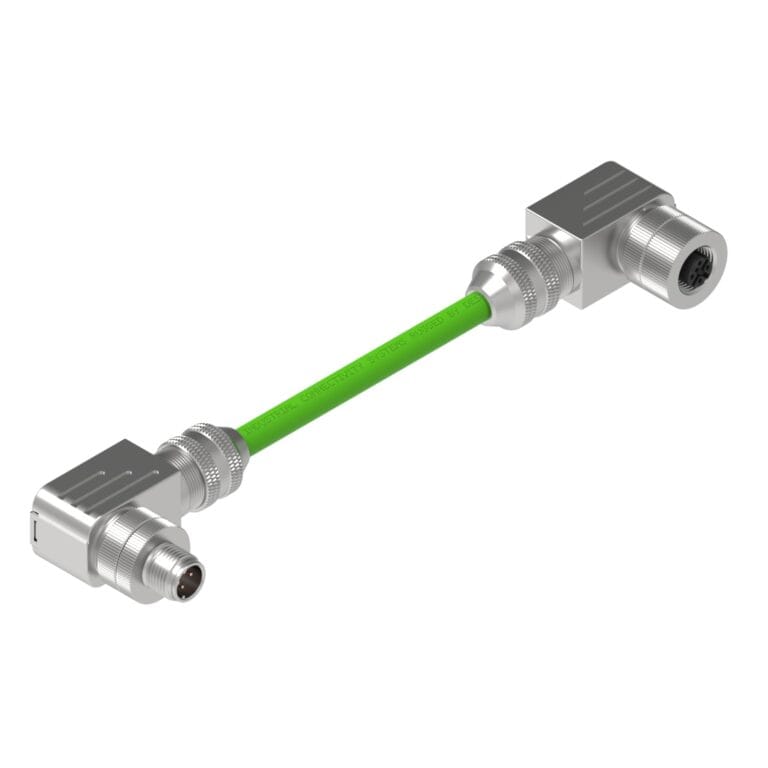
Field termination of industrial cable takes time. DTECH Cat6 S/FTP PUR industrial RJ45 patch leads and M12 X-code assemblies come ready-made with PUR jackets, and the industrial Ethernet lead range covers RJ45 and keystone ends in PVC and PUR. Industrial connectivity: M12 connectors, assemblies and cable shows the full range.
Frequently asked questions
What is the difference between PVC and PUR cable?
PUR (polyurethane) is tougher and more flexible, with high resistance to abrasion, oil and continuous flexing. PVC (polyvinyl chloride) is economical and easy to work with, and suits fixed or occasionally moving runs.
Is PUR cable better than PVC?
For moving, oily or abrasive applications, yes. For fixed runs in panels and trays, PVC does the job for less money.
Can PVC cable go in a drag chain?
Not for continuous flexing. Use PUR cable built for cable chains, and keep to its flexing bend radius.
Is PUR cable suitable outdoors?
PUR handles cold, abrasion and moisture well and is common on outdoor machinery. Check the cable datasheet for UV resistance where it will be in direct sunlight.
Can I use PVC or PUR cable inside an office building?
Check the Euroclass and fire requirements for the area. Occupied areas and escape routes usually call for LSZH cable, because PVC gives off dense smoke and acid gas when it burns.
Summary
Use PUR where the cable moves continuously or meets oil, coolant and abrasion: drag chains, robots and machine tools. Use PVC for fixed and semi-moving runs in panels, trays and conduit, where it does the job for less. Keep to the flexing bend radius in drag chains, and use LSZH in the occupied parts of buildings. DTECH supplies industrial Ethernet cable in both jackets.
If you need help choosing cable for a machine or production line, get in touch with the DTECH team.