DTECH supplies a complete fibre optic cabling system — from bulk backbone cable through pre-terminated assemblies, patch leads, pigtails, adaptors, splice accessories, and patch panels. Every component is available from a single supplier, specified to work together, and stocked for UK and international delivery. Whether you are cabling a single inter-building backbone link, a multi-floor commercial building, or a campus network across several sites, the DTECH fibre range covers the complete installation from first pull to final patch lead.
This guide walks through the complete DTECH fibre range — what each product category covers, when to use it, and how it fits into a complete fibre installation.
Fibre types: OM3, OM4 and OS2
DTECH’s fibre range covers three fibre types — OM3 and OM4 multimode, and OS2 single mode — covering the full spectrum of commercial structured cabling from legacy multimode infrastructure through to long-distance single mode backbone.
OM3 is an established multimode standard supporting 10 Gigabit Ethernet to 300 metres. It remains in wide use in existing installations and is available in DTECH’s patch lead and pigtail range for compatibility with installed OM3 infrastructure. An aqua colour identifies OM3 patchleads, pigtails, and adaptors.
OM4 is the current mainstream standard for new multimode installations. Laser-optimised for 850nm VCSEL sources, it supports 10 Gigabit Ethernet to 550 metres, and 40G and 100G to 150 metres using standard parallel optics transceivers. OM4 is the correct specification for intra-building backbone runs, equipment room to floor distributor links, and any new multimode installation. A violet colour identifies OM4 patchleads, pigtails, and adaptors.
OS2 is single mode fibre — manufactured to ITU-T G.657.A1 and fully G.652.D compliant, with a 10mm minimum bend radius. OS2 supports transmission over distances that multimode cannot — suitable for inter-building campus links, long backbone runs, and installations that need to scale beyond multimode’s distance limits. A yellow colour identifies OS2 patchleads and pigtails, with green for apc, and blue for upc connectors / adaptors respectively.
Bulk fibre cable
DTECH’s bulk fibre cable range covers OM3, OM4, and OS2 in four construction types — tight buffered, loose tube, CST armoured loose tube, and internal drop cable — with a range of fibre counts and CPR ratings for internal and internal/external installation.
Tight buffered
Tight buffered cables have a 900µm protective buffer applied directly to each fibre, allowing direct termination onto pigtails without breakout hardware. The UV-stabilised LSZH black jacket is rated for internal and internal/external installation — the same cable can run from inside a building through an external wall to a second building without a join at the transition. Available in OM4 and OS2, in 4, 8, 12, and 24 fibre counts, in CPR Cca (higher fire performance, for occupied commercial buildings) and CPR Eca ratings.
DTECH’s OM4 tight buffered 8 fibre Cca and OS2 tight buffered 8 fibre Cca are the standard backbone specifications for commercial structured cabling installations.
Loose tube
Loose tube cables have 250µm bare fibres floating freely in a gel-filled protective tube, providing maximum moisture protection and temperature tolerance for underground runs, long external sections, and harsh external environments. Available in OM4 and OS2, in 4, 8, 12, and 24 fibre counts, CPR Eca rated, UV-stabilised LSZH black jacket, internal/external rated.
DTECH’s OM4 loose tube 8 fibre and OS2 loose tube 8 fibre are the standard specifications for underground runs where loose tube is specifically requested.
CST armoured loose tube
CST (Corrugated Steel Tape) armoured loose tube cable adds a corrugated steel armour layer beneath the outer jacket, providing physical protection against crushing, rodent damage, and mechanical hazard on exposed external routes, direct burial applications, and installations where the cable is at risk of physical damage that a standard jacket cannot resist. The armour layer does not affect the optical performance of the cable — it protects the gel-filled loose tube construction and the fibres inside it.
DTECH’s OM4 CST armoured loose tube 8 fibre and OS2 CST armoured loose tube 8 fibre are LSZH blue jacketed, CPR Eca rated, and suitable for internal/external installation including direct burial and exposed external routes.
OS2 internal drop cable
DTECH’s OS2 4-fibre internal drop cable is manufactured to G.657.A2 — a tighter bend radius specification than G.657.A1, designed for installations where the cable must navigate tight bends, corners, and restricted spaces inside a building. The white LSZH jacket and flat drop cable profile make it suitable for surface routing along skirting, door frames, and wall surfaces in FTTH, office, and residential single mode installations where conventional round cable would be impractical.
View the full bulk cable range: Fibre optic bulk cable
Pre-terminated fibre assemblies
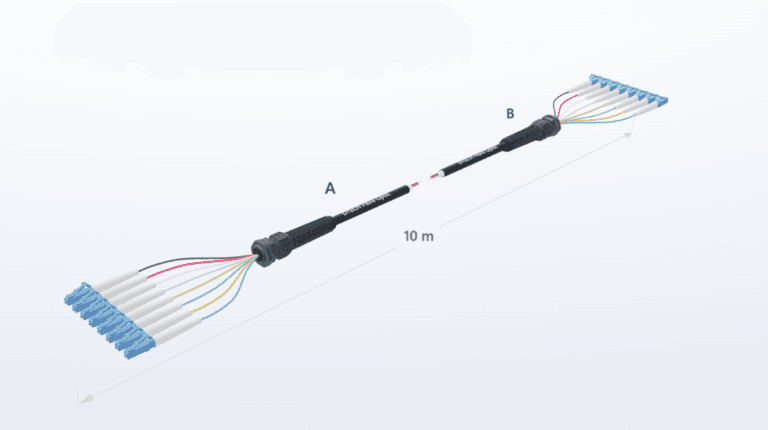
Pre-terminated fibre assemblies are factory-built cable runs with connectors already installed and tested at both ends — the fastest installation method for structured fibre. No on-site splicing, termination, or individual fibre testing is required. Pre-terminated assemblies are particularly suited to data centre structured cabling, equipment room to floor distributor links, and any application where installation speed and guaranteed performance matter.
Factory termination consistently delivers lower insertion loss than field-terminated connectors — controlled polishing conditions and 100% pre-despatch testing mean every assembly meets specification before it leaves the factory.
DTECH’s pre-terminated range covers OM3, OM4, and OS2 in tight buffered and loose tube constructions — including CST armoured loose tube for external routes — in 4 to 24 fibre counts. Cca rated for tight buffered, Eca for loose tube. DTECH’s OM4 tight buffered pre-terminated assemblies are available in 4 to 24 fibre counts, CPR Cca rated — ready to install directly between patch panels. View the full pre-terminated fibre range for all available specifications and lengths.
Fibre optic patch leads
Fibre patch leads are the flexible cables used at the front of patch panels and at equipment connections — connecting panel ports to active equipment and connecting end devices to outlets. They are the only part of the fibre infrastructure designed for repeated connection and disconnection, and are available in OM3, OM4, and OS2, in LC and SC connector types, UPC and APC polish, simplex and duplex configurations, and lengths from 1m to 10m.
OM3 — DTECH’s OM3 LC UPC to LC UPC duplex patch lead in aqua LSZH is the standard connection for existing OM3 infrastructure — available in 1m, 2m, and 3m lengths.
OM4 — DTECH’s OM4 LC UPC to LC UPC duplex patch lead in violet LSZH is the standard connection for OM4 links — available in 1m, 2m, 3m, 5m, and 10m lengths.
OS2 — available in a comprehensive range of connector combinations covering LC UPC, LC APC, SC UPC, and SC APC, in both simplex and duplex configurations, in 1m, 2m, 3m, 5m, and 10m lengths. DTECH’s OS2 LC UPC to LC UPC duplex patch lead covers standard data applications; the OS2 SC APC to SC APC simplex patch lead covers PON, FTTH, and long-distance applications where APC connectors are required for back-reflection sensitivity.
View the full patch leads range: Fibre optic patch leads
Pigtails
Pigtails are factory-terminated on one end and left bare on the other for fusion splicing to the installed bulk cable. They are the standard termination method for bulk fibre in commercial structured cabling — the factory-terminated connector provides a clean, tested, low-loss connection at the patch panel, while the bare end is fusion-spliced to the backbone cable inside a splice tray or enclosure.
DTECH’s pigtail range covers OM3 (LC UPC, aqua), OM4 (LC UPC, violet), and OS2 in LC UPC, LC APC, SC UPC, and SC APC configurations — all in 0.9mm LSZH, 1m length, supplied in packs of 12. Individually coloured TIA 2m versions are also available in OM4 and OS2 for installations where longer pigtail length is required for splice tray management.
Factory-polished pigtails consistently deliver insertion loss below 0.3 dB — significantly lower and more consistent than field-polished connectors, without the skill dependency or equipment cost of on-site polishing.
Fibre optic adaptors
Fibre adaptors are the passive couplers fitted to patch panels and wall outlets that accept patch leads and align the ferrules to make the optical connection. DTECH’s adaptor range covers LC and SC connector types, UPC and APC polish, flanged and flangeless configurations, and all three fibre types — available in the correct colour coding for each: beige for multimode, aqua for OM3, violet for OM4, green for OS2 APC, blue for OS2 UPC.
Flangeless adaptors fit standard keystone-style panel cutouts without a retention flange, making them the correct choice for high-density panels where space is at a premium. DTECH’s OM4 LC UPC flangeless duplex adaptor in violet and OS2 SC APC flangeless simplex adaptor in green are examples from the range — flanged quad and duplex variants are also available in LC and SC for standard panel apertures.
Splicing accessories
DTECH’s splicing accessories range covers fast field connectors, splice trays, splice cassettes, and splice protectors for field termination and splice management.
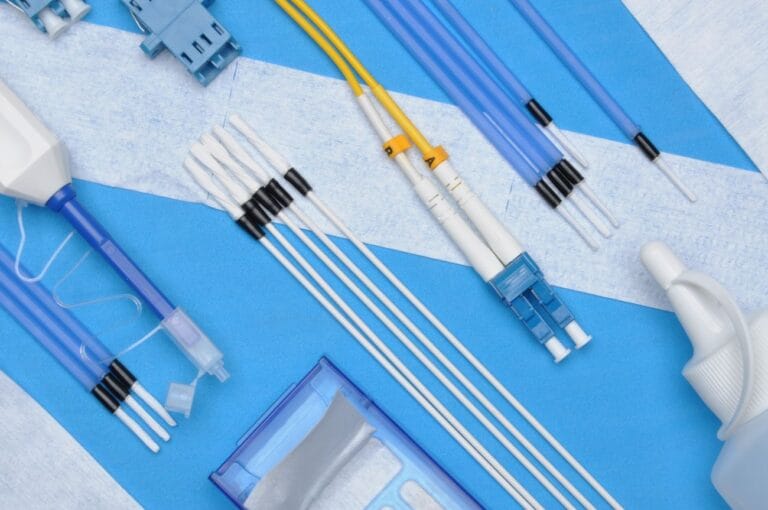
Fast field connectors allow a connector to be applied to a bare fibre on site without a fusion splicer — using a short factory-polished fibre stub inside the connector body that is mechanically joined to the field fibre. Available in OS2 LC UPC, LC APC, SC UPC, and SC APC configurations in packs of 10. Suitable for short patch cord fabrication, repair, and installations where fusion splicing equipment is not available.
Splice trays and cassettes organise and protect individual fusion splices inside patch panels and enclosures. DTECH’s 24-fibre stackable splice tray in black is designed for use in standard 1U and 2U fibre patch panels — stackable construction allows multiple trays to be fitted in a single panel body for higher splice counts. Splice cassettes in 24-fibre configuration are also available for installations where cassette-based splice management is preferred.
Splice protectors — 2mm x 45mm and 2mm x 60mm 304 stainless steel heat-shrink splice protectors in packs of 100 — cover and protect individual fusion splices inside splice trays, securing the splice point and preventing mechanical damage to the fused joint.
Fibre optic patch panels
Fibre patch panels are the termination and management point for backbone fibre in the equipment room or telecommunications room — rack-mounted enclosures where backbone cables terminate and patch leads connect to active equipment. DTECH supplies loaded and unloaded panels in 1U rack-mount configurations covering 24/48 and 48/96 fibre capacities.
Loaded panels
Pre-populated with adaptors factory-fitted — ready to accept patch leads immediately on installation with no on-site panel population required. DTECH’s LC duplex loaded patch panel covers 24/48 fibre in 1U — the standard configuration for commercial structured cabling. SC simplex loaded, LC quad, and SC duplex loaded variants are available in both 24/48 and 48/96 port configurations for higher density installations.
Unloaded panels
Supplied without adaptors fitted — the installer selects and populates the panel with the appropriate adaptor type on site, giving full flexibility over connector type and configuration. DTECH’s 24/48 fibre unloaded patch panel in 1U black and the 48/96 fibre unloaded variant cover the standard rack-mount configurations. Removable sliding tray construction on all panels allows access to splices and rear terminations without removing the panel from the rack.
The complete DTECH fibre range at a glance
| Category | Fibre types | Key variants |
|---|---|---|
| Bulk cable — tight buffered | OM4, OS2 | 4, 8, 12, 24 fibre — Cca and Eca — internal/external |
| Bulk cable — loose tube | OM4, OS2 | 4, 8, 12, 24 fibre — Eca — internal/external |
| Bulk cable — CST armoured | OM4, OS2 | 8 fibre — Eca — internal/external — direct burial rated |
| Drop cable | OS2 | 4 fibre — G.657.A2 — LSZH white — internal |
| Pre-terminated assemblies | OM3, OM4, OS2 | 4–24 fibre — tight buffered, loose tube, armoured — Cca and Eca |
| Patch leads | OM3, OM4, OS2 | LC UPC, LC APC, SC UPC, SC APC — simplex and duplex — 1m to 10m |
| Pigtails | OM3, OM4, OS2 | LC UPC, LC APC, SC UPC, SC APC — 12pk — standard and TIA 2m |
| Adaptors | MM, OM3, OM4, OS2 | LC and SC — UPC and APC — flanged and flangeless — simplex, duplex, quad |
| Fast field connectors | OS2 | LC UPC, LC APC, SC UPC, SC APC — 10pk |
| Splice trays and cassettes | All | 24-fibre stackable tray, 24-fibre cassette |
| Splice protectors | All | 45mm and 60mm — 304 steel — 100pk |
| Patch panels — loaded | All | LC duplex, SC simplex, LC quad, SC duplex — 24/48 and 48/96 fibre |
| Patch panels — unloaded | All | 24/48 and 48/96 fibre — sliding tray — 1U black |
View the complete DTECH fibre range: DTECH fibre optic systems
Frequently asked questions
Should I use OM4 or OS2 for a new backbone installation?
For intra-building backbone runs within OM4’s supported distances — up to 550m at 10G and 150m at 40G/100G — OM4 multimode is the cost-effective specification because multimode transceivers and active equipment are significantly less expensive than single mode equivalents at these distances. OS2 is the correct specification for inter-building campus links, longer backbone runs, or installations that need to support very high speeds over distances that exceed OM4’s capability. For a typical multi-floor commercial building, OM4 backbone is the standard specification. For campus environments linking buildings across a site, OS2 is the correct choice.
What is the difference between UPC and APC connectors?
UPC (Ultra Physical Contact) connectors have a flat-polished endface. APC (Angled Physical Contact) connectors have an 8-degree angled endface that reduces back-reflection by directing reflected light away from the fibre core. UPC is the standard for OM3 and OM4 multimode and most OS2 data applications. APC is specified for OS2 applications where back-reflection sensitivity matters — long-distance transmission, PON, CWDM, DWDM, and passive optical networks. UPC and APC connectors are not intermateable — the entire channel must use one polish type. APC connectors are identified by green housing or boot.
When should I use pre-terminated assemblies instead of bulk cable and pigtails?
Pre-terminated assemblies are the fastest installation method — the cable arrives ready to plug in with no on-site termination required. They are the right choice for data centre structured cabling, equipment room to floor distributor links where run lengths can be accurately measured in advance, and any installation where speed and guaranteed factory-tested performance take priority. Bulk cable with fusion-spliced pigtails gives more flexibility where exact run lengths cannot be determined until the cable is installed — the pigtail is spliced after the cable is pulled, accommodating whatever length was needed on site.
What is the difference between tight buffered Cca and Eca?
Both are CPR Euroclass ratings under EN 50575 for the reaction-to-fire performance of permanently installed cables. Cca is the higher rating — it requires testing for heat release, smoke production, flaming droplets, and acidity in addition to flame propagation. Eca requires only the basic vertical flame propagation test. DTECH’s tight buffered cables are available in both Cca and Eca — Cca is the correct specification for commercial buildings, healthcare, education, and any project where higher CPR fire performance is required or specified.
When do I need armoured fibre cable?
Armoured fibre is specified where the cable route presents a physical hazard that a standard LSZH jacket cannot protect against — direct burial without conduit, exposed external wall routes, plant rooms with heavy machinery, areas with rodent activity, or any installation where the cable may be subject to crushing, impact, or abrasion. DTECH’s CST armoured loose tube cable adds a corrugated steel tape armour layer beneath the LSZH outer jacket, providing mechanical protection without affecting the optical performance of the fibre. For external routes in buried conduit, standard loose tube internal/external cable inside a protected duct is generally sufficient — armoured cable is for routes where physical protection of the cable itself is required.
Summary
DTECH’s fibre optic range covers the complete system from first pull to final patch lead — OM3, OM4, and OS2 bulk cable in tight buffered, loose tube, CST armoured, and drop cable constructions; pre-terminated assemblies in multiple fibre types and constructions; a comprehensive patch lead range covering all connector combinations in OM3, OM4, and OS2; pigtails, adaptors, fast field connectors, splice trays, and splice protectors for termination and splice management; and loaded and unloaded patch panels in 24/48 and 48/96 fibre configurations. Every component is available from a single supplier, specified across OM3, OM4, and OS2, and stocked for UK and international delivery.
If you need help specifying fibre components for an installation, or cant find what you’re looking for get in touch with the DTECH team — we supply complete fibre optic cabling systems to installers and IT teams across the UK, Europe, and the Middle East.